Author's Purpose vs. Point of View: A Parent's Guide to PIE, Narrators, and Perspective
May 11, 2026
Your child brings home a reading worksheet with two questions stacked on top of each other: "What is the author's purpose?" and "What is the point of view?" You read the passage. You're pretty sure the answers are connected — maybe even the same. The teacher's key says they're not. And now you're stuck explaining a distinction you can't quite name yourself.
If that sounds familiar, you've found one of the most reliably confusing pairings in elementary and middle school ELA. Author's purpose and point of view sound like they should be answering the same question — who is behind this writing and what do they want? — but in today's classroom, they mean two very different things, and the difference shows up regularly on upper-elementary and middle school reading assessments.
Here's what your child's teacher actually means when they ask for each one — including the two different meanings of "point of view" that trip up almost every parent — and how to help at home without second-guessing yourself.
What Is Author's Purpose?
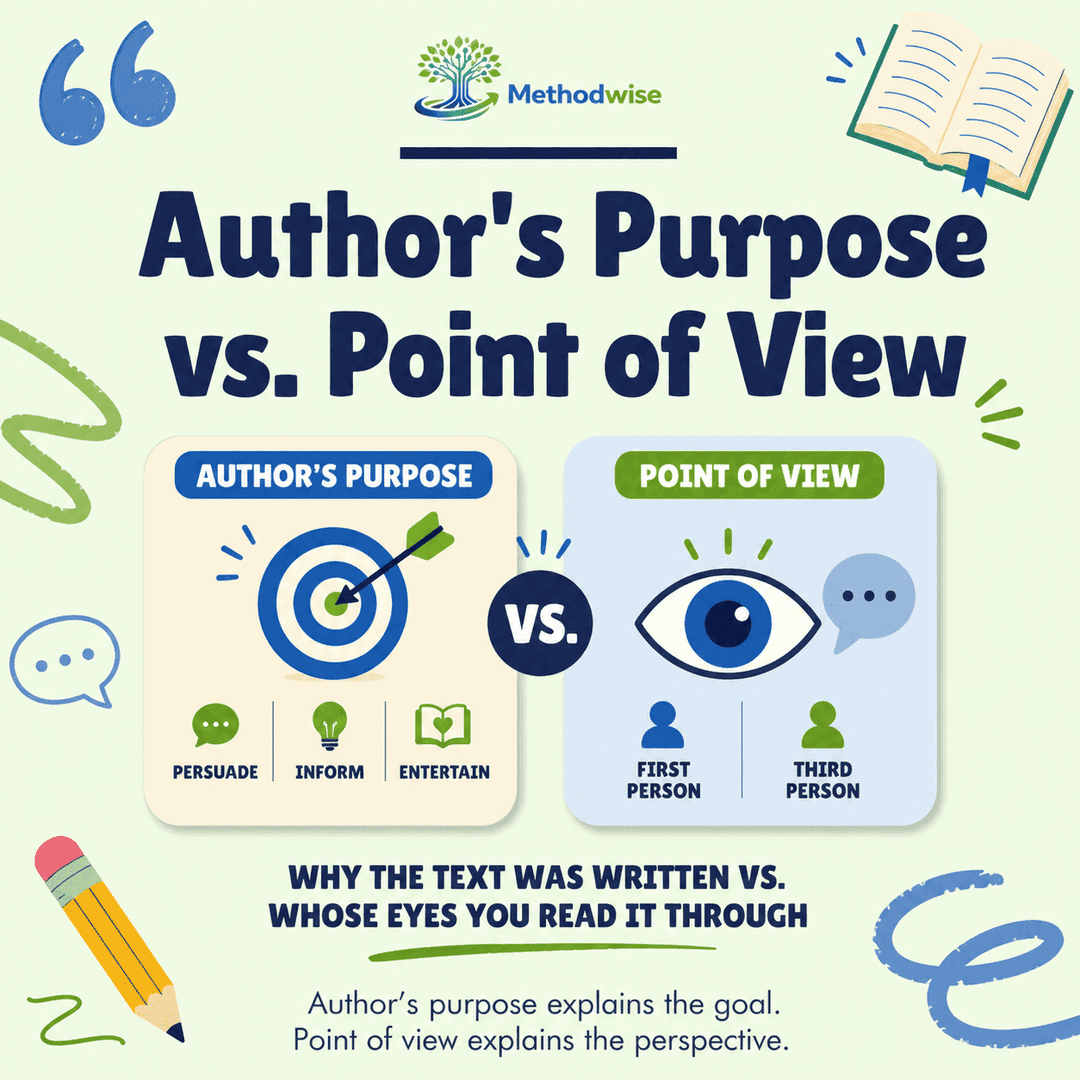
Author's purpose is the reason the author wrote the text. Not what it's about — why it was written. Most teachers introduce this with the acronym PIE:
- Persuade — convince you to think or do something
- Inform — give you facts and information
- Entertain — tell a story, make you laugh, make you feel something
Some classrooms use an expanded version like PIE'ED or PIED, which adds Explain (how something works) and Describe (paint a picture with words). The core idea is the same: a text exists for a reason, and naming that reason is a real reading skill.
If someone asks "Why did the author write this?" and you answer with one of those verbs — to persuade, to inform, to entertain — you've identified the author's purpose.
What Is Point of View?
Here's where it gets tricky, because point of view has two different meanings in ELA, and your child's teacher uses both.
In fiction, point of view means the narrator. Who is telling the story?
- First person — the narrator is in the story, using "I" and "we."
- Second person — the narrator talks directly to the reader as "you." (Rare — common in choose-your-own-adventure books.)
- Third person limited — the narrator is outside the story but can only see inside one character's head.
- Third person omniscient — the narrator is outside the story and can see inside all the characters' heads.
In nonfiction, "author's point of view" usually means the author's stance or perspective — what the author thinks or feels about the topic. An article about climate change can be informative, but if the author writes "this is the most urgent crisis of our time," you're reading their point of view, not just facts.
Both meanings show up in the standards, which is why your child's worksheet can swing between "Is this first person or third person?" and "What is the author's point of view on the issue?"
Why Parents (and Kids) Mix Them Up
The confusion is built into the language. Both questions feel like they're about "who's behind the writing," and in nonfiction the line really does blur — an author's purpose (to persuade) and an author's point of view (their stance) are connected, even if they're not the same thing.
A clean way to keep them separate:
- Author's purpose = the goal. Why was this written?
- Point of view (fiction) = the narrator. Who is telling it?
- Point of view (nonfiction) = the stance. What does the author think?
Most homework questions will steer you toward one of those three. The trick is to notice which kind of text you're reading and which question is being asked.
Stuck on tonight's homework?
Paste in the problem and get a step-by-step explanation in your child's grade level — using the same method their teacher uses.
Try 3 Questions Free — No Signup RequiredWhy Do Teachers Teach Both?
When most of us were in school, reading questions stayed close to what happened and who was the main character. Today's standards push students one level up: why was this written, and who's framing it?
That shift matters because almost everything kids will read as adults — news articles, social media posts, ads, opinion pieces, even text messages — is shaped by an author's purpose and a particular point of view. Recognizing those two layers is what separates a reader who takes in what they read from a reader who can evaluate it.
Teachers aren't making things harder for the sake of it. They're training the muscle students need to spot a persuasive piece dressed up as news, notice when a narrator might be biased, or catch the difference between "the dog ran away" and "the dog ran away because she was scared."
What Grade Are Author's Purpose and Point of View Taught?
Kindergarten–1st Grade — The Big Questions
Both skills start with simple oral questions. Teachers ask "Why do you think the author wrote this book?" and "Who is telling the story?" Students might say "to make us laugh" or "a girl named Mia is telling it because she says I." The standards (RL.K.6, RL.1.6) call this "identifying who is telling the story at various points in a text." No acronyms yet — just noticing.
2nd–3rd Grade — PIE Arrives, First vs. Third Person Arrives
Second and third grade are when both skills get formal vocabulary. PIE shows up on anchor charts in many classrooms — students sort books and short passages into Persuade, Inform, and Entertain piles. At the same time, students learn to name first-person and third-person narration (RL.3.6) and to distinguish "my point of view" from "the character's point of view" and "the narrator's point of view." These are often taught in the same week because they answer the two halves of "who is doing the talking and why?"
4th–5th Grade — Nuance and Narrator Types
By 4th grade, students go deeper on both. For author's purpose, they identify multiple purposes in the same text (an article that informs and persuades) and distinguish purpose from main idea. For point of view, they meet third-person limited vs. third-person omniscient and start to compare "how does the narrator's point of view change what we know?" (RL.4.6, RL.5.6). The nonfiction sense — author's perspective — also gets more explicit (RI.4.8, RI.5.8): "How does the author feel about this topic, and how can you tell?"
6th–8th Grade — Rhetoric, Bias, and Unreliable Narrators
Middle school is where these two skills become tools for analysis instead of vocabulary terms. Students examine how an author's purpose shapes word choice, structure, and tone. They look at point of view as something that limits or colors the story — the same events told by a different narrator would land completely differently. They meet unreliable narrators, dramatic irony, and the idea that an author's stance might be hidden under apparently neutral writing (RL.6.6, RI.6.6, RI.7.6, RI.8.6).
If your child is working on author's purpose or point of view at any of these stages, it's developmentally appropriate and part of a deliberate progression from "who's talking?" to "why did they choose this voice — and what does that do to me as a reader?"
How Author's Purpose and Point of View Work
The cleanest way to see the difference is to apply both lenses to the same kinds of texts your child sees in homework. Here are three worked examples.
Example 1: A Persuasive Letter (Grades 3–4)
The passage: "Dear Principal Garcia, I think our school should add an extra recess in the afternoon. Kids who play outside between lessons pay better attention. My brother is in middle school and they get more recess and he says it really helps. Please consider this idea. — Sincerely, Theo, 4th grade."
Author's purpose: To persuade. Theo wants Principal Garcia to change something. The clue words: "I think," "should add," "please consider."
Point of view: First person. Theo is telling the letter himself — "I think," "my brother." He's a character in his own piece of writing.
Notice the answers are different but related. Theo's purpose (persuade) and his point of view (first person) work together — first person is a natural choice for persuasive writing because it lets him speak directly. But they're not the same answer.
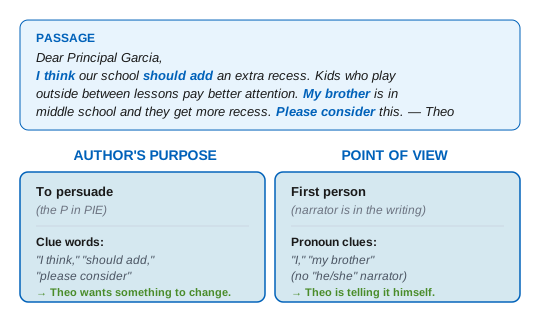 Persuasive letter labeled with two columns: Author's Purpose says To persuade with PIE highlighted, Point of View says First person with quoted I and my evidence
For more on how to back up an answer with the right kind of proof, see What Is Citing Evidence? A Parent's Guide to Text Evidence in Reading and Writing.
Example 2: A Short Story (Grades 4–5)
The passage: "Mara watched her brother Eli pull on his shoes. He didn't know she had seen him sneaking the cookies last night. She wasn't going to tell. Not yet. She liked having something he didn't know she had. The kitchen smelled like coffee and rain."
Author's purpose: To entertain. The author is telling a story — there are characters, a small mystery, a bit of tension. The clue: it's narrative; nobody is being persuaded or informed.
Point of view: Third person limited. The narrator is outside the story (notice — Mara, she, not I) but can only see inside Mara's head. We know what Mara is thinking ("she liked having something he didn't know she had"), but we don't know what Eli is thinking. If we did, it would be omniscient.
The PIE answer is fast — it's a story, so entertain. The point-of-view answer takes one extra step: notice the third-person pronouns, then check whose thoughts you're being shown.
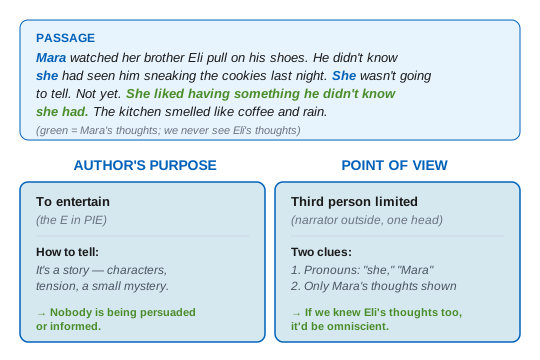 Short story passage with two callout columns: Author's Purpose says To entertain because it tells a story, Point of View says Third person limited because narrator uses she but only shows Mara's thoughts
For more on telling the difference between what's specific to one story and what's a bigger pattern, see Main Idea vs. Theme: What Your Child's Teacher Actually Means.
Example 3: An Informational Article (Grades 5–7)
The passage: "Single-use plastic bags are a serious problem. Each year, billions of them end up in oceans, where they harm fish, birds, and sea turtles. Several states have banned them, and the results have been encouraging. It's time for the rest of the country to follow."
Author's purpose: To persuade — even though the article looks informational. The clues: "a serious problem," "encouraging," "it's time…to follow." These are stance words, not neutral facts. The author is informing and persuading, but the persuasion is doing most of the work.
Point of view (nonfiction sense): The author is in favor of banning single-use plastic bags. That's the author's perspective. We can tell because of word choices — serious, harm, encouraging, it's time — and because the only examples cited are positive (states that banned them).
This example is the one most likely to trip your child up. There's no narrator using "I" — so it's not a fiction-style point of view question. It's the nonfiction sense: what does the author think about this topic? The trick is the same trick taught for inference work: look at the word choices, look at what the author left out, and figure out the stance.
For more on how to read between the lines and figure out what an author isn't saying outright, see What Is Making Inferences? A Parent's Guide to Reading Between the Lines.
The Quick Test
When you're staring at a question and not sure which lens to use, this little decision tree usually does the trick:
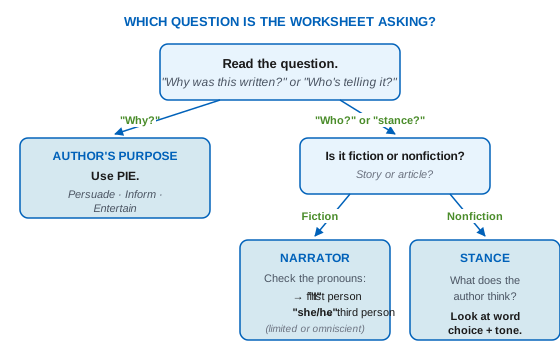 Decision tree for telling apart authors purpose and point of view: first ask is the question why was this written then PIE, otherwise ask if the text is fiction then narrator type, otherwise authors stance
How Author's Purpose and Point of View Connect to What You Already Know
You sort writing by purpose constantly. You just don't call it PIE.
When you open the mailbox and quickly separate the bills (inform) from the political flyers (persuade) from the magazine your kid subscribed to (entertain) — you're applying author's purpose. You're so good at it that you barely notice. You're using cover design, headlines, and tone of voice as clues, exactly the way the worksheet asks your child to use word choice and details.
You also read for point of view automatically. When a friend tells you a story about a fight she had with her sister, you instinctively understand that you're getting her version — first person, with all the framing that comes with it. If the sister told you the same story, you'd hear different details and probably draw different conclusions. That's the difference between first-person narration and a different character's perspective at the dinner table.
And in nonfiction, you read for the author's stance every time you scroll through opinion columns or product reviews. You can tell within two sentences whether the reviewer loves the restaurant or hates it, even if the words "I love this restaurant" never appear. You're picking up the author's point of view from word choice and emphasis.
The difference is that today's students are taught to recognize and name these two strategies — to label the purpose with PIE and the point of view with the right narrator type — so they can apply them deliberately to a reading question, instead of just absorbing them on autopilot when they're reading something fun.
Watch: Author's Purpose and Point of View Explained
How to Help at Home
Use PIE every time you read together
When you finish a book or article with your child, ask "Was that mostly to persuade, inform, or entertain?" It takes ten seconds and reinforces the framework their teacher is using. Over a few weeks, the question becomes automatic — and the homework version of it stops feeling like a trick.
When you read a story, ask "Who is telling it?"
Pause partway through the first chapter. Ask "Is the narrator in the story or outside it? How do you know?" Have them point to the pronouns. "I" and "we" mean first person. "He," "she," and "they" mean third person. Once they get used to checking the pronouns first, narrator questions go from intimidating to mechanical.
When you read an article together, ask "What does the author think?"
This is the move for the nonfiction "point of view" question. After reading a news piece or opinion column, ask "How does this author feel about the topic? What words gave it away?" This is also the doorway to talking about media literacy — recognizing that many articles reflect an author's perspective, even when they sound neutral at first.
Match the teacher's vocabulary, even when it feels weirdly specific
If your child's class uses PIE, you say PIE. If they use PIE'ED or PIED, use the version on the anchor chart. Same for point of view — if the worksheet says third person limited, don't shorten it to "the narrator's outside." In many classrooms, the vocabulary itself is part of what's being assessed. Matching it removes friction.
Don't fix wrong answers — investigate them
If your child says "It's first person because the author is talking," don't jump in with the right answer. Ask "What word did the narrator use?" If the passage says "Lila walked to the door," the narrator said Lila and she, not I. Walking back to the clue is more useful than supplying the right label.
Let Methodwise walk through it
If your child is stuck on a "why did the author write this?" or "who is the narrator?" question and doesn't know where to start, open the Methodwise chat, paste or describe the passage and the question, and ask for help with author's purpose or point of view. Methodwise will walk through the clues — purpose words, pronouns, stance language — and model the answer using the same vocabulary the teacher uses.
Common Mistakes to Watch For
Answering "the author" for point of view
A surprising number of kids will see "What is the point of view?" and write "the author." That's because the question feels like it's asking who's behind the words. The fix: remind them the question is about the narrator (in fiction) or the stance (in nonfiction), not about the person who wrote the book. Authors choose narrators — they aren't the same thing.
Confusing author's purpose with main idea
A child writes "to tell about pandas" for the author's purpose of a nonfiction article about pandas. That's actually the topic or main idea, not the purpose. The purpose is to inform (using PIE language). The fix: walk back to the verb. PIE answers always start with to + a verb (to persuade, to inform, to entertain).
Treating "point of view" the same way in fiction and nonfiction
Your child writes "first person" for the point of view of an opinion column. Technically it's not even wrong — the writer might use I — but the question is almost certainly asking about the author's stance. The fix: read the question carefully. Story = narrator question. Article = stance question.
Calling everything "third person omniscient"
Once kids learn the word omniscient, they want to use it. But omniscient means the narrator can see inside every character's head. If the story only shows you what one character thinks, it's third person limited. The fix: ask "Whose thoughts have we actually seen?" If only one, it's limited.
Mixing up the character's point of view with the narrator's
In an upper-elementary worksheet, "the character's point of view" often means how does the character feel about what's happening? That's different from "the narrator's point of view," which means who's telling the story. The fix: notice which word the question uses. Different word, different answer.
Practice Questions
Try these with your child. Read each short passage, answer the questions, and notice the purpose and point of view clues separately. Answers are below.
Passage A:
Have you ever wished your school day started later? Studies show that middle schoolers don't get enough sleep, and starting school at 8:00 instead of 7:30 would help. Some schools have already tried it, and grades went up. Our school should do the same.
Grades 3–4 — Author's purpose with PIE:
- What is the author's purpose? Use one clue from the passage to support your answer.
Passage B:
Sage tightened her grip on the soccer ball. She could feel the other team watching her, waiting. Her coach had told her this morning, "Just trust your feet." She wasn't sure her feet wanted to be trusted. The whistle was about to blow.
Grades 4–5 — Point of view (narrator):
- What is the point of view of this passage — first person, third person limited, or third person omniscient? How do you know? Cite a detail from the passage.
Passage C:
Many people believe that homework helps students learn. The truth is more complicated. Researchers have found that for elementary students, more than 30 minutes of homework a night doesn't improve grades — and in some studies, it actually hurts learning. Schools that have cut back on homework report happier students and better classroom focus. It may be time to rethink the way we assign homework.
Grades 6–8 — Author's purpose AND author's point of view:
- What is the author's purpose? What is the author's point of view on homework? Identify two pieces of evidence that support your answer for point of view.
Answers
-
To persuade. The clue is "Our school should do the same" — the author is telling the reader what should happen, which is the move of persuasive writing. (You could also cite "would help," "grades went up," or any of the stance-y word choices.)
-
Third person limited. The narrator uses Sage and she (not I), which means it's third person — so it's not first person. But the only thoughts we get are Sage's ("She wasn't sure her feet wanted to be trusted"). We don't know what the other team is thinking. If the narrator could see into the other team's heads too, it would be omniscient. Because we only see one character's thoughts, it's third person limited.
-
Author's purpose: To persuade, with a strong informative element (it cites researchers and studies). The author isn't just describing homework — they want the reader to reconsider it. Author's point of view: The author thinks elementary schools assign too much homework and that less homework is better. Two pieces of evidence: (a) "more than 30 minutes of homework a night doesn't improve grades — and in some studies, it actually hurts learning," which is presented as the truth the author is correcting; and (b) "It may be time to rethink the way we assign homework," which is the author's recommended action. The article only cites studies that support cutting homework — that selection itself reveals the author's stance.
Ready to try it with your child?
Open the chat, pick the subject and your child's grade, and get a step-by-step explanation you can use to help tonight.
Try 3 Questions Free — No Signup RequiredFrequently Asked Questions
What's the difference between author's purpose and main idea?
Author's purpose is *why* the author wrote the text — to persuade, inform, or entertain. Main idea is *what* the text is about — the central point the author makes. A book about Jane Goodall might have the purpose of informing readers, but the main idea is 'Jane Goodall changed how scientists study primates.' Purpose answers 'why?'; main idea answers 'what?' Both questions can show up on the same worksheet, and the answers will be different.
Is tone the same as author's point of view?
No — though they're related. Tone is the author's *attitude* expressed through word choice and style (sarcastic, hopeful, alarmed, neutral). Point of view in nonfiction is the author's *stance* — what they think about the topic. Tone is *how* the writing sounds; point of view is the author's *perspective* or *stance*. A passage about plastic bags could have an alarmed tone AND a pro-ban stance — but you can also have an alarmed tone with a neutral stance, like a news article that reports a crisis without taking sides.
My child's worksheet uses 'author's intent' — is that the same as author's purpose?
Yes, in most elementary and middle school contexts. 'Author's intent' and 'author's purpose' are usually used interchangeably in K–8 ELA, and both are typically answered using PIE (Persuade, Inform, Entertain). Some middle school teachers use 'intent' to imply something slightly more specific — the particular outcome the author wants from a particular reader — but for elementary homework, you can treat them as synonyms.
Can a text have more than one author's purpose?
Yes, and it's actually the norm by 4th or 5th grade. A persuasive essay almost always *informs* before it *persuades.* A funny news article *entertains* and *informs* at the same time. When a teacher asks for 'the' author's purpose, they usually mean the *primary* one — the goal everything else in the text serves. Help your child notice the secondary purposes too, but lead with the strongest one.
What's an unreliable narrator, and when does it come up?
An unreliable narrator is one whose version of events the reader is *not* supposed to fully trust — usually because they're biased, mistaken, dishonest, or limited in some way. Famous examples: Holden Caulfield in *The Catcher in the Rye*, the narrator in *The Tell-Tale Heart.* Unreliable narrators often show up by middle school as a way to teach that point of view shapes what the reader knows. Recognizing one usually means noticing contradictions between what the narrator says and what other clues in the text suggest.
Can Methodwise help with author's purpose and point of view questions?
Yes. If your child is stuck on a 'why did the author write this?' or 'who is telling this story?' question, you can paste the passage and the question into Methodwise. It'll walk through the clues, name the purpose using PIE (or PIE'ED if that's what their teacher uses), identify the point of view with the right vocabulary, and explain how to tell the two apart — using the same language the teacher uses.
Try Methodwise Free
When your child brings home a reading worksheet that asks "What is the author's purpose?" or "What is the point of view?" and you're not sure how to walk them through it the way their teacher would, Methodwise does it for you — step by step, using PIE and the right narrator vocabulary their teacher is using.
- Start with 3 free questions — no account needed
- Free plan: 15 questions/month after signup
- Plus plan: unlimited questions + saved chat history + 7-day free trial
- Step-by-step explanations the way teachers teach
Related Articles
-
What Is Making Inferences? A Parent's Guide to Reading Between the Lines
-
What Is Citing Evidence? A Parent's Guide to Text Evidence in Reading and Writing
-
Main Idea vs. Theme: What Your Child's Teacher Actually Means
-
What Is Close Reading? A Parent's Guide to Deeper Comprehension
-
Reading Comprehension Strategies: A Parent's Guide to How Teachers Teach Reading
-
What Are Text Features? A Parent's Guide to Nonfiction Reading
-
Reading Levels Explained: Lexile, F&P, and DRA in Plain English
-
Homework Help Tools: Built for Kids vs. Built for Parents — What's the Difference?
-
What Are Context Clues? A Parent's Guide to How Kids Figure Out New Words Without a Dictionary
-
What Is Text Structure? A Parent's Guide to How Nonfiction Is Organized
-
Opinion Writing vs. Argument Writing: A Parent's Guide to the K–8 Writing Progression
-
Summarizing vs. Retelling: A Parent's Guide to Why the Teacher Keeps Saying 'Too Many Details'
-
What Are Story Elements? A Parent's Guide to Characters, Setting, Problem, and Solution
-
What Is Phonemic Awareness? A Parent's Guide to Playing With Sounds Before Reading
Have questions about author's purpose or point of view? Email me at hello@methodwise.co
About the Author
Samantha Black is the founder of Methodwise and an educator with over 15 years in higher education and instructional design. She built Methodwise after experiencing the homework gap firsthand as a parent of two K–8 daughters. Learn more about why we built Methodwise →