
Fractions on a Number Line: A Parent's Guide to Why Pie Charts Aren't Enough
May 21, 2026
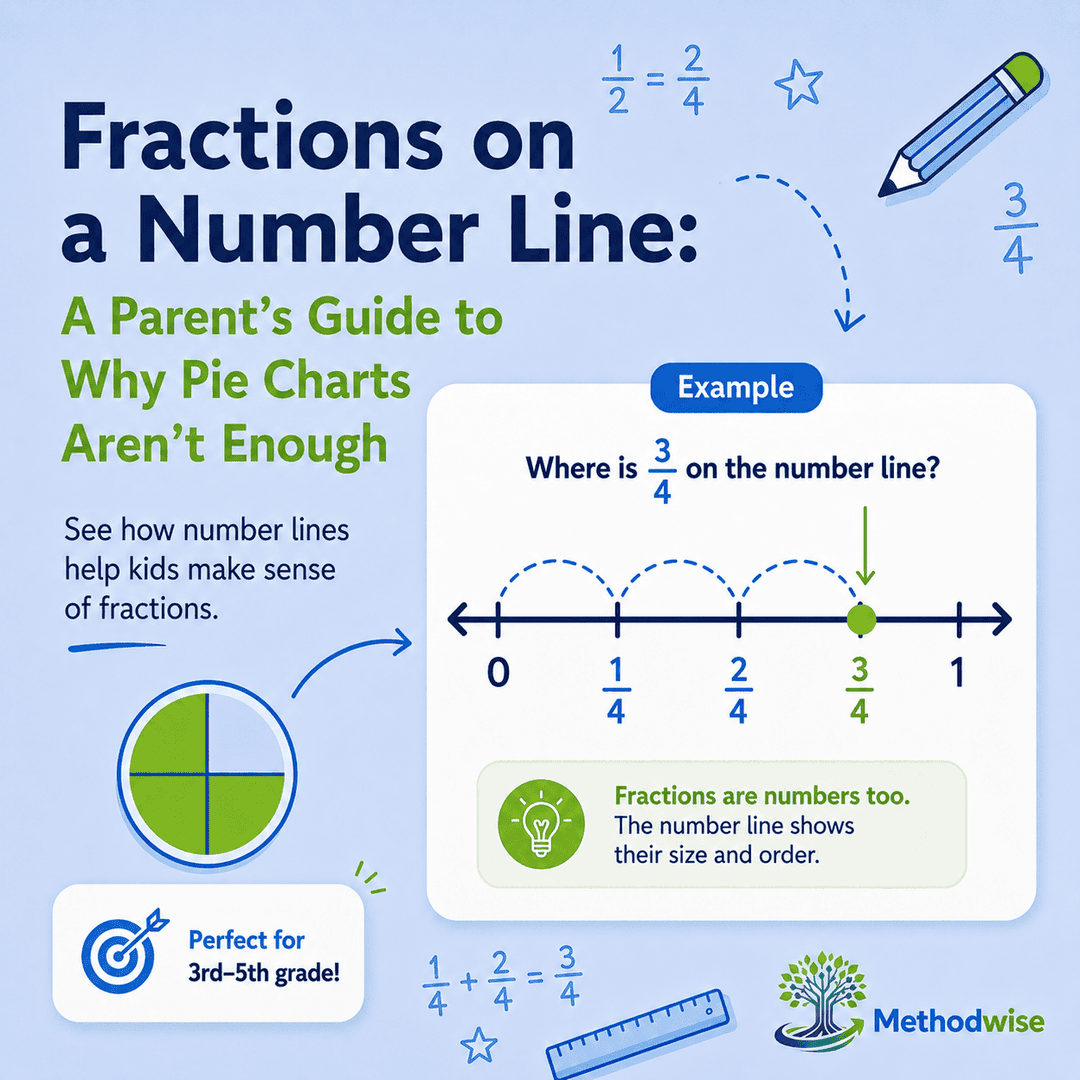
If your third grader's fraction homework looks more like a ruler than a pizza, you've found one of the biggest shifts in how fractions are taught today. Instead of starting with circles divided into slices, teachers now introduce fractions as points on a number line — specific numbers that live between 0 and 1, or between 1 and 2, or anywhere else along the line. It looks unfamiliar, and it can feel like the pie charts you grew up with have disappeared overnight. They haven't. But your child is being asked to think about fractions in a way that pie charts alone can't fully teach. This shift isn't just about fractions - it's about helping students see math as a system of numbers that can be placed, compared, and reasoned about.
What Is a Fraction on a Number Line?
A fraction on a number line is a fraction shown as a specific point or location on a number line, rather than as a shaded part of a shape. A line is drawn — usually from 0 to 1 to start — and divided into equal intervals. The fraction is marked at the end of the matching interval (shown by a tick mark).
The key shift: fractions stop being "pieces of a thing" and start being numbers in their own right. 3/4 isn't "three shaded slices of a pizza" — it's a specific number, slightly less than 1, that sits at a specific spot on the line.
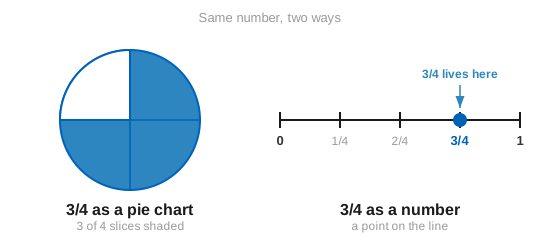 A pie chart showing 3/4 shaded next to a number line from 0 to 1 with 3/4 marked as a point, illustrating that both represent the same number
Why Do Teachers Use Number Lines for Fractions?
Pie charts and rectangle models aren't gone — your child will still see them, especially in 1st and 2nd grade. But they have a built-in limitation: they make fractions look like amounts of stuff rather than numbers. And once fractions get bigger than 1, or once you need to compare two fractions with different denominators, pie charts become harder to use.
The number line fixes this. It treats 3/4 the same way it treats 5 or 17 — as a number with a place. That makes everything that comes later (comparing fractions, finding equivalents, adding, subtracting) far more concrete. Common Core Standard 3.NF.A.2 introduces this explicitly: "Understand a fraction as a number on the number line." That single standard reshapes the next three years of fraction work.
It also gives students a clean way to see that 1/2 and 2/4 are the same number — they share a point on the line. With pie charts, showing equivalence means overlaying multiple circles, which gets messy fast. With a number line, you just look at where the dot lands.
Stuck on tonight's homework?
Paste in the problem and get a step-by-step explanation in your child's grade level — using the same method their teacher uses.
Try 3 Questions Free — No Signup RequiredWhat Grade Are Fractions on a Number Line Taught?
2nd Grade — Pre-fraction Foundation
Second graders aren't placing fractions on a number line yet, but they're partitioning shapes into halves, thirds, and quarters and learning the words half, third, and fourth. This sets up the language they'll need next year.
3rd Grade — Introduction (the big one)
This is where fractions on a number line officially begins. Per Common Core standard 3.NF.A.2, students learn to represent fractions with denominators of 2, 3, 4, 6, and 8 as points on a number line. They learn to divide the segment from 0 to 1 into equal parts, plot unit fractions like 1/4 (one of those parts), and plot non-unit fractions like 3/4 (three of those parts). By the end of 3rd grade, students should be comfortable placing any fraction with those denominators on a line.
4th Grade — Equivalent Fractions and Comparing
Fourth graders extend the work to denominators of 5, 10, 12, and 100. They use the number line to show why 1/2 = 2/4 = 4/8 (the dots all land on the same point), to compare fractions with different denominators by plotting both and seeing which is farther right, and to plot mixed numbers and improper fractions like 1 3/4 and 7/4.
5th Grade — Operations
Fifth graders use the number line as a thinking tool when adding, subtracting, and multiplying fractions with unlike denominators. They often find a common interval on a shared line to add fractions like 1/3 + 1/4. By this point, the number line is less of a worksheet activity and more of a way to check whether an answer makes sense.
If your child is working with fractions on a number line at any of these stages, it's developmentally appropriate and part of a deliberate progression.
How to Plot Fractions on a Number Line
The Basics: Plotting 3/4 (3rd grade)
Here's how a 3rd grader plots 3/4 on a number line.
Step 1: Draw a line from 0 to 1. This represents one whole. The fraction we're plotting is less than 1, so we don't need any marks beyond 1.
Step 2: Look at the denominator. The denominator (the bottom number) tells you how many equal parts to divide the line into. The denominator is 4, so split the line into 4 equal intervals.
Step 3: Count the intervals using the numerator. The numerator (the top number) tells you how many intervals to count from 0. Start at 0 and count three intervals to the right. The point where you land is 3/4.
That's it. No shading, no slicing — just dividing, counting, and marking.
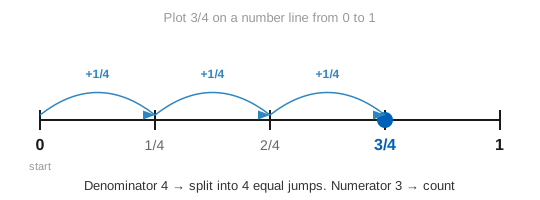 Number line from 0 to 1 divided into fourths with a dot at 3/4, labeled with arrows showing three equal jumps from 0
Notice that you're counting the spaces between tick marks. Each space is one equal part. The tick marks just show where each part ends. This is the single most important thing to watch — and it's the most common mistake we'll cover later.
For a fuller introduction to how teachers use number lines for whole numbers first, see What Is a Number Line? A Parent's Guide to How Teachers Use It.
Equivalent Fractions: 1/2 = 2/4 = 4/8 (4th grade)
Here's where the number line really shines — and where pie charts are less effective.
You can draw three number lines, or use one number line and relabel it in different ways. On the first, divide into 2 parts and mark 1/2. On the second, divide into 4 parts and mark 2/4. On the third, divide into 8 parts and mark 4/8.
Step 1: Divide each line by its denominator. First line: 2 intervals. Second: 4 intervals. Third: 8 intervals.
Step 2: Count by the numerator on each. Mark a dot at 1/2, at 2/4, and at 4/8.
Step 3: Look down. All three dots land at exactly the same point on the line.
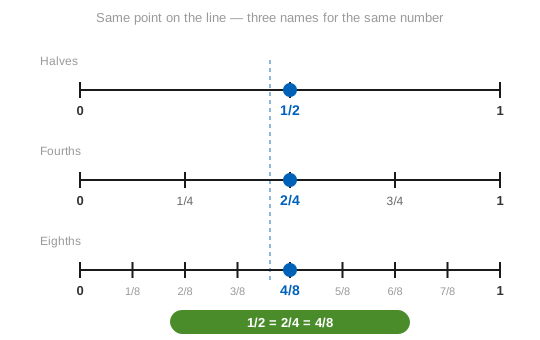 Three stacked number lines from 0 to 1 showing 1/2, 2/4, and 4/8 all aligned vertically at the same point, with a dashed line connecting them
That's what equivalent fractions means — different names for the same number. The number line shows it cleanly. With pie charts, you'd need three same-size circles and you'd have to overlay them in your head to see the shaded amounts match. Here, the dots line up and the point is made.
For another visual model teachers use to show equivalent fractions, see What Is a Tape Diagram? A Parent's Guide to Visualizing Word Problems.
Mixed Numbers and Improper Fractions: 1 3/4 (4th–5th grade)
Fractions don't stop at 1. A mixed number is a whole number plus a fraction (like 1 3/4). An improper fraction is a fraction whose numerator is bigger than its denominator (like 7/4). The number line treats them the same way.
Step 1: Extend the line past 1. Draw a line from 0 to 2 and mark the whole number tick at 1.
Step 2: Divide each whole into fourths. The segment from 0 to 1 gets 4 equal intervals; so does the segment from 1 to 2. There are now 8 intervals total.
Step 3: Count three intervals past 1. Start at 1 and count three fourths to the right. The point you land on is 1 3/4 — and if you count all the fourths from 0, it's also 7/4.
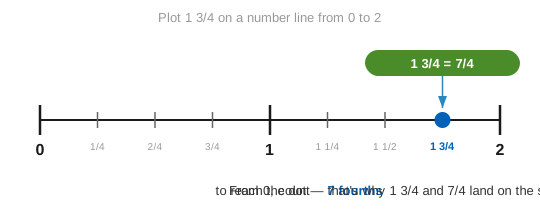 Number line from 0 to 2 with each whole divided into fourths, a dot plotted at 1 and 3/4, labeled as both 1 3/4 and 7/4
This is one of the moments where pie charts genuinely fall short. To show 7/4 with pies, you need two pies — one whole circle, plus another with three shaded slices. The number line just keeps going. Students who see 1 3/4 as a point on a line have a much easier time when they later have to add, subtract, or compare mixed numbers.
How Fractions on a Number Line Connects to What You Already Know
You're using fraction number lines every day without thinking about it.
The tape measure or ruler in your toolbox is a number line with fractions marked on it. When you measure something at "two and a half inches," you're reading a point on a number line — the half-inch tick between the 2-inch and 3-inch marks.
A measuring cup is a vertical number line. When the milk reaches the 3/4-cup line, that's 3/4 as a position, not 3/4 as a shaded shape.
A car's gas gauge is a number line from E to F, with quarter-tank marks in between. When you say "I'm at three-quarters of a tank," you're naming a point on a line.
Highway mile markers, oven thermometers, kitchen timers, and even the volume slider on your TV remote all work the same way: a continuous line with fractional points along it.
The difference is that today's students are taught to recognize and name this representation, so they can apply it deliberately rather than only using it when the numbers happen to be familiar.
Watch: Fractions on a Number Line Explained
How to Help at Home
Use a ruler before you use a worksheet
The fastest way for a child to "get" fractions on a number line is to look at a ruler. Find the 1/2-inch mark. Find the 1/4-inch mark. Notice that 2/4 is the same place as 1/2. Five minutes with a ruler does more than half an hour of textbook practice — because the ruler is a fraction number line.
Count intervals, not tick marks
This is the single biggest fix you can make. If your child is plotting 3/4 and counts "1, 2, 3" by pointing at tick marks instead of counting the spaces between them, gently redirect: "Each space is one-fourth. Count the spaces." One change in habit prevents most fraction-on-a-number-line errors.
Fold a paper strip
Cut a strip of paper to be a "number line from 0 to 1." Fold it in half — that crease is 1/2. Fold it again — those creases are 1/4 and 3/4. Fold once more — eighths. Kids feel the equal partitioning in their hands, and they see why a bigger denominator means smaller pieces.
Don't correct the method, even if you'd do it differently
If your child plots a fraction by first dividing the line and then carefully counting, resist the urge to say "just imagine where it would go." The slow, deliberate process is what's being taught — and what builds the deep understanding that fractions are numbers. Let them follow the steps.
Use the same words their teacher uses
Numerator. Denominator. Unit fraction (a fraction with 1 on top, like 1/4). Equivalent. Mirror these words at home. Your child doesn't need a translator — they need to hear you say the same words their teacher says.
Let Methodwise walk through it
If you're staring at a fraction problem and can't remember the steps, open Methodwise and type or snap a photo of the problem. It will walk you and your child through it step by step — using the same method their teacher is using.
Common Mistakes to Watch For
Counting tick marks instead of intervals
By far the most common mistake. To plot 1/4, students count "1" at the first tick mark — but that mark is at 1/4 only if you count the interval before it, not the mark itself. The fix: tell your child to count jumps, not dots. Each jump is one of the equal pieces named in the denominator.
Making unequal intervals
When students freehand a number line, the intervals are often wildly unequal. A fraction only means anything if the parts are the same size. If your child's number line has a tiny 1/4 next to a huge 1/4, the whole problem is off. Encourage them to use a ruler or grid paper for the first few months.
Assuming bigger denominator means bigger fraction
1/8 is smaller than 1/2, not bigger, even though 8 is larger than 2. The number line makes this obvious: when you split a line into more pieces, each piece gets smaller. If your child is confused, draw two lines side by side — one cut into halves, one into eighths — and let them see it for themselves.
Forgetting that the line goes past 1
Many students assume fractions can only live between 0 and 1. When they meet 5/4 or 7/3, they get stuck because there's no room on their drawing. Remind them that the number line keeps going forever — 5/4 just lives a little past 1, and 7/3 lives a little past 2.
Mixing up the numerator and denominator
The numerator is on top and tells you how many pieces to count. The denominator is on the bottom and tells you how big each piece is (by how many pieces the whole is split into). A trick that sticks for many kids: "Denominator lives Down below."
Practice Questions
Try these with your child. Answers are below.
Plotting on a 0–1 line (3rd grade):
- Where would you plot 1/4 on a number line from 0 to 1?
- Where would you plot 5/8 on a number line from 0 to 1?
- Divide a line from 0 to 1 into thirds. Plot 2/3.
Equivalent fractions (4th grade):
- On a number line from 0 to 1, which of these points is the same as 1/2? Choose: 2/3, 3/6, or 5/8.
- Is 3/4 equivalent to 6/8 on a number line? How do you know?
Mixed numbers and improper fractions (4th–5th grade):
- Plot 1 1/2 on a number line from 0 to 2.
- Plot 7/4 on a number line from 0 to 2. Is it the same point as 1 3/4?
Answers
- Divide the line into 4 equal intervals. 1/4 is at the end of the first interval after 0 (the first mark).
- Divide the line into 8 equal intervals. 5/8 is at the end of the fifth interval after 0 (the fifth mark) — just past the halfway point.
- Divide the line into 3 equal intervals. 2/3 is at the end of the second interval after 0 (the second mark) — about two-thirds of the way to 1.
- 3/6 (because 3/6 = 1/2). 2/3 is more than 1/2 and 5/8 is also more than 1/2.
- Yes. If you split a 0–1 line into fourths and plot 3/4, then split the same line into eighths and plot 6/8, the two dots land at exactly the same place.
- Divide the line from 0 to 2 into halves at every whole number. 1 1/2 is at the midpoint between 1 and 2.
- Divide the line from 0 to 2 into fourths (8 intervals total). 7/4 is at the end of the seventh interval after 0, which is the same as 1 3/4. Yes — they're equal.
Ready to try it with your child?
Open the chat, pick the subject and your child's grade, and get a step-by-step explanation you can use to help tonight.
Try 3 Questions Free — No Signup RequiredFrequently Asked Questions
How do I help my child compare two fractions with different denominators on a number line?
Draw two number lines from 0 to 1, one above the other. Split the first into the first fraction's denominator (for 3/5, into fifths) and split the second into the second fraction's denominator (for 2/3, into thirds). Plot a dot on each, then look at which dot is farther to the right — that's the bigger fraction. This visual approach is much easier than memorizing 'cross-multiply' rules, because your child can see why one fraction is larger.
How do decimals fit on a number line with fractions?
They share the same line. 0.5 and 1/2 land at the same point; so do 0.25 and 1/4, 0.75 and 3/4, and 0.1 and 1/10. By 4th grade, most curricula have students plotting fractions and decimals together so they see they're just two different names for the same numbers. The moment your child plots 0.6 and 3/5 and the dots stack on top of each other is usually a big breakthrough for upper-elementary math.
My 3rd grader is struggling with fractions on a number line. Should I be worried?
Almost certainly not. The leap from 'fractions are pieces of a shape' to 'fractions are numbers with a location' takes weeks for most kids, not days. Watch for two specific signs of confusion rather than general frustration: (1) your child can't divide a line into equal parts even with a ruler, or (2) your child consistently reverses the numerator and denominator even when prompted. If you see either, mention it to the teacher. Otherwise, give it time — this skill builds steadily across all of 3rd grade.
Are there any free tools that help kids practice fractions on a number line?
A few favorites: NCTM Illuminations has a free 'Fraction Game' built around a number-line board. Toy Theater has a simple drag-and-drop fraction number line. Khan Academy's 3rd-grade fractions unit has guided number-line problems with instant feedback. And for a free printable, search 'fraction number line strips' — you'll find blank halves, thirds, fourths, sixths, and eighths to print on regular paper. For step-by-step help on a specific homework problem, Methodwise will walk through it using your child's exact method.
How will fractions on a number line connect to math my child does later?
Directly. In 5th and 6th grade, the same number line gets extended to include negative numbers, decimals, and percents — and students start treating 1/2, 0.5, and 50% as three names for the same point. In 6th and 7th grade, that line becomes the x-axis (and y-axis) of the coordinate plane, and graphing begins. By high school algebra, every equation a student graphs is built on the foundation 'a number has a location.' The number line work happening in 3rd grade is the start of that thread.
Try Methodwise Free
When your child brings home a fraction problem on a number line and you're not sure how to explain it the way their teacher would, Methodwise walks you through it — step by step, using the same method their teacher is using.
- Start with 3 free questions — no account needed
- Free plan: 15 questions/month after signup
- Plus plan: unlimited questions + saved chat history + 7-day free trial
- Step-by-step explanations the way teachers teach
Related Articles
-
What Is a Number Line? A Parent's Guide to How Teachers Use It
-
What Is a Tape Diagram? A Parent's Guide to Visualizing Word Problems
-
What Is the Area Model? A Parent's Guide to Box Multiplication
-
What Is Decomposing Numbers? A Parent's Guide to Breaking Apart Numbers
-
What Are Number Bonds? A Parent's Guide to Making and Breaking Numbers
-
What Is Partial Sums Addition? A Parent's Guide to Why Your Child Doesn't 'Carry the One' Anymore
-
What Is Partial Quotients Division? A Parent's Guide to the New Way Kids Learn Long Division
-
What Are Arrays in Math? A Parent's Guide to Visualizing Multiplication
-
What Is a Ten Frame? A Parent's Guide to the Box That Builds Number Sense
-
What Are Fact Families? A Parent's Guide to How Addition and Subtraction Connect
-
What Is the Standard Algorithm? A Parent's Guide to Why Your Child Learns the 'Long Way' First
-
What Are Common Core Math Methods? A Parent's Guide to How Math Is Taught Today
-
Homework Help Tools: Built for Kids vs. Built for Parents — What's the Difference?
-
What Are Ratios and Proportional Reasoning? A Parent's Guide to Middle School Math
-
What Is Skip Counting? A Parent's Guide to How Counting by 2s, 5s, and 10s Becomes Times Tables
-
What Math Will My Child Learn This Year? A Parent's Guide to K-8 Math Methods by Grade
-
What Are Mental Math Strategies? A Parent's Guide to How Kids Add and Subtract in Their Heads
Have questions about fractions on a number line? Email me at hello@methodwise.co
About the Author
Samantha Black is the founder of Methodwise and an educator with over 15 years in higher education and instructional design. She built Methodwise after experiencing the homework gap firsthand as a parent of two K–8 daughters. Learn more about why we built Methodwise →