
What Math Will My Child Learn This Year? A Parent's Guide to K–8 Math Methods by Grade
June 22, 2026
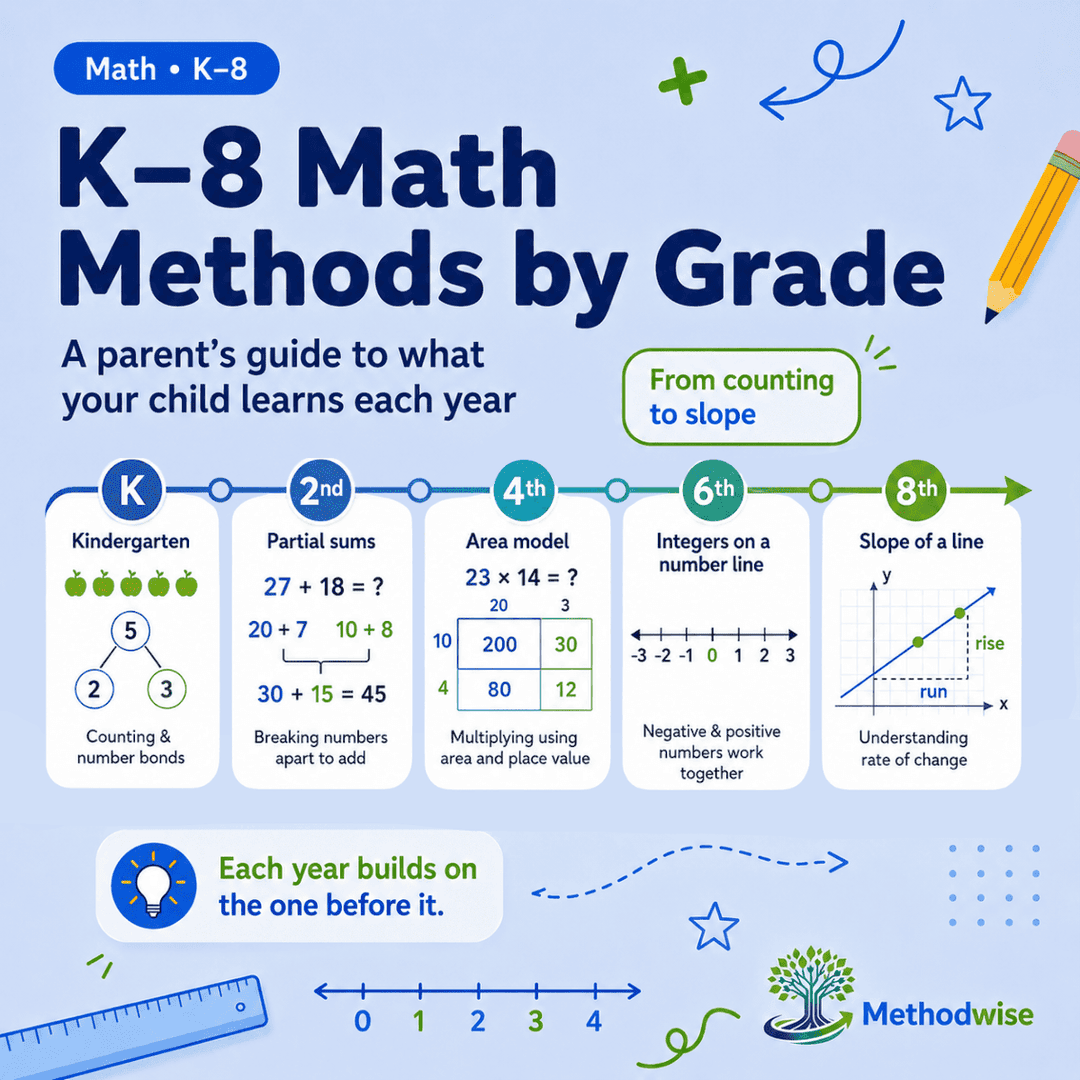
If your child's math homework looks unfamiliar, you're not alone. This guide shows the exact math methods taught in each grade, from rectangles split into boxes to numbers broken apart and added in pieces to circles connected by branching lines. Each grade introduces a new set of them, and they're designed to build on each other from one year to the next, so when the homework lands on your kitchen table this year, you already know what you're looking at.
What Are Today's Math Methods?
"Math methods" are the visual models and step-by-step strategies teachers use to show how numbers work before students move to faster shortcuts. Instead of starting with the stacked, carry-the-one algorithm you probably learned, today's classrooms start with pictures: number bonds, ten-frames, number lines, area models, and tape diagrams.
The arithmetic answer is the same one you'd get. The path to it is what changed. A child learns to see why 24 × 6 equals 144 by breaking it into 20 × 6 and 4 × 6, then adds the standard algorithm later, once the reasoning is solid.
Stuck on tonight's homework?
Paste in the problem and get a step-by-step explanation in your child's grade level — using the same method their teacher uses.
Try 3 Questions Free — No Signup RequiredWhy Do Teachers Teach Math This Way?
The method you learned, line up the digits and follow the steps, is efficient and still gets taught. The trouble is that a student can run those steps perfectly without knowing what they mean, and that understanding gap shows up later in fractions, ratios, and algebra, where memorized steps stop being enough.
Today's sequence front-loads the meaning. Students spend the early grades building number sense, an intuitive feel for how quantities come apart and fit back together, using models they can see and touch. The standard algorithms still arrive, usually in 4th and 5th grade. By then a child knows why carrying works, so the shortcut is a time-saver rather than a mystery. The visual methods are the foundation; the fast methods are built on top. This approach builds conceptual understanding before procedural fluency, which research shows leads to stronger long-term math performance.
At-a-Glance: Math Methods by Grade
Here's a quick snapshot before we go grade by grade:
- Kindergarten: Counting, ten-frames, number bonds
- 1st Grade: Addition and subtraction within 20, making ten
- 2nd Grade: Place value to 1,000, partial sums
- 3rd Grade: Multiplication, division, fractions on number line
- 4th Grade: Area model, multi-digit multiplication, fractions
- 5th Grade: Decimals, fraction operations, standard algorithm
- 6th Grade: Ratios, integers, algebraic expressions
- 7th Grade: Proportions, percent, rational numbers
- 8th Grade: Linear equations, slope, functions
What Math Methods Come at Each Grade?
Math standards are deliberately sequenced. Each grade assumes the one before it, which is why a gap in 2nd-grade place value can make 4th-grade multiplication feel impossible. Here's the grade-by-grade map.
Kindergarten: Counting, Comparing, and Breaking Numbers Apart
Kindergarten is about what numbers actually mean. Children count objects, match a number to a quantity, and compare groups (which has more?). They meet ten-frames, a two-by-five grid that builds a mental picture of numbers up to ten, and they start decomposing numbers, seeing that 5 is 4 and 1, or 3 and 2.
On the homework: drawing dots to show a number, or filling in two parts that make a whole.
1st Grade: Addition and Subtraction Within 20
First graders add and subtract within 20 using strategies rather than memorization. The big one is making ten: to solve 8 + 5, a child breaks the 5 into 2 and 3, makes 8 + 2 = 10, then adds the leftover 3 to reach 13. Number bonds (the circle-and-branches diagram) and number lines show up constantly here. Place value also begins, as kids start seeing two-digit numbers as tens and ones.
2nd Grade: Place Value and Strategy-Based Addition
Second grade pushes place value to the hundreds and uses it to add and subtract numbers within 1,000. Instead of stacking and carrying right away, students break numbers apart by place and combine the pieces, the strategy that becomes partial sums. They also work extensively on number lines and skip-counting, which quietly lays the groundwork for multiplication.
3rd Grade: Multiplication, Division, and Fractions Begin
Third grade is a turning point. Multiplication and division arrive through equal groups and arrays (rows and columns of dots), so 4 × 6 is four rows of six. Fractions begin as numbers on a number line, not just slices of pizza, which is how students learn that 3/4 is a specific point between 0 and 1. Rounding and area also enter here.
4th Grade: Multi-Digit Multiplication and Long Division
Fourth grade is where the area model does heavy lifting. Multi-digit multiplication like 24 × 6 gets split into a box, and long division is taught through the area model and partial quotients before the traditional long-division steps. Place value extends into expanded form, writing 3,472 as 3,000 + 400 + 70 + 2. Fraction work deepens into equivalence and comparing.
5th Grade: Decimals, Fractions, and the Standard Algorithms
Fifth grade brings the methods together. Students add, subtract, multiply, and divide decimals using place-value reasoning, add and subtract fractions with unlike denominators, and begin multiplying and dividing fractions. This is also where the standard algorithms you remember become the expected, efficient method, now that the understanding underneath them is in place. Order of operations and volume appear too.
6th Grade: Ratios, Rates, and Negative Numbers
Sixth grade shifts from arithmetic toward relationships. Ratios and unit rates get formal names and notation (3 cups of flour to 2 cups of sugar), often shown in ratio tables. Students divide fractions by fractions, meet negative numbers and the full number line including integers, and start writing algebraic expressions and equations with variables.
7th Grade: Proportional Relationships and Rational Numbers
Seventh grade builds proportional reasoning: recognizing when two quantities scale together, finding unit rates, and solving percent problems (tax, tip, discount, markup). Students do full operations with rational numbers, including negatives, and solve multi-step equations. This is the year the math starts to look recognizably like algebra.
8th Grade: Linear Equations, Slope, and Functions
Eighth grade is the on-ramp to high school algebra. Students work with linear equations and graph them, learn slope as a rate of change, and meet functions for the first time. They also solve systems of equations, use exponents and scientific notation, and apply the Pythagorean theorem.
If your child is working with any of these methods at the grade listed, it's developmentally appropriate and part of a deliberate progression. The grade a specific skill appears can shift by a year depending on the curriculum, and that's normal.
How These Methods Build on Each Other
The clearest way to see the design is to follow one thread from kindergarten to middle school. Each method below grows directly out of the one before it.
Breaking numbers apart (K–2)
It starts with number bonds. A child learns that 10 can be split into 7 and 3, or 6 and 4, and that those parts can be recombined. To solve 8 + 5, they break the 5 to make a friendly 10 first.
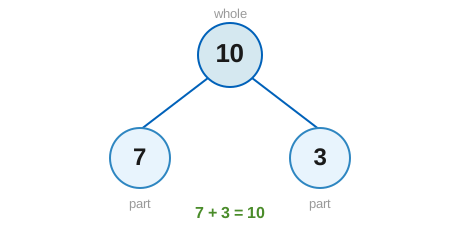 Number bond showing 10 split into 7 and 3, with the parts recombining to make ten
This single idea, that numbers come apart into useful pieces, is the seed for everything that follows.
For more on this strategy, see What Is Decomposing Numbers? A Parent's Guide to Breaking Apart Numbers.
Adding by place value (2nd grade)
The same breaking-apart move scales up. To add 247 + 36, a child splits each number by place, adds the hundreds, tens, and ones separately, then combines. That's partial sums, and it works because of the place-value understanding built the year before.
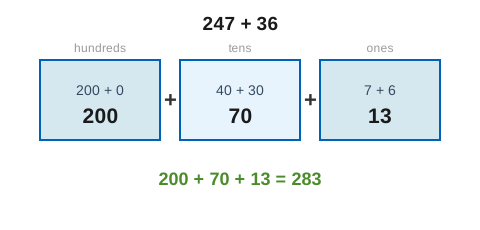 Partial sums for 247 + 36: hundreds 200, tens 70, ones 13, totaling 283
For more on this strategy, see What Is Partial Sums? A Parent's Guide to Adding by Place Value.
Multiplying with the area model (4th grade)
Breaking numbers apart now becomes a picture. To multiply 24 × 6, students draw a box, split 24 into 20 and 4, multiply each piece by 6, and add the results: 120 + 24 = 144.
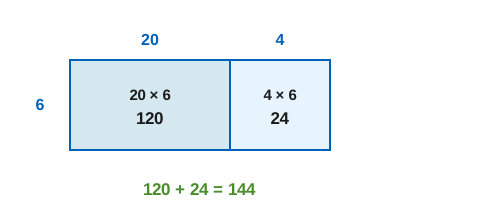 Area model for 24 times 6: a box split into 20 by 6 equals 120 and 4 by 6 equals 24, totaling 144
The same logic that broke 5 into 2 and 3 in first grade is now breaking 24 into 20 and 4.
For more on this strategy, see What Is the Area Model? A Parent's Guide to Box Multiplication.
Extending the number line to integers (6th grade)
The number line that placed 3/4 between 0 and 1 in third grade now stretches left of zero. To solve -3 + 5, a student starts at -3 and jumps 5 to the right, landing on 2.
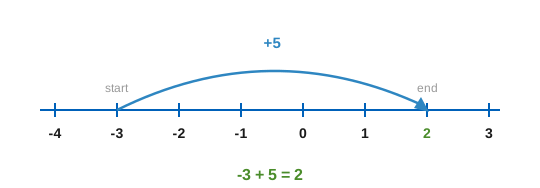 Number line from negative 4 to positive 3 showing a jump of 5 starting at negative 3 and landing on 2
The tool is the same one from elementary school, extended to handle negatives.
For more on this tool, see What Is a Number Line? A Parent's Guide to How Teachers Use It.
How This Connects to What You Already Know
You use most of these methods without naming them.
Making change is partial sums in reverse. When a $14 bill is paid with a $20, you count up: $14, then $1 to $15, then $5 to $20. You broke the gap into friendly pieces.
Doubling a recipe is proportional reasoning, the heart of 6th- and 7th-grade ratios. Two cups of flour to one of sugar stays the same relationship when you scale it to four and two.
Reading a thermometer in winter is the integer number line. You already know that -3 degrees is colder than 1 degree, and that warming up by 5 gets you to 2.
Splitting a check four ways is division and fractions working together, the same reasoning a 5th grader uses on fraction problems.
The difference is that today's students are taught to recognize and name these methods, so they can apply them deliberately rather than only reaching for them when a problem happens to be easy.
How to Help at Home
Find out where your child is in the progression
Before you help, figure out which method the worksheet is using. A 4th grader's multiplication page might want the area model, partial products, or the standard algorithm, and they're not interchangeable on a given assignment. Knowing where your child sits in the sequence tells you which tool to reach for.
Match the teacher's vocabulary
If the worksheet says "number bond," use those words, not "the circle thing." If it says "partial products," don't call it "the box." Using the same language the teacher uses keeps your help connected to what happened in class instead of adding a competing version your child has to reconcile.
Don't correct the method, even if yours is faster
When your child solves 24 × 6 with a box and you'd have stacked it, resist jumping in. The slower-looking method is building the understanding the fast one assumes. Let them finish their way, confirm the answer, and save your shortcut for a "want to see another way?" moment once they're solid.
Ask your child to teach you
"Show me how your teacher did it" does two things at once. It surfaces the method you need to match, and explaining a step out loud often shows a child the exact spot where they're stuck.
Keep the year's arc in mind
A method that feels pointless in isolation usually exists to set up next year. Drawing out every step of an area model in 4th grade is what makes the standard algorithm click in 5th. When a method seems slow, it's often laying track.
When you're stuck on tonight's homework, let Methodwise walk through it
When a problem stumps you both, open Methodwise, choose the subject and your child's grade, and it walks through the problem step by step using the method their teacher is using. You can even share a photo of the worksheet so it matches the exact model on the page.
Common Mistakes to Watch For
Teaching the standard algorithm too early
A common parent instinct is to skip the "slow" methods and show carrying or borrowing right away. The problem is that the shortcut hides the place-value reasoning the teacher is deliberately building. Wait until your child understands why the steps work, which is usually when the curriculum introduces the algorithm itself.
Treating a different method as a wrong method
When the homework method doesn't match how you learned it, it's easy to assume the school overcomplicated things. The visual methods reach the same answers and exist to build understanding. Match the worksheet rather than overriding it.
Confusing the parts and the whole in number bonds
In a number bond, the larger number on top is the whole and the two branches are the parts. Children often write a part where the whole goes, or add the whole to a part. When checking, ask "which number is the whole here?" before looking at the parts.
Skipping place value as "too basic"
Place value looks simple, so it's tempting to rush past it. But weak place-value understanding is a frequent reason multi-digit multiplication and decimals fall apart later. If 3rd- or 4th-grade work is shaky, it's worth checking whether the real gap is back in place value.
Assuming the grade list is a deadline
If your child sees a method a year earlier or later than this guide suggests, that's usually curriculum variation, not a problem. The sequence matters more than the exact timing.
Practice Questions
Try a few of these with your child, matched to roughly where they are. Answers are below.
Grades K–1: Breaking numbers apart and making ten
- Fill in the missing part: 10 = 6 + ___
- Solve 9 + 4 by first making a ten. What do you break the 4 into?
Grades 2–3: Place value and early multiplication
- Add 153 + 24 by breaking each number into hundreds, tens, and ones.
- Draw 3 × 5 as equal groups or an array. How many in total?
Grades 4–5: Area model and fractions
- Use an area model to solve 32 × 4.
- Add 1/4 + 1/2 by giving them the same denominator.
Grades 6–8: Ratios, integers, and slope
- A recipe uses 3 cups of flour to 2 cups of sugar. How much sugar for 9 cups of flour?
- Solve -5 + 8 using a number line.
Answers
- 10 = 6 + 4
- Break the 4 into 1 and 3: 9 + 1 = 10, then 10 + 3 = 13
- 100 + 50 + 3 and 0 + 20 + 4, so 100 + (50+20) + (3+4) = 100 + 70 + 7 = 177
- Three groups of five (or 3 rows of 5) = 15
- 30 × 4 = 120 and 2 × 4 = 8, so 120 + 8 = 128
- 1/2 = 2/4, so 1/4 + 2/4 = 3/4
- The ratio triples (3 cups to 9 cups), so sugar triples too: 2 × 3 = 6 cups
- Start at -5, jump 8 to the right, land on 3
Ready to try it with your child?
Open the chat, pick the subject and your child's grade, and get a step-by-step explanation you can use to help tonight.
Try 3 Questions Free — No Signup RequiredFrequently Asked Questions
Is this the same as Common Core, and does it apply if my state dropped Common Core?
Most of the methods in this guide come from the Common Core math standards, which the majority of states still use as the backbone of their math curriculum. Several states have rewritten or rebranded their standards (Florida's B.E.S.T., for example), but the grade-by-grade progression looks almost identical: place value first, then strategy-based operations, then fractions, then ratios and algebra. If your state has its own standards, the grade your child works on a given method might shift by a year, but the overall sequence will be familiar.
When will my child be allowed to use a calculator?
It varies by district, but calculators usually appear around 6th or 7th grade for problems where the point is the reasoning rather than the arithmetic, and most state tests have both calculator and non-calculator sections. In the elementary grades the goal is building number sense and fact fluency by hand first. Your school's syllabus or your child's teacher can tell you their specific policy.
Is 8th grade math the same as Algebra 1?
Usually not, though they overlap. Standard 8th grade math (functions, slope, linear equations, and an intro to systems of equations) is the on-ramp to Algebra 1, which most students take in 9th grade. Some students take Algebra 1 in 8th grade through an accelerated track. The course name on your child's schedule or report card will tell you which one they're in.
Do kids still need to memorize math facts and times tables?
Yes. Fluency with addition facts and multiplication tables still matters and is expected (multiplication facts through 10x10 by the end of 3rd grade). What changed is the order: kids first build an understanding of what multiplication means through groups and arrays, then commit the facts to memory so the memorization sticks to something. Short, regular practice still helps.
How do I find out which math curriculum my child's school uses?
Check the front of the homework packet or the textbook spine for a name like Eureka Math, Illustrative Mathematics, enVision, Bridges, or Go Math. Many districts also list their adopted curriculum on the school or district website. Knowing the curriculum name helps you search for the exact model your child is using.
Try Methodwise Free
When your child brings home math homework and you're not sure how to explain it the way their teacher would, Methodwise walks you through it, step by step, using the same method their teacher is using.
- Start with 3 free questions, no account needed
- Free plan: 15 questions/month after signup
- Plus plan: unlimited questions + saved chat history + 7-day free trial
- Step-by-step explanations the way teachers teach
Related Articles
-
What Is a Number Line? A Parent's Guide to How Teachers Use It
-
What Is Decomposing Numbers? A Parent's Guide to Breaking Apart Numbers
-
What Are Number Bonds? A Parent's Guide to Making and Breaking Numbers
-
What Is a Ten Frame? A Parent's Guide to the Box That Builds Number Sense
-
What Is Skip Counting? A Parent's Guide to How Counting by 2s, 5s, and 10s Becomes Times Tables
-
What Are Fact Families? A Parent's Guide to How Addition and Subtraction Connect
-
What Is Partial Sums Addition? A Parent's Guide to Why Your Child Doesn't 'Carry the One' Anymore
-
What Are Arrays in Math? A Parent's Guide to Visualizing Multiplication
-
What Is the Area Model? A Parent's Guide to Box Multiplication
-
What Is Partial Quotients Division? A Parent's Guide to the New Way Kids Learn Long Division
-
Fractions on a Number Line: A Parent's Guide to Why Pie Charts Aren't Enough
-
What Is a Tape Diagram? A Parent's Guide to Visualizing Word Problems
-
What Is the Standard Algorithm? A Parent's Guide to Why Your Child Learns the 'Long Way' First
-
What Are Ratios and Proportional Reasoning? A Parent's Guide to Middle School Math
-
What Are Common Core Math Methods? A Parent's Guide to How Math Is Taught Today
-
Homework Help Tools: Built for Kids vs. Built for Parents — What's the Difference?
-
What Are Mental Math Strategies? A Parent's Guide to How Kids Add and Subtract in Their Heads
Have questions about your child's math this year? Email me at hello@methodwise.co
About the Author
Samantha Black is the founder of Methodwise and an educator with over 15 years in higher education and instructional design. She built Methodwise after experiencing the homework gap firsthand as a parent of two K–8 daughters. Learn more about why we built Methodwise →