
Opinion Writing vs. Argument Writing: A Parent's Guide to the K–8 Writing Progression
June 1, 2026
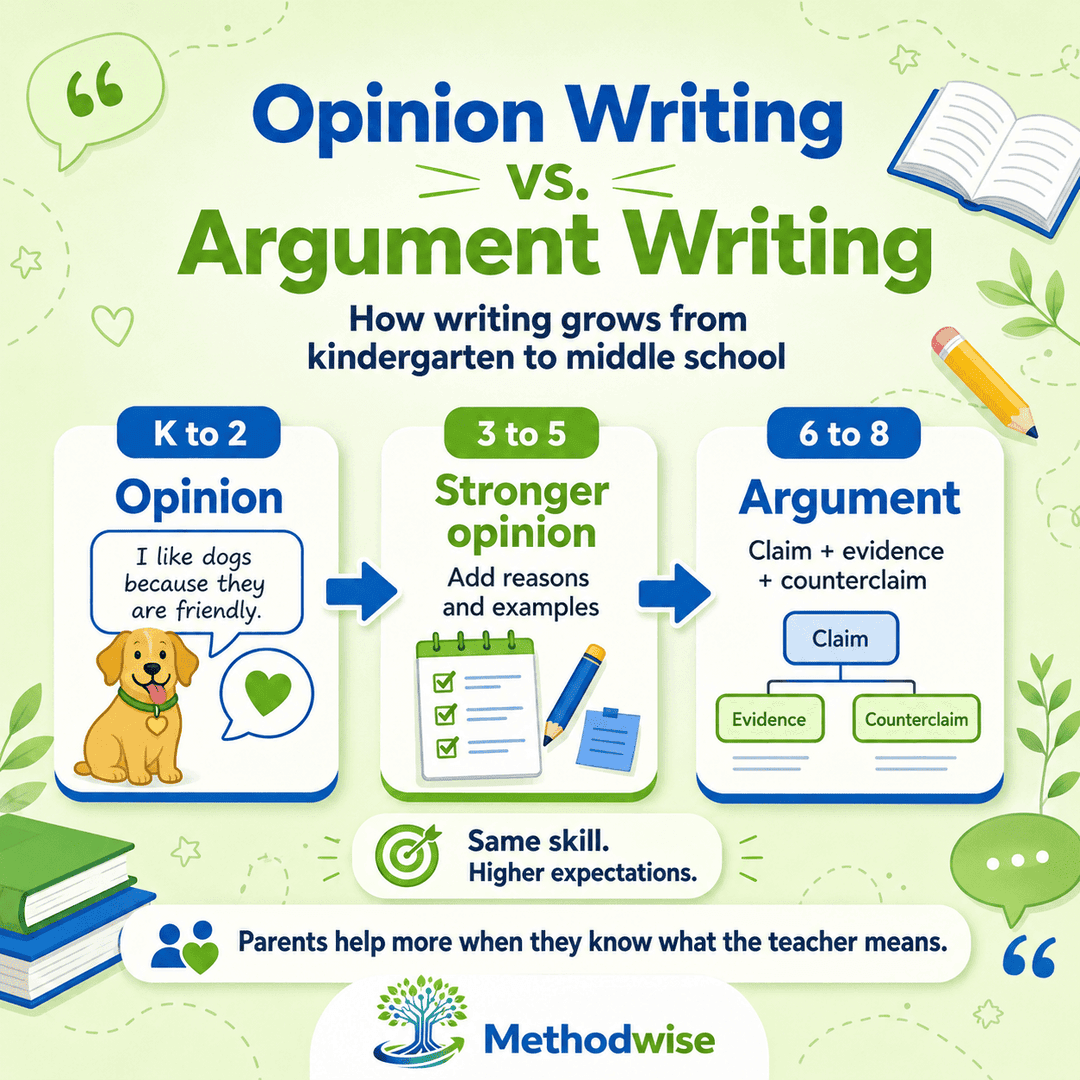
If your kindergartener brought home a paper that says "I like dogs because they are fluffy" and your 7th grader is writing an essay about school uniforms that has to "introduce a claim, acknowledge a counterclaim, and organize the evidence logically," you're looking at two ends of the same writing skill.
It doesn't always look that way. The kindergarten version sounds like a feeling. The 7th grade version sounds like a debate-team prep packet. But in today's classroom, they sit on a single line that Common Core calls Writing Standard 1, and the path between them is deliberate. Each grade adds one new requirement on top of the last.
Here's what changes between elementary and middle school, why teachers split it into two phases, and what to expect from each grade your child moves through.
What Is Opinion Writing?
Opinion writing is what your child is doing from kindergarten through 5th grade. The student picks a position (a favorite book, a preferred season, whether dogs are better than cats) and supports it with reasons. The reasons can come from personal experience, feelings, or general knowledge. The audience knows the writer is sharing a view, not making a formal case.
By the end of 5th grade, an opinion piece looks like a short essay: an introduction that states the opinion, a few paragraphs of reasons supported by facts and details, and a conclusion. The structure is real, but the support can still be personal.
What Is Argument Writing?
Argument writing is what starts in 6th grade and continues through high school. The student makes a claim, a defensible position about a topic that can be debated. The support is also different: evidence drawn from credible sources (texts, studies, quotations, data), not personal feelings or general experience.
By 7th grade, students also have to acknowledge a counterclaim, the opposing side of the argument, and by 8th grade they have to distinguish their claim from the counterclaim using evidence. The audience is no longer assumed to agree. The writer's job is to convince a reader who might think otherwise.
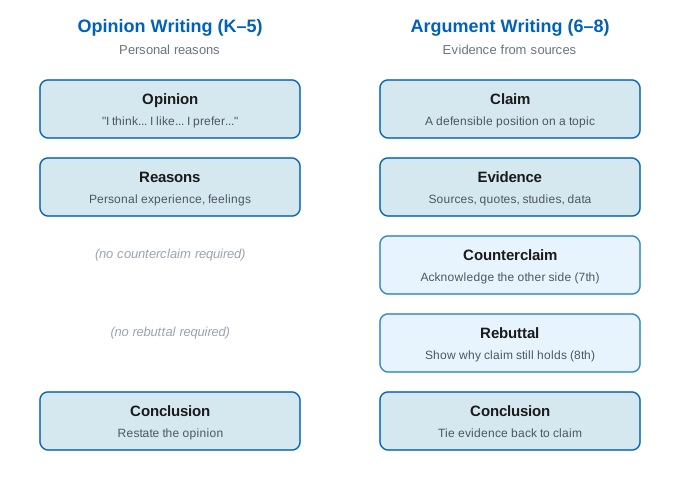 Side-by-side comparison of opinion writing structure (opinion, reasons, conclusion) and argument writing structure (claim, evidence, counterclaim, rebuttal, conclusion)
Stuck on tonight's homework?
Paste in the problem and get a step-by-step explanation in your child's grade level — using the same method their teacher uses.
Try 3 Questions Free — No Signup RequiredWhy Does Common Core Split Them This Way?
The progression looks like a vocabulary change, but it reflects a real change in how students are expected to think. Younger writers haven't done a lot of research yet, and pushing kindergartners to "support a claim with evidence from credible sources" would skip every step in between. Opinion writing lets young students practice the bones of an argument (take a position, give reasons, organize them, close them out) without needing source material they can't yet handle.
By 6th grade, students have spent six years reading nonfiction, citing text evidence, and learning what makes a source credible. They have the raw skills argument writing requires. The shift from opinion to argument formalizes what they've been building toward.
The change also reflects what writing looks like outside school. A Yelp review is opinion writing: personal taste, a few reasons, a star rating. A position paper, a legal brief, a published op-ed, a research-backed pitch deck: these are arguments. Both are useful. Students need to know how each one works and when to use which.
For more on how teachers build the evidence habit before formal argument writing starts, see What Is Citing Evidence? A Parent's Guide to Text Evidence in K–8.
What Grade Is Each Stage Taught?
The K–8 arc adds one new requirement each year. Skipping a grade in this list usually means skipping a foundational skill, which is part of why teachers stay on each step instead of jumping ahead.
Kindergarten: "I like dogs because…"
Students share an opinion using a mix of drawing, dictating, and writing. The opinion can be about a topic (favorite animal) or a book (whether they liked the story). They may or may not give a reason, depending on where they are in their writing development. The goal is naming a preference and starting to explain it.
1st Grade: Opinion plus a reason plus a closing
Students write a short opinion piece that names the topic or book, states an opinion, gives a reason, and provides some sense of closure. A first-grade opinion piece might be three or four sentences: "My favorite season is summer. I like summer because we go to the beach. Summer is the best season."
2nd Grade: Opinion with linking words
Students give multiple reasons and connect them to the opinion using linking words like because, and, and also. They also write a real concluding sentence. This is the first year linking words appear by name in the standard, and they're the building blocks of every essay that comes later.
3rd Grade: Linking phrases and a clear structure
Linking words expand into linking phrases (for example, therefore, since). Students now organize their reasons in a way that makes sense to a reader, which usually means writing an introduction, body, and conclusion as separate paragraphs for the first time.
4th Grade: Reasons supported by facts and details
The big shift. Reasons can no longer just stand alone. Each reason needs to be backed by facts or details that show why it holds up. A 4th grader writing about why recess should be longer can't just say "because recess is fun." They need to show what kids actually do at recess, how it affects the rest of the school day, and why the time matters.
5th Grade: Logically ordered reasons
Same elements as 4th grade, but the reasons now have to be logically ordered. The strongest reason might go last, or the order might follow cause-and-effect, or move from least to most important. Students learn to think about which reason should come first and why.
6th Grade: Arguments, claims, and evidence
The vocabulary changes. Students now write arguments to support claims using relevant evidence. Evidence comes from sources, not personal experience. Students also start using a more formal style: less I think, more direct statement of the position. This is the year a writing assignment can suddenly look unrecognizable to a parent who remembers a 5th-grade opinion piece from the year before.
7th Grade: Counterclaims enter the picture
Students still write arguments, but now they have to acknowledge alternate or opposing claims. A 7th-grade essay on whether middle schoolers should have homework has to recognize that some people think homework helps and some think it hurts. Acknowledging the counterclaim is not the same as agreeing with it; it's showing the reader that the writer has considered both sides.
8th Grade: Distinguished claims and counterclaims
Acknowledging the counterclaim is no longer enough. Students now distinguish their claim from the counterclaim, organize reasons and evidence logically, and use evidence to show why their position is stronger. This is the structure students will keep building on through high school and beyond.
If your child is working at any of these stages, the assignment is developmentally appropriate and part of a sequence designed to build on what they already know.
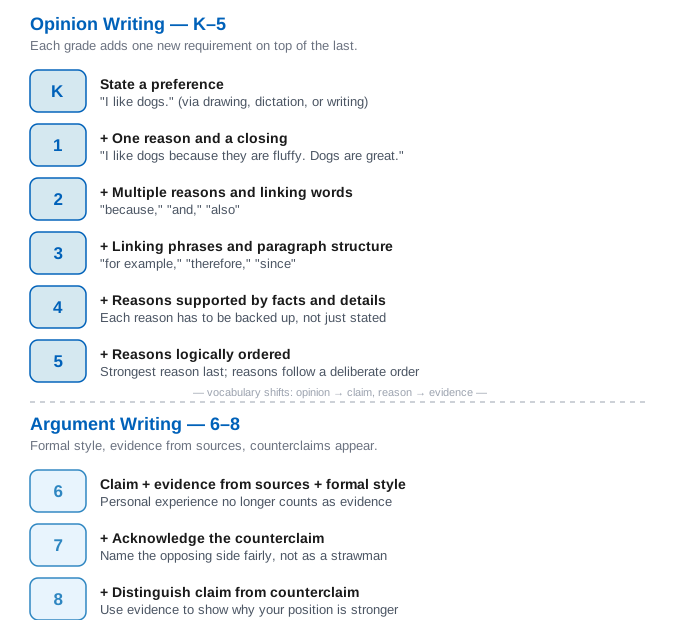 K-8 progression of opinion to argument writing showing the new requirement added at each grade level
How Opinion Writing Works (K–5)
Here's what opinion writing looks like at three points along the elementary arc.
Kindergarten or 1st grade
Prompt: What is your favorite season, and why?
A first-grade response might be:
My favorite season is fall. I like fall because the leaves change color. Fall is my favorite.
That's the standard at its full development for 1st grade: topic (favorite season), opinion (fall), reason (leaves change color), closing (fall is my favorite). The student isn't expected to do more than this.
3rd grade
Prompt: Should students be allowed to bring phones to school?
A 3rd-grade response gets longer and uses linking words to connect the parts:
Students should be allowed to bring phones to school. For example, students can call their parents if there is an emergency. Also, students can use phones to look up information for school projects. Therefore, schools should let students bring phones.
The opinion is clearly stated. Two reasons are linked with phrases (for example, also). The closing restates the position. The reasons are still general, but the structure is now visible.
5th grade
Prompt: Should fifth graders have a longer lunch period?
A 5th-grade response adds facts and details and orders the reasons:
Fifth graders should have a longer lunch period. Right now, lunch is only 20 minutes, which is barely enough time to walk to the cafeteria, get food, and eat. Many students don't finish their meals, which means they're hungry by the time afternoon classes start. A longer lunch would also give kids a chance to socialize and reset before the second half of the day, which research has shown improves focus. The strongest reason for a longer lunch is that students simply can't eat a healthy meal in 20 minutes. For these reasons, the school should add at least ten more minutes to the lunch period.
The piece states an opinion, supports each reason with a specific detail, references general research, and saves the strongest reason for last. The student isn't required to cite a source yet, but they are expected to explain why each reason matters.
For a look at the flip side, how students learn to recognize when an author is making a case in something they're reading, see Author's Purpose vs. Point of View: A Parent's Guide to PIE, Narrators, and Perspective.
How Argument Writing Works (6–8)
In middle school, the same topic looks different. Here's the same kind of position taken at three argument-writing grade levels.
6th grade: Claim plus evidence
Prompt: Should middle schools start later in the morning?
A 6th-grade argument might begin:
Middle schools should start at 8:30 a.m. or later. According to the American Academy of Pediatrics, teenagers' natural sleep cycles shift in early adolescence, making it difficult for them to fall asleep before 11 p.m. When schools start at 7:30 a.m., students are often sleep-deprived, which research links to lower test scores and more car accidents among teen drivers. Schools that have shifted to later start times report higher attendance and improved grades.
The opinion is now a claim, the support is evidence from sources (a named organization, research findings), and the language is more formal. The student is still defending a position, but the supports are external rather than personal.
7th grade: Claim plus counterclaim
The same essay now has to recognize the other side. The 7th-grade version adds a paragraph like:
Some parents argue that later start times disrupt family schedules, especially when parents need to leave for work before students leave for school. This is a real concern, and some districts have addressed it by adjusting bus schedules and after-school programs to fit the later start. The benefits to student health and academic performance still outweigh the scheduling challenges for most families.
The student names the counterclaim fairly (not as a strawman), acknowledges it has weight, and then explains why the original claim still holds. The argument is stronger because it accounts for the disagreement instead of pretending it doesn't exist.
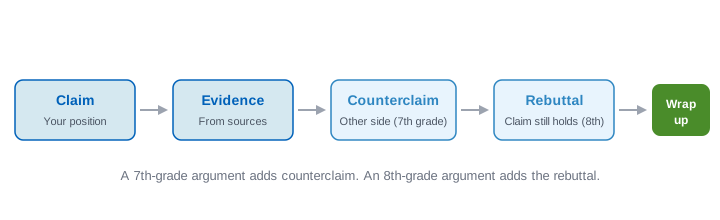 Diagram of an argument structure showing claim, evidence, counterclaim acknowledgment, and rebuttal flowing together
8th grade: Distinguished claims
By 8th grade, acknowledging the counterclaim isn't enough. The student has to distinguish their claim from the counterclaim and use evidence to show why their position is stronger.
While the scheduling concerns raised by some parents are valid, they describe a logistical challenge that can be solved through planning. The health and academic consequences of early start times, on the other hand, are documented across multiple studies and affect students directly during the school day. A logistical inconvenience is not the same as a measurable harm to student wellbeing, and schools should make decisions based on what serves students first.
The student is now making a comparative judgment. The work has moved from "my side is right" to "here is why my side weighs more than the counterclaim, supported by evidence." That's the skill that carries into high school argumentative essays, SAT writing, and most of the writing students will do in college.
How This Connects to What You Already Know
You use the opinion-to-argument progression every week without naming it.
When you tell a friend about a movie you loved, that's opinion writing. You give a reason or two, you don't bother citing sources, you're not trying to talk them out of liking a different movie. You expect the friend to either agree, disagree, or shrug.
When you write a Yelp or Amazon review, you're still in opinion writing. You name the thing, state your view, give reasons, and close.
When you're trying to convince your partner to make a major financial decision, you've moved into argument writing. You have to bring in real information (the actual numbers, the comparison to alternatives, the research you did), and you have to address their concerns up front instead of pretending they don't exist. That's a counterclaim acknowledgment, even though nobody calls it that at the kitchen table.
When a doctor explains a treatment recommendation, when a lawyer writes a brief, when a journalist writes an op-ed: those are all argument writing. The skill your 7th grader is practicing is the same skill those adults use every day at work.
The difference is that today's students are taught to recognize and name each structure, so they can apply it deliberately rather than stumbling into the right shape on a topic they happen to feel strongly about.
Watch: Opinion vs. Argument Writing Explained
How to Help at Home
Match the vocabulary the teacher is using
If your 4th grader's assignment uses opinion and reasons, use those words. If your 7th grader's rubric uses claim, evidence, and counterclaim, use those words. The vocabulary isn't decorative. Each term cues a specific kind of thinking, and using the wrong word at home can make the work harder when the child sits back down at school.
Brainstorm aloud before they write
A lot of writing trouble is actually thinking trouble. Before the pencil moves, ask your child to talk through their position. What do you think? Why? What's a reason that supports that? What's another reason? For middle schoolers, add: What would someone who disagrees say? You're not writing the piece for them. You're helping them get the ideas out of their head and into a usable form.
Don't push argument structure too early
If your 3rd grader is writing an opinion piece, they don't need to "address the counterclaim." Trying to teach a 9-year-old to argue against themselves usually creates confusion, not skill. The progression exists for a reason, and the 7th-grade version of the skill builds on the 5th-grade version. Help them do the assignment in front of them, not the assignment they'll see in three years.
Read real-world examples together
Yelp reviews, Amazon reviews, and movie reviews are opinion writing in the wild. Op-eds, position papers, and product comparison articles are argument writing in the wild. Pull up one of each on your phone and read it with your child. Ask them to spot the opinion or the claim, name the reasons or evidence, and find where the writer addresses the other side (if they do).
For middle schoolers, hunt for the counterclaim together
The counterclaim is the part students skip most often, partly because finding it requires thinking about people who disagree with them. Before your 7th or 8th grader writes their argument, ask: Who would push back on this? What would they say? What's the strongest version of their position? Make the counterclaim a real person in the conversation, not a sentence to be checked off.
Let Methodwise walk through it
If your child is stuck on an opinion or argument writing assignment and you're not sure how to coach them through the structure their teacher is asking for, paste the prompt and the rubric into Methodwise and it will walk through it using the same vocabulary the teacher uses, at the right grade level, with examples your child can follow.
Common Mistakes to Watch For
Treating opinion and argument as the same kind of writing
The most common mistake at the 5th-to-6th-grade transition is assuming the new "argument essay" is just a longer opinion essay. It isn't. The evidence requirement, the formal style, and the eventual counterclaim are real differences that show up on rubrics. If your 6th grader is writing arguments the way they wrote 5th-grade opinion pieces, the grade will reflect that.
Using personal experience as evidence in argument writing
A 6th grader might write "School should start later because I am tired in the morning." That's a reason in opinion writing, and a weak piece of support in argument writing. By middle school, the expectation is that evidence comes from somewhere outside the writer: a study, an expert, a quoted source, or specific examples that aren't just me. Help your child notice when their support is personal and when it's external.
Forgetting the counterclaim in 7th and 8th grade
Students often skip the counterclaim because addressing the other side feels like weakening their own position. The opposite is true on a rubric: a missing counterclaim usually drops the score by a full level. If your child's draft doesn't have a counterclaim, ask them to add one before they hand it in.
Confusing the topic with the claim
The topic of an essay might be school uniforms. The claim is the position the writer is taking about school uniforms: "School uniforms should not be required in public middle schools." Students sometimes state the topic and forget to state the position. If your child can't finish the sentence "I am arguing that..." in one clear statement, they don't have a claim yet.
Treating the counterclaim as a strawman
When a 7th grader does include a counterclaim, they sometimes pick the weakest possible version of the opposing argument so it's easy to knock down. Teachers see this and grade it down. The point of the counterclaim is to show real consideration of the other side, which means picking a version that someone who actually disagrees would recognize.
Practice Questions
Try these with your child at the right grade level. Sample responses are below.
Grades K–1: Opinion with a reason:
- What is your favorite snack? Write one sentence with your opinion and a reason why.
- Should kids be allowed to have a pet at home? Tell what you think and one reason.
Grades 2–3: Opinion with linking words:
- Should homework be assigned over the weekend? State your opinion and give two reasons using because and also.
Grades 4–5: Opinion with facts and details:
- Should screen time on school nights be limited? State your opinion, give two reasons, and support each reason with a specific detail or example.
Grades 6–7: Argument with a claim and evidence:
- Should middle schools require students to learn a second language? Write a claim and support it with two pieces of evidence (you can imagine the sources if you don't have time to look them up).
Grade 7–8: Argument with a counterclaim:
- Should middle schools allow phones in classrooms during the school day? Write a claim, give one piece of evidence, then acknowledge a counterclaim and respond to it.
Answers
-
Sample: My favorite snack is apples. I like apples because they are crunchy.
-
Sample: Kids should be allowed to have a pet. Pets are fun to play with.
-
Sample: Homework should not be assigned over the weekend. Kids work hard all week and need a break, because they need rest to do well in school. Also, weekends are when families spend time together, and homework gets in the way. Weekends should be for resting and family time.
-
Sample: Screen time on school nights should be limited. First, too much screen time keeps kids up late. Many studies have found that screens at night make it harder to fall asleep, which means students are tired the next morning. Second, kids who spend hours on screens have less time for reading, homework, and family. A weeknight limit of one or two hours leaves room for the other things that matter.
-
Sample claim: Middle schools should require students to learn a second language. Evidence 1: Research from the American Council on the Teaching of Foreign Languages shows that students who study a second language perform better on standardized tests, including in English. Evidence 2: The U.S. Bureau of Labor Statistics projects that bilingual workers will be in higher demand over the next decade, especially in healthcare, education, and customer service. Starting in middle school gives students more years to reach real proficiency.
-
Sample claim: Phones should not be allowed in middle school classrooms during the school day. Evidence: A 2024 study found that students in classrooms with phones reported more difficulty focusing and lower retention of new material than students in phone-free classrooms. Counterclaim: Some parents argue that phones are necessary so they can contact their child during the day, and so students can use phone-based tools for schoolwork. Response: These are real concerns, but front offices and school-provided devices can handle both. Parents can reach the office in an emergency, and most schools already provide laptops or tablets for academic work. The focus benefits of a phone-free classroom outweigh the convenience of having a phone in hand.
Ready to try it with your child?
Open the chat, pick the subject and your child's grade, and get a step-by-step explanation you can use to help tonight.
Try 3 Questions Free — No Signup RequiredFrequently Asked Questions
How is opinion or argument writing typically graded?
Most teachers use a rubric with categories like focus (is there a clear opinion or claim?), support (are the reasons or evidence strong enough?), organization (does the piece flow logically?), and language (are linking words or formal vocabulary used correctly?). Argument-writing rubrics in middle school usually include a counterclaim category starting in 7th grade. If your child brings home a low score, the rubric will usually show which category dropped, which makes a revision much more targeted than rewriting the whole piece.
Is persuasive writing the same as opinion or argument writing?
Persuasive writing is the older term, and Common Core replaced it with opinion (K–5) and argument (6–12). Persuasive writing focused on convincing the reader using any tools that work, including emotional appeals. Argument writing is more disciplined: it uses logic and evidence to support a claim, acknowledges opposing views, and aims to inform the reader's thinking rather than just sway it. If your child's teacher still says 'persuasive writing,' they usually mean opinion or argument depending on the grade.
When does my child need to start citing sources?
Formal source citation typically starts in 6th grade with argument writing. Before that, 4th and 5th graders are asked to support reasons with facts and details, which may come from reading they've done in class, but bibliography-style citation isn't required yet. By 7th grade, many teachers ask for in-text references like 'According to a 2024 study by…' By 8th grade, a works-cited list or bibliography usually appears on the rubric. If your child's teacher expects citations earlier than 6th grade, that's a specific classroom expectation worth asking about.
Can younger kids practice counterclaims early?
They can practice the thinking, but they aren't expected to include counterclaims in their writing until 7th grade. Younger students benefit from being asked 'What might someone who disagrees say?' as a discussion question. This builds the habit of considering other perspectives, which makes the formal counterclaim work easier in middle school. Pushing the full structure too early often frustrates kids who are still mastering opinion-with-reasons.
What counts as a credible source for middle school argument writing?
Most teachers accept news sites with editorial standards (major newspapers, established magazines), academic or government sources (.edu, .gov), peer-reviewed studies summarized for a general audience, and books by recognized experts. Less reliable: random blogs, AI-generated content, Wikipedia as a primary source (though Wikipedia's own citations can be useful), and one-off social media posts. A quick credibility check: can your child find the author's name and credentials, and does the site have an 'About' page that explains who runs it? Many schools provide access to databases like JSTOR or Gale; ask the school librarian if you're not sure what's available.
What if my child writes 'I think' or 'I believe' in argument writing?
Some teachers allow it, but many ask students to drop first-person phrases in formal argument writing starting in middle school. The reasoning is that an argument should stand on its evidence, not on a claim of personal belief. Instead of 'I think school uniforms are unfair,' the argument version is 'School uniforms limit students' ability to express identity, and research suggests this affects engagement.' If you're not sure what's expected, check the rubric the teacher provided.
What's a thesis statement, and is it the same as a claim?
In middle school argument writing, the thesis statement and the claim are usually the same thing: a single sentence that states the position the rest of the essay will defend. Some teachers reserve 'thesis' for a longer, multi-part statement that previews the supporting reasons too. By high school, 'thesis statement' becomes the more common term. In 6th–8th grade, if a rubric asks for either one, your child can treat them as the same.
Try Methodwise Free
When your child brings home an opinion or argument writing assignment and you're not sure how to coach them through the structure their teacher is asking for, Methodwise walks you through it, step by step, using the same vocabulary their teacher is using.
- Start with 3 free questions, no account needed
- Free plan: 15 questions/month after signup
- Plus plan: unlimited questions + saved chat history + 7-day free trial
- Step-by-step explanations the way teachers teach
Related Articles
-
What Is Citing Evidence? A Parent's Guide to Text Evidence in Reading and Writing
-
Author's Purpose vs. Point of View: A Parent's Guide to PIE, Narrators, and Perspective
-
What Is Text Structure? A Parent's Guide to How Nonfiction Is Organized
-
What Are Text Features? A Parent's Guide to Nonfiction Reading
-
Reading Comprehension Strategies: A Parent's Guide to How Teachers Teach Reading
-
Main Idea vs. Theme: What Your Child's Teacher Actually Means
-
What Is Close Reading? A Parent's Guide to Deeper Comprehension
-
Reading Levels Explained: Lexile, F&P, and DRA in Plain English
-
What Is Making Inferences? A Parent's Guide to Reading Between the Lines
-
What Are Context Clues? A Parent's Guide to How Kids Figure Out New Words Without a Dictionary
-
Homework Help Tools: Built for Kids vs. Built for Parents — What's the Difference?
-
Summarizing vs. Retelling: A Parent's Guide to Why the Teacher Keeps Saying 'Too Many Details'
-
What Are Story Elements? A Parent's Guide to Characters, Setting, Problem, and Solution
-
What Is Phonemic Awareness? A Parent's Guide to Playing With Sounds Before Reading
Have questions about opinion and argument writing? Email me at hello@methodwise.co
About the Author
Samantha Black is the founder of Methodwise and an educator with over 15 years in higher education and instructional design. She built Methodwise after experiencing the homework gap firsthand as a parent of two K–8 daughters. Learn more about why we built Methodwise →