
Reading Levels Explained: Lexile, F&P, and DRA in Plain English
April 13, 2026
Your child comes home with a report card that says "Lexile 540L" or a reading folder labeled "Level M" — and you have no idea whether that's good, bad, or somewhere in between. Maybe you've seen the letters DRA on an assessment sheet, or a teacher mentioned your child is "on level" without explaining what level that actually is.
You're not alone. Schools use at least three major reading level systems, and none of them come with a parent-friendly instruction manual. The good news: once you understand what each system measures and how they roughly compare, those letters and numbers start making a lot more sense.
What Are Reading Levels?
Reading levels are systems that teachers and schools use to match students with books they can read successfully — not too easy, not too frustrating, but in the productive zone where real learning happens. Think of them like shoe sizes: they help find the right fit, but they're not a judgment of your child's intelligence or potential.
The three most common systems in U.S. schools are Lexile (a numeric score like 650L), Fountas & Pinnell or F&P (a letter from A to Z), and DRA (A, then a numeric level 1 to 80). Each one measures reading ability, but they approach it from different angles — which is why a single child can have what looks like three different "scores."
Why Do Schools Use Reading Levels?
If you grew up picking books off a shelf by whatever looked interesting, the idea of assigning a number to every book your child reads might feel strange. But reading levels solve a real problem: they help teachers put the right book in front of the right kid at the right time.
Research consistently shows that students grow the most as readers when they're working with texts that are challenging but not overwhelming — what educators call the "instructional level." Too easy, and there's nothing new to learn. Too hard, and comprehension collapses. Reading levels give teachers a way to find that sweet spot for each student, even in a classroom of 25 kids who are all in different places.
The reason there are multiple systems rather than just one is that different assessments were developed by different organizations, each with their own philosophy about what matters most in reading. Some schools pick one system; others use two. There isn't one that is "better" — they're just different lenses on the same thing.
Stuck on tonight's homework?
Paste in the problem and get a step-by-step explanation in your child's grade level — using the same method their teacher uses.
Try 3 Questions Free — No Signup RequiredWhat Grade Is Each Reading Level System Used?
Kindergarten–2nd Grade — Where Levels Are Introduced
This is where most families first encounter reading levels. Teachers typically assess students one-on-one using F&P or DRA, listening to them read aloud and noting accuracy, fluency, and comprehension. Lexile scores may appear if your school uses standardized assessments test like MAP, STAR, DIBELS, or I-ready.
At this stage, levels change rapidly. A kindergartner might jump several F&P levels in a single semester, which is completely normal.
3rd–5th Grade — Levels Become More Familiar
By now your child probably knows their own reading level and may talk about it at home. Lexile scores become more common as students take standardized tests. F&P and DRA continue in many classrooms, though some schools shift to relying primarily on Lexile in upper elementary.
Growth between levels slows down compared to K–2, which is also normal — the jumps between levels represent larger leaps in text complexity.
6th–8th Grade — Levels Shift to Lexile
In middle school, F&P and DRA are used less often. Lexile becomes the dominant system because it connects directly to standardized test scores and can measure texts all the way through adulthood. Your child's teacher may reference Lexile ranges when recommending books or assigning independent reading.
If your child is working with reading levels at any of these stages, it's developmentally appropriate and part of a deliberate progression.
How Each Reading Level System Works
Lexile: The Numeric Score
The Lexile Framework, developed by MetaMetrics, assigns a number to both readers and books. A student's Lexile measure comes from a standardized test (MAP, STAR, DIBELS, iReady), and books are rated based on sentence length and word frequency.
Here's how it works: if your child scores 650L, that means they can read a 650L book with about 75% comprehension — challenging enough to learn, but not so hard they're lost. Their "sweet spot" for independent reading is typically 100L below to 50L above their score (so 550L–700L for a 650L reader).
What the ranges look like by grade:
- Kindergarten: BR (Beginning Reader) to 300L
- 1st Grade: 200L–500L
- 2nd Grade: 300L–600L
- 3rd Grade: 500L–800L
- 4th Grade: 600L–900L
- 5th Grade: 700L–1000L
- 6th Grade: 800L–1050L
- 7th Grade: 850L–1100L
- 8th Grade: 900L–1150L
The "BR" designation stands for Beginning Reader and applies to early texts that don't yet register on the numeric scale. You might also see numbers with an "AD" prefix (like AD400L), which means "Adult Directed" — books meant to be read aloud to a child rather than by the child independently.
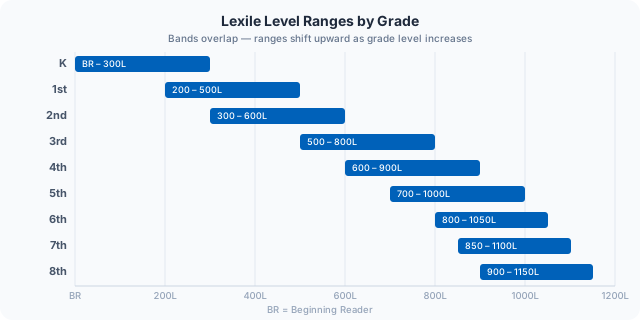 Lexile level ranges by grade: a horizontal bar chart showing overlapping Lexile bands from Kindergarten through 8th grade
For more on how reading connects to other ELA skills, see the Methodwise blog for more parent guides.
Fountas & Pinnell (F&P): The Letter Levels
Fountas & Pinnell Guided Reading Levels use letters from A to Z (and beyond, with Z+). Unlike Lexile, which relies on a formula, F&P levels are assigned by analyzing a book across multiple dimensions: meaning, sentence structure, vocabulary, text features, illustrations, and more. A teacher then assesses your child through a one-on-one running record — listening to them read aloud and asking comprehension questions.
What the letters mean by grade:
- Kindergarten: A–D
- 1st Grade: D–J
- 2nd Grade: J–M
- 3rd Grade: M–P
- 4th Grade: P–S
- 5th Grade: S–V
- 6th Grade: V–Y
- 7th–8th Grade: Y–Z+
The personal, observational nature of F&P is its strength. A teacher doesn't just know your child's letter — they know why your child is at that level. Maybe they decode well but struggle with inference. Maybe their fluency is strong but they rush past unfamiliar vocabulary. That kind of detail doesn't show up in a Lexile score.
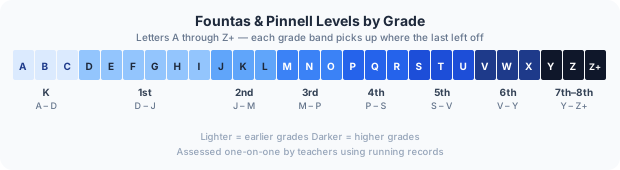 Fountas & Pinnell levels by grade: a letter gradient from A to Z+ showing which letters correspond to each grade band
DRA: The Number Assessment
The Developmental Reading Assessment (DRA), published by Pearson, combines elements of both systems. It assigns a numeric level (A, then 1–80) based on one-on-one assessment where the teacher evaluates reading accuracy, fluency, and comprehension together.
What the numbers mean by grade:
- Kindergarten: A–4
- 1st Grade: 4–16
- 2nd Grade: 16–28
- 3rd Grade: 28–38
- 4th Grade: 38–40
- 5th Grade: 40–50
- 6th Grade: 50–60
- 7th–8th Grade: 60–80
DRA is especially common in K–3 classrooms. Like F&P, it gives teachers rich qualitative information because they're sitting with the child, observing in real time. Many schools use DRA in early grades and transition to Lexile as students move into standardized testing.
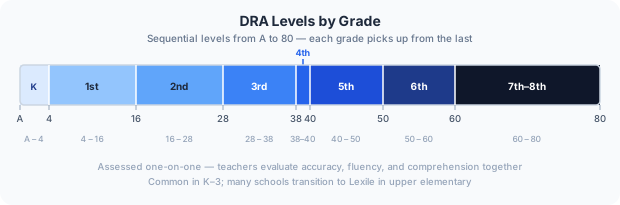 DRA levels by grade: a number scale from A to 80 showing grade-band ranges
How Reading Levels Connect to What You Already Know
You already think in "levels" more than you realize. When you pick a podcast, you instinctively know whether it's light listening or something you need to concentrate on. When you choose a book for your child at the library, you flip to a page and gauge whether it's going to be a stretch or a breeze. When you pick a movie for family night, you factor in who can follow the plot and who'll get lost.
That's exactly what reading levels do — they formalize the instinct you already have about matching difficulty to the reader. The difference is that teachers have systematic tools to do this across an entire classroom, while you do it intuitively for the people you know well.
You probably also already adjust how you help based on difficulty. If your child is reading something easy, you let them go. If it's hard, you sit closer, help with tricky words, and ask questions along the way. That's the instructional level in action — you just never called it that.
The difference is that today's students are taught to recognize where they are as readers and choose books that fit, so they can grow deliberately rather than only reading what happens to land in front of them.
Watch: Reading Levels Explained
How to Help at Home
Ask your child's teacher which system they use
Don't try to figure this out from the report card alone. A quick email — "Can you help me understand what Level M means for my child's reading?" — gives you context no chart can provide. Teachers appreciate when parents ask.
Focus on the trend, not the number
A single reading level is a snapshot. What matters is whether your child is growing over time. Ask at conferences: "How has their level changed since the beginning of the year?" That tells you far more than any individual score.
Don't restrict books to "their level"
Reading levels are a teaching tool, not a bookshelf police force. Your child should absolutely read books above and below their assessed level. Easy books build fluency and confidence. Hard books (especially read together) build vocabulary and curiosity. The assessed level is for instructional planning, not for limiting what your child can enjoy.
Use the right vocabulary
If your child says "I'm a Level M," they're using their teacher's language. Match it. Saying "Oh, you're reading at a 3rd-grade level" when their teacher uses F&P letters creates unnecessary confusion. Mirror the system your child's school uses.
Avoid comparing levels across systems
A Lexile score and an F&P letter measure different things. Trying to convert one to the other and then worrying about discrepancies will drive you crazy. Trust each assessment for what it's designed to measure.
Let Methodwise walk through it
When your child brings home a reading comprehension assignment or a response-to-reading question and you're not sure how to help, Methodwise can walk you through the approach their teacher is using — step by step, in plain language.
Common Mistakes to Watch For
Treating the level as a label
Reading levels are diagnostic tools, not identity markers. When a child says "I'm just a Level J" with resignation, that's a sign the level has become a label rather than a guide. Remind your child (and yourself) that levels change — that's the whole point.
Panicking about being "below grade level"
Grade-level benchmarks represent the middle of a wide range. Being one or two levels below benchmark — especially in K–2 — is incredibly common and doesn't mean your child is falling behind permanently. Talk to the teacher about what support is in place and what you can do at home.
Comparing your child to classmates
Reading development isn't a race with a fixed finish line. Children develop at different rates, and a child who's "behind" in 1st grade may catch up entirely by 3rd. Comparison creates anxiety for both you and your child, and anxiety is the enemy of reading enjoyment.
Assuming higher level = smarter child
A high reading level means a child can decode and comprehend complex text. It doesn't mean they have better critical thinking, deeper emotional intelligence, or greater academic potential. Some brilliant kids are average readers. Some strong readers struggle in other areas. The level measures one specific skill.
Refusing to let your child read "easy" books
If your 5th-grader wants to reread a Diary of a Wimpy Kid book that's technically below their level, let them. Rereading familiar, enjoyable books builds fluency, reinforces vocabulary, and — most importantly — keeps reading fun. A child who loves reading will always outgrow a child who's forced to read "at level."
Practice Questions
Try these with your child. They're not about measuring a level — they're about practicing the skills that reading assessments look for.
Comprehension check (Grades 2–4):
- Read a page from your child's current book together. Ask: "What just happened?" (literal comprehension) Then ask: "Why do you think the character did that?" (inferential comprehension)
- Before turning the page, ask: "What do you think will happen next? What makes you think so?" (prediction with evidence)
- After finishing a chapter, ask: "What was the most important thing that happened? How do you know it's the most important?" (summarizing and evaluating)
Fluency check (Grades 1–3):
- Have your child read a familiar page aloud. Listen for: Are they reading in phrases or word-by-word? Do they pause at periods? Does their voice go up at question marks? (These are the fluency markers teachers assess in F&P and DRA.)
- If they stumble on a word, wait 3 seconds before helping. Do they try to sound it out? Skip it and come back? Use the picture or context? (This shows you their decoding strategies.)
Vocabulary in context (Grades 3–6):
- Find a word in the text your child doesn't know. Ask: "What do you think that word means based on the sentence around it?" Then look it up together. (Context clue use — a key skill at every reading level.)
Answers
These are open-ended questions, so there aren't single "right" answers. What you're looking for is whether your child can explain their thinking, point to evidence in the text, and make reasonable inferences. If they can do those three things, they're building the skills that drive reading level growth — regardless of what letter or number they've been assigned.
Ready to try it with your child?
Open the chat, pick the subject and your child's grade, and get a step-by-step explanation you can use to help tonight.
Try 3 Questions Free — No Signup RequiredFrequently Asked Questions
Why does my child get different reading levels on different assessments?
Because Lexile, F&P, and DRA measure reading through different methods — and they don't always produce the same result. A standardized test gives a Lexile score based on how your child performs on reading passages. A teacher gives an F&P or DRA level based on watching your child read aloud one-on-one. Different conditions, different moments, different frameworks. It's common for a child to have a Lexile score, an F&P letter, and a DRA number that don't line up precisely — that's expected, not a red flag.
Which reading level system does my child's school use?
Most schools use one or two systems. F&P and DRA are common in elementary classrooms because they involve one-on-one teacher observation. Lexile scores often come from standardized tests like MAP, STAR, or state assessments. Check your child's report card or ask their teacher which system they use.
Can I convert between Lexile, F&P, and DRA?
Roughly, yes — but not precisely. Conversion charts exist, but the systems measure different things, so a 'Level M' in F&P and a '600L' in Lexile aren't identical. Use conversion charts as general guides, not exact translations.
What does 'reading at grade level' actually mean?
It means your child can read and understand texts that are typical for their grade — not that every book at that level is easy. A student reading 'at level' should comprehend about 75–90% of grade-appropriate material independently.
Should I be worried if my child's reading level is below grade level?
Not necessarily. Reading levels fluctuate, especially in early grades. A below-level score is a snapshot, not a verdict. Talk to your child's teacher about the trend over time — that matters more than any single score.
How can Methodwise help with reading levels?
Methodwise explains ELA concepts and homework using the same methods your child's teacher uses. If your child is working on comprehension skills, vocabulary strategies, or reading response questions, Methodwise walks you through how to help — step by step.
Try Methodwise Free
When your child brings home a reading comprehension assignment or a response-to-reading question and you're not sure how to help the way their teacher would, Methodwise walks you through it — step by step, using the same strategies their teacher is using.
- Start with 3 free questions — no account needed
- Free plan: 15 questions/month after signup
- Plus plan: unlimited questions + saved chat history + 7-day free trial
- Step-by-step explanations the way teachers teach
Related Articles
-
What Are Text Features? A Parent's Guide to Nonfiction Reading
-
Reading Comprehension Strategies: A Parent's Guide to How Teachers Teach Reading
-
Main Idea vs. Theme: What Your Child's Teacher Actually Means
-
What Is Close Reading? A Parent's Guide to Deeper Comprehension
-
What Is Citing Evidence? A Parent's Guide to Text Evidence in Reading and Writing
-
Homework Help Tools: Built for Kids vs. Built for Parents — What's the Difference?
-
What Is Making Inferences? A Parent's Guide to Reading Between the Lines
-
Author's Purpose vs. Point of View: A Parent's Guide to PIE, Narrators, and Perspective
-
What Are Context Clues? A Parent's Guide to How Kids Figure Out New Words Without a Dictionary
-
What Is Text Structure? A Parent's Guide to How Nonfiction Is Organized
-
Opinion Writing vs. Argument Writing: A Parent's Guide to the K–8 Writing Progression
-
Summarizing vs. Retelling: A Parent's Guide to Why the Teacher Keeps Saying 'Too Many Details'
-
What Are Story Elements? A Parent's Guide to Characters, Setting, Problem, and Solution
-
What Is Phonemic Awareness? A Parent's Guide to Playing With Sounds Before Reading
Have questions about reading levels? Email me at hello@methodwise.co
About the Author
Samantha Black is the founder of Methodwise and an educator with over 15 years in higher education and instructional design. She built Methodwise after experiencing the homework gap firsthand as a parent of two K–8 daughters. Learn more about why we built Methodwise →