
What Are Arrays in Math? A Parent's Guide to Visualizing Multiplication
May 1, 2026
If your child's homework has neat rows of dots, circles, or little squares — and the assignment is asking how many there are or to write a multiplication sentence to match — you're looking at an array. Arrays might seem like a long way around to get to "3 × 4 = 12," but they're doing something important: they're turning multiplication into a picture your child can see, count, and eventually grow into the area model they'll use for years to come.
What Is an Array?
An array is a rectangular arrangement of objects in equal rows and equal columns. Each row has the same number of items, and each column has the same number of items. That neat rectangle is what makes an array different from a random pile of objects or a set of unequal groups.
When a student looks at an array of 3 rows and 4 columns of dots, they're seeing 3 × 4 = 12. The rows tell you how many groups there are; the columns tell you how big each group is. That's multiplication, drawn as a picture.
Why Do Teachers Use Arrays?
When most of us learned multiplication, we memorized facts from a times table. It worked — we could recite 3 × 4 = 12 — but a lot of us couldn't have explained why 3 × 4 was 12, or what the answer actually represented. Multiplication felt like a list of facts to memorize rather than something that meant anything.
Arrays change that. By drawing or arranging the problem as a rectangle, students can see that "3 × 4" means "3 groups of 4" — and they can literally count to prove it. This visual foundation does three important things at once. It builds a true understanding of what multiplication is, not just what the answers are. It shows that 3 × 4 and 4 × 3 give the same total, which is the commutative property in action. And it sets up the area model — the rectangular method students will use to multiply two-digit and three-digit numbers in 4th and 5th grade.
In other words, the time spent drawing dots in 2nd grade is paying for the multiplication strategies they'll lean on for the rest of elementary school.
Stuck on tonight's homework?
Paste in the problem and get a step-by-step explanation in your child's grade level — using the same method their teacher uses.
Try 3 Questions Free — No Signup RequiredWhat Grade Are Arrays Taught?
Kindergarten–1st Grade — Equal Groups
Before "arrays" gets a name, kids work with equal groups. They might see three plates with two cookies on each plate and count "2, 4, 6." This is the first step toward array thinking — the idea that things can be organized into equal groups and counted by groups instead of one at a time.
2nd Grade — Formal Arrays Begin
This is where arrays appear by name. Common Core standard 2.OA.4 asks 2nd graders to "use addition to find the total number of objects arranged in rectangular arrays with up to 5 rows and up to 5 columns; write an equation to express the total as a sum of equal addends." A typical assignment shows a 3-by-4 array of circles and asks the student to write 4 + 4 + 4 = 12. Multiplication is right around the corner, but for now the focus is on seeing equal rows and using repeated addition.
3rd Grade — Arrays Become Multiplication
Third grade is the big year for arrays. Students use them to define multiplication itself (3.OA.1), to solve word problems (3.OA.3), and to understand the commutative property (3.OA.5). The same 3-by-4 array your child saw last year is now written as 3 × 4 = 12, and they're learning that 3 × 4 and 4 × 3 both equal 12 because the array looks like the same rectangle no matter which side you call "rows."
4th Grade and Beyond — Arrays Become the Area Model
Once numbers get bigger than what's reasonable to draw with dots — like 23 × 8 — students transition from arrays to the area model. The rectangle stays; the dots disappear. Now the dimensions are written along the sides (23 on top, 8 on the side), and the rectangle is split into smaller boxes that get multiplied separately. The area model is just a grown-up array.
If your child is working with arrays at any of these stages, it's developmentally appropriate and part of a deliberate progression.
How Arrays Work
Basic Array: 3 × 4
Here's the kind of array your child will see in 2nd or 3rd grade:
Step 1: Count the rows. There are 3 rows.
Step 2: Count the columns. There are 4 columns.
Step 3: Write the multiplication. 3 rows × 4 columns = 12 in all.
Students often check their answer by skip-counting one row at a time: "4, 8, 12." That skip-counting is a quiet but important step — it's the bridge between repeated addition (4 + 4 + 4) and multiplication (3 × 4).
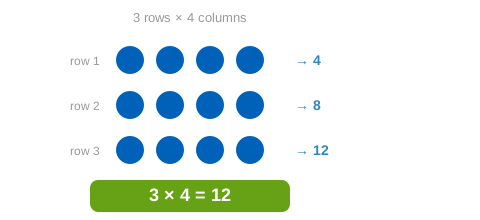 Array of 3 rows and 4 columns showing 3 × 4 = 12 with skip-counting on the right
For more on the foundational thinking that makes arrays click, see What Is Decomposing Numbers? A Parent's Guide to Breaking Apart Numbers.
Same Array, Two Ways: 3 × 4 = 4 × 3
This is one of the most powerful uses of arrays — showing that multiplication is commutative.
Take the same 12 dots. Arrange them as 3 rows and 4 columns. Now turn the page sideways. The exact same dots are now 4 rows and 3 columns.
Step 1: Count the original array as 3 rows and 4 columns. That's 3 × 4 = 12.
Step 2: Count the rotated array as 4 rows and 3 columns. That's 4 × 3 = 12.
Step 3: Notice that nothing changed except the perspective. The total has to be the same.
This is why your child only has to memorize half of the multiplication table — once they know 3 × 4, they automatically know 4 × 3.
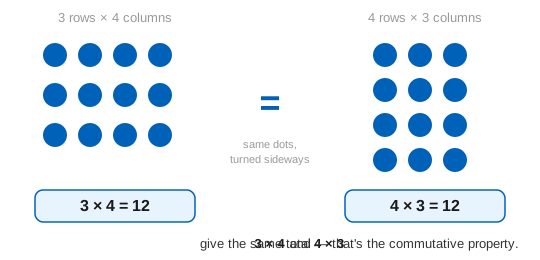 The same 12 dots arranged two ways: 3 rows and 4 columns on the left equals 4 rows and 3 columns on the right
From Array to Area Model
Here's the part that makes 4th and 5th grade math so much easier for kids who learned arrays well: the array doesn't disappear, it just changes shape.
A 3 × 4 array can be drawn as 12 individual dots. It can also be drawn as a grid with 3 rows and 4 columns of unit squares. Slide those squares together and you have a single rectangle that is 3 units by 4 units. Label the sides with the dimensions, and you've got an area model.
Step 1: Start with 12 dots arranged in 3 rows and 4 columns.
Step 2: Replace each dot with a unit square. Now the rectangle has 12 squares inside.
Step 3: Erase the inside lines and just label the sides: "3" on one side, "4" on the other.
That last picture is an area model — and it's how your child will multiply 23 × 14 in a couple of years. The numbers get bigger, but the rectangle stays the same.
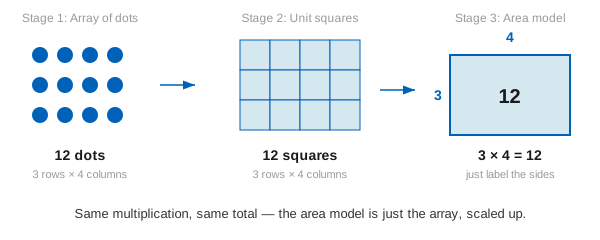 An array of dots transforming into a labeled area model rectangle in three stages
For more on how arrays grow up into multi-digit multiplication, see What Is the Area Model? A Parent's Guide to Box Multiplication.
How Arrays Connect to What You Already Know
You see arrays every day without naming them.
Open the egg carton in your fridge — that's a 2 × 6 array. Twelve eggs, 2 rows and 6 columns. You probably don't count them one at a time; you glance and know.
Look at a muffin tin. Two rows and three columns. That's a 2 × 3 array, and the answer (6 muffins) is obvious without thinking.
Walk past a parking lot or a movie theater. The neat rows of cars or seats are an array — and the manager who needs to know the total capacity multiplies rows × columns rather than counting every spot.
A calendar month is an array (about 5 rows and 7 columns), which is why you can find any date by tracking down to the row and across to the column without scanning every square.
The difference is that today's students are taught to recognize and name this strategy, so they can apply it deliberately rather than only noticing it when someone points it out.
Watch: Arrays Explained
How to Help at Home
Use the words "rows" and "columns"
Your child's teacher uses these terms specifically — rows go across, columns go up and down. Mirror that language when you help. If your child says "there are 3 rows and 4 columns," they're describing an array correctly, and your job is to use the same vocabulary back: "Right — 3 rows and 4 columns. So what's 3 times 4?"
Skip-count instead of counting one by one
When your child is finding the total in an array, encourage them to count by the number in one row: "4, 8, 12" instead of "1, 2, 3, 4, 5, 6, 7, 8, 9, 10, 11, 12." Skip-counting is multiplication in disguise, and it's faster and more accurate. If your child is still counting one by one, that's a signal that they're seeing 12 separate objects rather than 3 groups of 4 — which is exactly what arrays are designed to fix.
Draw arrays for any multiplication fact
If your child is stuck on a multiplication fact like 6 × 7, suggest they draw the array. It might feel slow, but drawing an array of 6 rows and 7 columns and skip-counting the answer is exactly the strategy their teacher wants them to use. Memorization comes after understanding, not before.
Don't "fix" their method
If your child writes 4 + 4 + 4 = 12 instead of 3 × 4 = 12, that's correct — they're using the strategy their teacher just taught them. Resist the urge to say "you can just multiply." Repeated addition is the on-ramp to multiplication, and skipping it can leave a gap in their understanding.
Find arrays in real life
Egg cartons, cookies on a baking sheet, the rows of buttons on a calculator, garden plots, the panes in a window — arrays are everywhere once you start looking. Every time you point one out and ask "how many?" together, you're reinforcing the strategy without making it feel like homework.
Let Methodwise walk through it
If your child is staring at an array problem and you can't remember whether to count rows or columns first, open Methodwise and type or snap a photo of the problem. It will walk you and your child through it step by step — using the same vocabulary their teacher is using.
Common Mistakes to Watch For
Calling unequal groups an array
If a student draws three rows with 4, 5, and 3 objects, they've drawn equal groups thinking — but it's not an array. Arrays require equal rows and equal columns. When you spot uneven rows, gently ask "is each row the same size?" Fixing it is usually a one-second adjustment.
Mixing up rows and columns
Rows go across; columns go up and down. Some kids reverse these terms and end up describing an array as "4 rows and 3 columns" when it's actually "3 rows and 4 columns." The total still works out (because of the commutative property), but the vocabulary matters for later word problems and for the area model. A quick "rows go across like the rows in a movie theater" usually clears it up.
Counting one by one instead of skip-counting
If your child counts every single dot to find the total, they're treating the array as 12 separate objects rather than 3 groups of 4. Encourage skip-counting by the number in one row. This is the habit that turns repeated addition into multiplication.
Not seeing that 3 × 4 and 4 × 3 are the same
Some students will solve 3 × 4 by drawing a 3-by-4 array, then start a new array from scratch when they see 4 × 3. Show them that the same array works — just turn the paper. This single insight is what makes multiplication tables half the work.
Treating the area model as a brand-new topic
When 4th grade brings the area model, kids who didn't fully grasp arrays sometimes feel lost. The area model isn't new — it's the array, scaled up. If your child hits this wall, go back and draw a few small arrays together. The bridge will reappear.
Practice Questions
Try these with your child. Answers are below.
Recognizing arrays (Grades 2–3):
- Sketch an array that shows 5 × 2.
- How many rows and columns are in the array for 6 × 3? What is the total?
- Draw two different arrays that both have a total of 12.
Multiplication with arrays (Grade 3):
- Write the multiplication equation for an array with 4 rows and 7 columns.
- An array has 9 columns and 5 rows. How many objects are in the array?
- If 3 × 8 = 24, what is 8 × 3? How does the array show this?
Bridging to the area model (Grades 3–4):
- Draw an array for 6 × 5. Then redraw it as a labeled rectangle (area model).
- Without drawing every square, what is the area of a rectangle that is 7 units long and 4 units wide?
Answers
- 5 rows and 2 columns of dots (or 2 rows and 5 columns) — both work; total is 10.
- 6 rows and 3 columns; total is 18.
- Examples: 3 × 4, 4 × 3, 2 × 6, 6 × 2, 1 × 12, 12 × 1.
- 4 × 7 = 28
- 5 rows × 9 columns = 45
- 8 × 3 = 24. The array shows it because turning a 3-rows-by-8-columns array on its side gives 8 rows and 3 columns — same dots, same total.
- 6 rows and 5 columns = 30 dots; redrawn as a rectangle labeled "6" on one side and "5" on the other, with 30 inside.
- 7 × 4 = 28
Ready to try it with your child?
Open the chat, pick the subject and your child's grade, and get a step-by-step explanation you can use to help tonight.
Try 3 Questions Free — No Signup RequiredFrequently Asked Questions
Do kids still memorize multiplication facts if they're learning arrays?
Yes — fact fluency is still part of the standards. Arrays come first because they build understanding of what multiplication means; once that's solid, students practice the facts until they know them by heart. Drawing an array isn't a replacement for memorization — it's the on-ramp.
Can arrays be used for division too?
Absolutely, and this is one of the main reasons teachers invest so much time in arrays. The same 12-dot array that shows 3 × 4 = 12 can also show 12 ÷ 3 = 4 (twelve dots split into three rows) or 12 ÷ 4 = 3 (twelve dots split into four columns). Arrays make the relationship between multiplication and division visible.
What if my child's teacher uses 'groups of' instead of 'rows and columns'?
That's common and fine — '3 groups of 4' means the same thing as 3 rows and 4 columns. If the teacher uses 'groups of,' use that phrase at home too. An array is just a particularly orderly way to draw equal groups, and the underlying math is identical.
What's an 'open array,' and how is it different from a regular array?
An open array is the bridge between dot arrays and the area model. It's a rectangle with the dimensions labeled on the sides but no dots or grid lines drawn inside. Teachers introduce open arrays in 3rd and 4th grade as students transition away from drawing every dot. The open array is essentially the area model's first draft.
Why does my child have to draw arrays for facts they probably already know?
Drawing the array is what builds the meaning behind the fact. Even if your child can recite 6 × 7 = 42, the teacher wants them to be able to show why — because that understanding is what supports the distributive property, the area model, fractions, and ratios later on. Once those concepts are secure, the drawing fades on its own.
Try Methodwise Free
When your child brings home array homework and you're not sure how to explain it the way their teacher would, Methodwise walks you through it — step by step, using the same method their teacher is using.
- Start with 3 free questions — no account needed
- Free plan: 15 questions/month after signup
- Plus plan: unlimited questions + saved chat history + 7-day free trial
- Step-by-step explanations the way teachers teach
Related Articles
-
What Is Decomposing Numbers? A Parent's Guide to Breaking Apart Numbers
-
What Is the Area Model? A Parent's Guide to Box Multiplication
-
What Is a Number Line? A Parent's Guide to How Teachers Use It
-
What Are Number Bonds? A Parent's Guide to Making and Breaking Numbers
-
What Is Partial Sums Addition? A Parent's Guide to Why Your Child Doesn't 'Carry the One' Anymore
-
What Is a Tape Diagram? A Parent's Guide to Visualizing Word Problems
-
What Is a Ten Frame? A Parent's Guide to the Box That Builds Number Sense
-
What Is Partial Quotients Division? A Parent's Guide to the New Way Kids Learn Long Division
-
What Are Common Core Math Methods? A Parent's Guide to How Math Is Taught Today
-
Homework Help Tools: Built for Kids vs. Built for Parents — What's the Difference?
-
What Are Fact Families? A Parent's Guide to How Addition and Subtraction Connect
-
What Is the Standard Algorithm? A Parent's Guide to Why Your Child Learns the 'Long Way' First
-
Fractions on a Number Line: A Parent's Guide to Why Pie Charts Aren't Enough
-
What Are Ratios and Proportional Reasoning? A Parent's Guide to Middle School Math
-
What Is Skip Counting? A Parent's Guide to How Counting by 2s, 5s, and 10s Becomes Times Tables
-
What Math Will My Child Learn This Year? A Parent's Guide to K-8 Math Methods by Grade
-
What Are Mental Math Strategies? A Parent's Guide to How Kids Add and Subtract in Their Heads
Have questions about arrays? Email me at hello@methodwise.co
About the Author
Samantha Black is the founder of Methodwise and an educator with over 15 years in higher education and instructional design. She built Methodwise after experiencing the homework gap firsthand as a parent of two K–8 daughters. Learn more about why we built Methodwise →