
What Are Context Clues? A Parent's Guide to How Kids Figure Out New Words Without a Dictionary
May 18, 2026
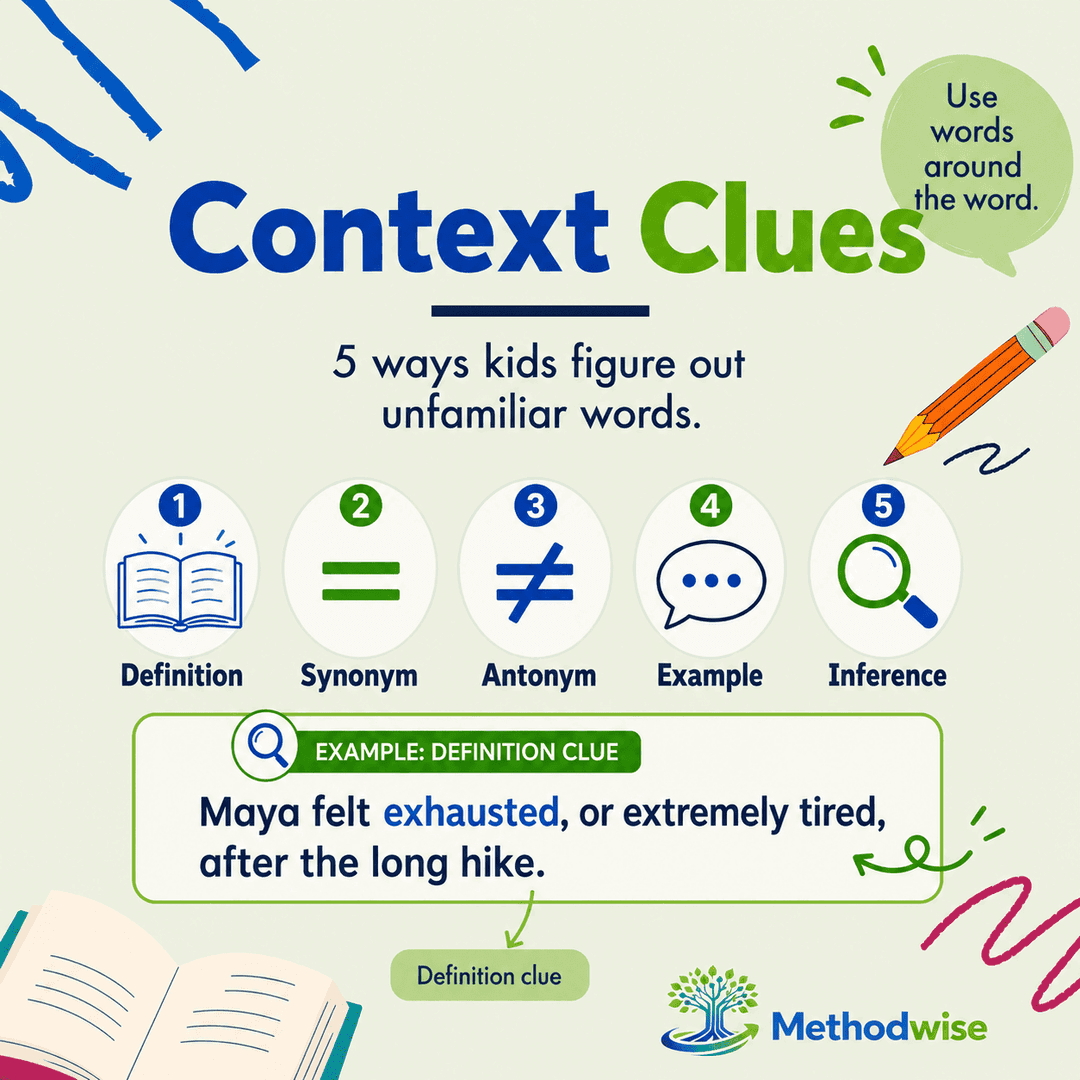
If your child has come home with a worksheet that points to a sentence and says "What does the word ___ mean? Use context clues to figure it out," you've run into one of the most common, and most quietly powerful, reading skills taught in elementary and middle school. And if your first instinct is to say "why don't they just look it up," that instinct makes sense, but classrooms teach the skill a little differently now.
Context clues are the hints sitting in the words around an unfamiliar word that let a reader keep reading without stopping to grab a dictionary. It's a skill that shows up on many state reading assessments, across the elementary and middle school grades, and in nearly every textbook your child will ever read. Once you know the moves teachers teach, you can walk your child through any vocabulary-in-context question in a couple of minutes.
What Are Context Clues?
Context clues are pieces of information surrounding an unfamiliar word that help a reader figure out what the word means. The "context" is just the rest of the sentence — and often the sentence before and the sentence after. The "clue" is the specific word, phrase, or example that points to the meaning.
Teachers usually frame the strategy as a small habit: when you hit a word you don't know, don't stop reading and don't guess wildly — look around the word for evidence. The author almost always leaves something. A definition tucked behind a comma. A synonym a few words later. An example. A contrast. The reader's job is to find the clue and let it do the work.
Why Do Teachers Use Context Clues?
When most of us learned vocabulary in school, the process was: see an unknown word, stop, open a dictionary, copy down the definition, move on. That works in a quiet room with a dictionary in arm's reach. It doesn't work on a state reading test, in a chapter book at bedtime, or in a science textbook with twenty new terms in a single chapter.
Context clues solve that problem. The Common Core puts the skill into the standards starting in kindergarten (RI.K.4: "ask and answer questions about unknown words in a text") and ramps it up every year through eighth grade, where students are expected to "determine the meaning of words and phrases as they are used in a text" across fiction, nonfiction, and academic content (L.8.4a, RL.8.4, RI.8.4). Standardized tests like the SAT and ACT include words-in-context items, and many state assessments also test this skill.
The deeper reason is even simpler: research on vocabulary growth shows that the vast majority of words children learn after about second grade are picked up from reading, not from direct instruction. If a child stops reading every time they hit a new word, they don't grow their vocabulary — they just slow down and lose comprehension. Context clues are how teachers train students to keep going, build meaning on the fly, and let reading itself do the vocabulary teaching.
Stuck on tonight's homework?
Paste in the problem and get a step-by-step explanation in your child's grade level — using the same method their teacher uses.
Try 3 Questions Free — No Signup RequiredWhat Grade Are Context Clues Taught?
Kindergarten–1st Grade — Asking About Unknown Words
At this age, context-clue work is mostly oral. A teacher reads a picture book aloud, hits a word like "the puppy was frantic" and pauses: "What do you think frantic means? What's happening on the page?" The student looks at the picture (the puppy running in circles) and the surrounding words ("barking, jumping, can't sit still") and offers a meaning. The standard (RL.K.4, RI.K.4) focuses on the habit of noticing unfamiliar words and asking about them — the formal strategy comes a little later.
2nd–3rd Grade — Sentence-Level Context Clues
This is where the strategy gets a name. By 2nd grade (L.2.4a) students are expected to "use sentence-level context as a clue to the meaning of a word or phrase." Teachers introduce the basic types — definition clues, synonym clues, antonym clues, example clues — and start asking students to point at the clue, not just guess. A typical question reads: "In the sentence 'The squirrel was timid, hiding behind the tree,' what does timid mean? Which words give you the clue?"
Grades 4–5 — Multiple Clue Types in Longer Passages
By 4th and 5th grade (L.4.4a, L.5.4a) students are working with longer passages and are expected to use clues that span more than one sentence. They're also expected to know types of context clues — many classrooms use acronyms like SAGE (Synonym, Antonym, General/Inference, Example) or DECCAI (Definition, Example, Comparison/Contrast, Antonym, Inference). A typical question: "What does the word meander mean as it is used in paragraph two? Which sentence helps you figure it out?" The expected answer names the clue and explains the connection.
Grades 6–8 — Inference, Connotation, and Figurative Language
Middle school context clue work gets harder because the words get more abstract and the clues are less obvious. Students are expected to figure out connotations (is cunning positive or negative?), distinguish shades of meaning between similar words, and use context to interpret figurative language (L.6.4a, L.7.4a, L.8.4a). A typical question: "The author writes that the politician's rhetoric was 'inflammatory.' Based on the passage, what does rhetoric mean here, and what is the author's attitude toward it?" The reader has to use context for both the literal meaning and the tone.
If your child is working with context clues at any of these stages, it's developmentally appropriate and part of a deliberate progression from "point to the picture clue" to "defend my reading of an abstract word with evidence from the text."
How Context Clues Work
Most teachers lean on the same simple framework: name the type of clue, point to the evidence, then check the meaning back against the sentence. Here's what that looks like in practice.
The Five Types of Context Clues
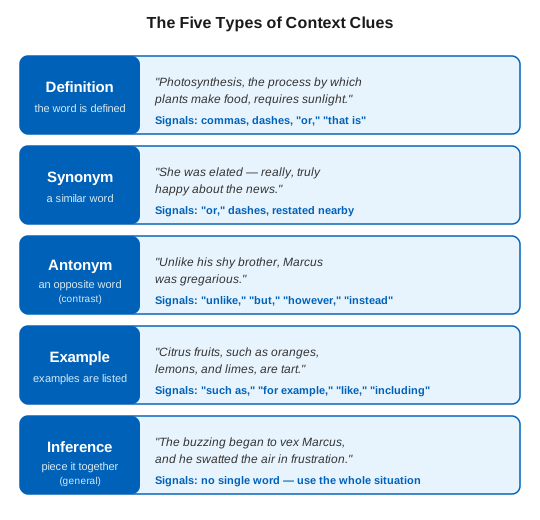 The five types of context clues shown as labeled cards: Definition, Synonym, Antonym, Example, and Inference, each with a one-sentence example
Almost every context clue your child will encounter falls into one of five buckets. Definition clues define the word right in the sentence, often set off by commas, dashes, or the word or — "Photosynthesis, the process by which plants make food, requires sunlight." Synonym clues drop a similar word nearby — "She was elated — really, truly happy." Antonym or contrast clues give an opposite, often signaled by but, unlike, however, instead — "Unlike his shy brother, Marcus was gregarious." Example clues list examples — "Citrus fruits, such as oranges, lemons, and limes, are high in vitamin C." Inference clues don't hand the meaning over — the reader has to piece it together from the broader situation. Most kids find this last type hardest, because there's no single word to point to.
For more on figuring out what the author didn't say outright, see What Is Making Inferences? A Parent's Guide to Reading Between the Lines.
A Worked Example
Here's a short sentence and the kind of context-clue work a 3rd or 4th grader would be expected to do with it.
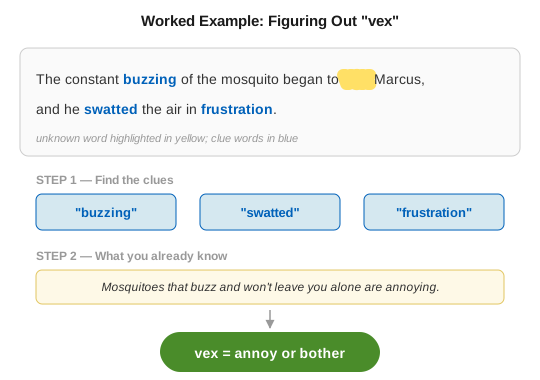 Worked example of a context clue: the sentence "The constant buzzing of the mosquito began to vex Marcus, and he swatted the air in frustration." with the clue words "buzzing," "swatted," and "frustration" highlighted, leading to the inferred meaning "annoy"
Notice what the student did. He didn't just guess that vex means annoy because the sentence "felt" like an annoyance sentence. He pointed to specific clue words — constant buzzing, swatted, frustration — and used what he already knew about how people behave when they're annoyed. That's an inference clue, the trickiest type, but the move is the same: find the evidence, propose a meaning, and check.
The Four-Step Strategy Teachers Teach
Most classrooms have some version of the same four-step routine.
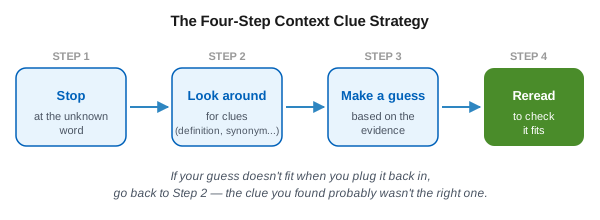 Four-step context clue strategy shown as a flow diagram: Step 1 Stop at the word, Step 2 Look around for clues, Step 3 Make your best guess, Step 4 Reread to check it fits
Step 1: Stop at the unknown word. Don't skip it, don't fake it. Notice that you don't know it. Step 2: Look around — usually one sentence before and one sentence after. Hunt for a definition, synonym, antonym, example, or general inference. Step 3: Make your best guess. Use what the clues suggest plus what you already know. Step 4: Reread the sentence with your guess swapped in for the unknown word. If it still makes sense, you've got it. If it doesn't, go back to Step 2 — the clue you found probably isn't the right one.
This last step is where a lot of homework points are won and lost. Plugging the guess back in is what turns a guess into an answer.
For more on slowing down and rereading on purpose to catch the clues you missed the first time, see What Is Close Reading? A Parent's Guide to Reading Like a Detective.
How Context Clues Connect to What You Already Know
You use context clues constantly. You just don't call them that.
When a coworker says "The new system is really clunky," and you've never heard them describe software that way, you don't grab a dictionary — you read their tone, the eye-roll, and the fact that they spent twenty minutes trying to log in, and you conclude that clunky means awkward to use. That's an inference clue.
When you read a recipe that says "sauté the onions, that is, cook them quickly in a little oil over medium-high heat," you've just been handed a definition clue. You may have never sautéed anything before, but the recipe defined the word right in the sentence, set off by that is and a comma — exactly the move teachers train kids to spot.
When you read a news article about a frugal shopper who never spends more than ten dollars on a shirt and clips coupons every Sunday, you've used an example clue. The article gave you concrete examples and trusted you to figure out the trait.
The difference is that today's students are taught to recognize and name this strategy — to call out the type of clue they used, point at the evidence, and check their guess — so they can apply it on purpose during a reading test, instead of only using it when the stakes are low and a coworker is rolling their eyes.
Watch: Context Clues Explained
How to Help at Home
Read with a pencil — circle the unknown words
When your child is reading, give them a pencil and ask them to circle any word they don't know rather than skipping it. You're not going to define them all on the spot — you're training the habit of noticing. After the chapter, pick two or three of the circled words and walk through the context clue strategy together. The act of circling is most of the win.
Use the teacher's vocabulary
If your child's teacher uses definition, synonym, antonym, example, inference — you use those words. If their classroom has an acronym like SAGE or DECCAI, use that too. Match the language exactly. It feels like a small thing, but it's the difference between homework feeling consistent and homework feeling like a translation problem.
Don't define the word for them right away
The instinct, when your child says "what does this word mean," is to tell them. Resist for one round. Ask "What's happening in the sentence? Is there a word right next to it that gives you a hint?" Even if they only get partway there, the muscle they're building is the one the test will ask for. Once they've taken a swing, you can confirm or refine.
Always plug the guess back in
The most common reason kids miss a vocabulary-in-context question isn't that they didn't find a clue — it's that they didn't check their guess. After your child proposes a meaning, have them reread the sentence with their guess swapped in for the unknown word. If it sounds wrong, the guess is wrong. This step takes ten seconds and catches half the mistakes.
Practice with text you'd never assign — menus, signs, sports articles
Context clues aren't a homework-only skill. Look at a restaurant menu and ask "what do you think braised means?" Read a movie review together and ask "what do you think campy means there?" Sports articles are gold for unknown words and crystal-clear context. The skill is the same — the lower the stakes, the more comfortable your child gets reaching for the strategy on their own.
Let Methodwise walk through it
If your child is stuck on a vocabulary-in-context question and doesn't know where to start, open the Methodwise chat, paste the sentence (or the whole short passage) and the question, and ask for help using context clues. Methodwise will name the type of clue, point to the specific evidence, and walk through the four-step strategy — using the same vocabulary the teacher uses.
Common Mistakes to Watch For
Guessing without finding a clue
If your child says "I think vex means scared because it sounds scary," that's a guess based on the sound of the word, not on context. The fix is the same every time: "Show me the clue. Where in the sentence did you get that idea?" If they can't point to it, they haven't used context clues yet.
Reading only the sentence the word is in
Sometimes the clue is in the sentence before or after the unknown word, not in the same sentence. If your child says "there's no clue here," have them reread the surrounding sentences out loud. The author almost always plants something nearby — sometimes one sentence away.
Skipping Step 4 — not plugging the guess back in
This is the single most preventable mistake. A child decides meander means run and writes that down without rereading the sentence. "The river meandered through the valley" doesn't make sense if rivers run, but it does if they wind slowly. Plugging the guess in catches it instantly.
Not knowing the clue word either
Sometimes the unknown word is surrounded by other unknown words. If your child says "I don't know what any of these words mean," the strategy isn't broken — they just need to back up and figure out one of the easier surrounding words first, then use that to crack the harder one. Vocabulary builds in a chain.
Treating every nearby word as a clue
Not every word near the unknown one is doing the work of a clue. "The librarian was taciturn and wore a red sweater" — the red sweater is not a clue to taciturn. Help your child notice that the clue has to logically connect to the meaning. If swapping the guess back in doesn't fit, the "clue" they found probably wasn't a clue.
Practice Questions
Try these with your child. Read each sentence, figure out the meaning of the bold word, and name the type of context clue. Answers are below.
Grades 2–3 — Sentence-level context clues:
- The puppy was timid — he hid behind his owner's legs whenever a stranger walked by. What does timid mean? What kind of clue helped you?
- Unlike her boisterous brother, Maya liked to read quietly in her room. What does boisterous mean? What kind of clue helped you?
Grades 4–5 — Multiple clue types:
- The chef showed us how to julienne the carrots, that is, cut them into long, thin matchstick-shaped strips. What does julienne mean? What type of clue is this?
- Citrus fruits, such as oranges, lemons, grapefruits, and limes, are abundant in vitamin C. What does abundant mean? What type of clue is this?
Grades 6–8 — Inference and connotation:
- The senator's rhetoric during the debate was so inflammatory that several audience members walked out, and reporters spent the next morning analyzing every line he had delivered. What does rhetoric mean here, and what is the author's attitude toward it? What clues support both answers?
Answers
- Timid means shy or easily frightened. The clue is "hid behind his owner's legs whenever a stranger walked by" — an example clue (the puppy's behavior is an example of being timid).
- Boisterous means loud and energetic. The clue is the word unlike, which signals an antonym/contrast clue — Maya liked to read quietly, so her brother is the opposite.
- Julienne means to cut into long, thin matchstick-shaped strips. This is a definition clue — the meaning is given right in the sentence, set off by that is.
- Abundant means plentiful, in large amounts. This is an example clue — the list of citrus fruits doesn't define the word directly, but combined with what we know about citrus and vitamin C, abundant clearly means a lot.
- Rhetoric means the language a speaker uses to persuade an audience (often with the suggestion that the language is more about effect than truth). The clue that the rhetoric was "inflammatory" and that "audience members walked out" points to the meaning, and the author's attitude is critical — the word inflammatory and the detail about reporters "analyzing every line" both carry a negative connotation. This is an inference clue (no single word defines rhetoric — the reader builds the meaning from the surrounding context).
Ready to try it with your child?
Open the chat, pick the subject and your child's grade, and get a step-by-step explanation you can use to help tonight.
Try 3 Questions Free — No Signup RequiredFrequently Asked Questions
Should my child still be learning prefixes and suffixes, or are context clues replacing that?
Both, and they work together. Context clues use the words around an unknown word; word parts (morphology) use the structure of the word itself — root, prefix, suffix. Most teachers cover both starting in 3rd or 4th grade and treat them as complementary strategies. Context clues help when the word is unfamiliar but the surrounding sentence is clear; word parts help when your child recognizes a piece of the word, like 'bio-' or '-able.' Strong readers reach for whichever fits the situation, and often use both at once.
Should my child still learn to use a dictionary?
Yes — but as a follow-up, not as the first move. Context clues are the in-the-moment skill; the dictionary is the verification step. After your child figures out a word from context, looking it up to confirm the meaning and add it to their working vocabulary is a great habit. Most classrooms now point students to digital dictionaries and student glossaries, which include kid-friendly definitions and example sentences.
What if there really aren't any context clues for a word?
It happens. If a word appears once with no defining language around it, the strategy isn't broken — the next move is to keep reading and watch for the word to reappear, since authors often define a key term on its second or third use. If the word never gets clearer, that's the moment to look it up. The skill isn't 'always figure it out without help' — it's 'always look around first.'
Will context clue practice help on standardized tests like the SAT?
Yes, especially on words-in-context questions. The SAT and ACT include items that ask students to choose the most logical meaning of a word in a passage, and many state assessments also test this skill. The format is almost always: a passage, a quoted or underlined word, and four meaning options. The strategy your child is learning in elementary and middle school — find the clue, plug the guess back in, check that it fits — is exactly what those questions test, just with harder words and longer passages.
What about words with more than one meaning, like 'bark' or 'run'?
Context is the only way to handle multiple-meaning words. 'The dog's bark woke the neighbors' and 'The bark on that birch tree is peeling' use the same word for completely different things — the only way to tell them apart is the surrounding sentence. Teachers introduce these around 2nd or 3rd grade and use them to make a bigger point: every word's meaning depends on context, not just the unfamiliar ones.
Can Methodwise help with context clues homework?
Yes. If your child has a vocabulary worksheet asking what a word means in a sentence, you can paste the sentence and the question into Methodwise. It'll point out the type of clue, walk through the reasoning, and use the same vocabulary your child's teacher uses — definition, synonym, antonym, example, or inference.
Try Methodwise Free
When your child brings home a vocabulary worksheet that says "use context clues to figure out the meaning of the bold word" and you're not sure how to walk them through it the way their teacher would, Methodwise does it for you — step by step, naming the type of clue and using the same four-step strategy their teacher is using.
- Start with 3 free questions — no account needed
- Free plan: 15 questions/month after signup
- Plus plan: unlimited questions + saved chat history + 7-day free trial
- Step-by-step explanations the way teachers teach
Related Articles
-
What Is Making Inferences? A Parent's Guide to Reading Between the Lines
-
What Is Citing Evidence? A Parent's Guide to Text Evidence in Reading and Writing
-
Author's Purpose vs. Point of View: A Parent's Guide to PIE, Narrators, and Perspective
-
Main Idea vs. Theme: What Your Child's Teacher Actually Means
-
What Is Close Reading? A Parent's Guide to Deeper Comprehension
-
Reading Comprehension Strategies: A Parent's Guide to How Teachers Teach Reading
-
What Are Text Features? A Parent's Guide to Nonfiction Reading
-
Reading Levels Explained: Lexile, F&P, and DRA in Plain English
-
Homework Help Tools: Built for Kids vs. Built for Parents — What's the Difference?
-
What Is Text Structure? A Parent's Guide to How Nonfiction Is Organized
-
Opinion Writing vs. Argument Writing: A Parent's Guide to the K–8 Writing Progression
-
Summarizing vs. Retelling: A Parent's Guide to Why the Teacher Keeps Saying 'Too Many Details'
-
What Are Story Elements? A Parent's Guide to Characters, Setting, Problem, and Solution
-
What Is Phonemic Awareness? A Parent's Guide to Playing With Sounds Before Reading
Have questions about context clues? Email me at hello@methodwise.co
About the Author
Samantha Black is the founder of Methodwise and an educator with over 15 years in higher education and instructional design. She built Methodwise after experiencing the homework gap firsthand as a parent of two K–8 daughters. Learn more about why we built Methodwise →