
What Are Fact Families? A Parent's Guide to How Addition and Subtraction Connect
May 7, 2026
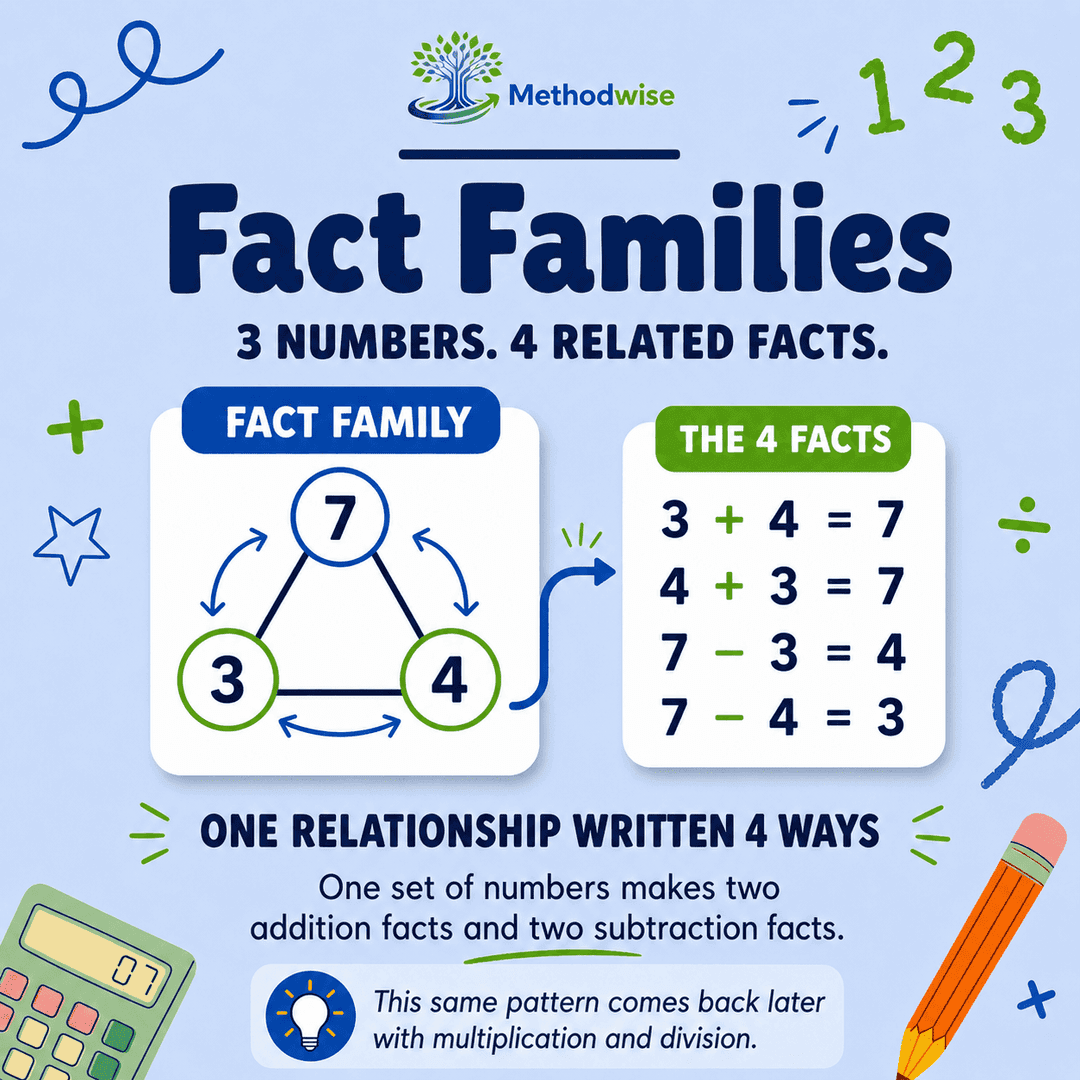
If your child's homework has a triangle with three numbers in it — one at the top and two at the bottom — and the directions say "write the four facts," you're looking at a fact family. The triangle might be replaced with a house, a circle, or just three numbers floating on the page, but the idea is the same: those three numbers belong together, and they make four different equations. Fact families are how today's classrooms teach kids that addition and subtraction aren't two separate skills to memorize — they're two sides of the same coin.
What Is a Fact Family?
A fact family is a group of related number sentences made from the same three numbers. For addition and subtraction, every fact family has exactly four equations: two addition facts and two subtraction facts.
The family for 3, 4, and 7 looks like this: 3 + 4 = 7, 4 + 3 = 7, 7 − 3 = 4, and 7 − 4 = 3. Same three numbers, four ways to write them. Once your child sees that pattern, they don't have four facts to memorize — they have one relationship that they can write four different ways.
The same idea applies to multiplication and division. The family for 3, 4, and 12 is 3 × 4 = 12, 4 × 3 = 12, 12 ÷ 3 = 4, and 12 ÷ 4 = 3.
Why Do Teachers Use Fact Families?
When most of us learned math, addition and subtraction came in separate units. Addition first, subtraction later — and the connection between them was something we were left to figure out on our own. Fact families flip that approach. From the very first time a child meets subtraction, they meet it as the opposite of an addition fact they already know.
There's a lot of cognitive heavy lifting baked into that one move. Fact families teach the inverse relationship — the idea that subtraction undoes addition (and division undoes multiplication). They cut memorization roughly in half, because every fact family is one relationship instead of four separate facts. They make subtraction feel less scary, because a child who knows 6 + 2 = 8 already knows that 8 − 6 = 2. And they set up the algebraic thinking kids will need years later, when "7 − ___ = 3" becomes "x + 3 = 7."
In short, the few weeks spent on fact families in 1st and 2nd grade are doing quiet work that pays off all the way through middle school algebra.
Stuck on tonight's homework?
Paste in the problem and get a step-by-step explanation in your child's grade level — using the same method their teacher uses.
Try 3 Questions Free — No Signup RequiredWhat Grade Are Fact Families Taught?
Kindergarten — Number Bonds and Part-Whole Thinking
Before fact families show up by name, kids spend a lot of time on part-whole thinking: the idea that numbers can be broken into parts. A kindergartener might draw a number bond showing 5 broken into 3 and 2. They aren't writing equations yet, but they're building the picture that fact families will turn into math sentences next year.
1st Grade — Fact Families Begin
This is where fact families officially start. Common Core standard 1.OA.6 expects 1st graders to "add and subtract within 20" using strategies including the relationship between addition and subtraction. A typical 1st grade assignment shows a triangle with 7 at the top and 3 and 4 at the bottom corners, with directions to write the four facts. Students are usually working with sums up to 20.
2nd Grade — Fact Families for Fluency
Second grade leans on fact families to build automatic recall (2.OA.2). Kids practice fact families daily, often with games, flashcards, or "missing number" problems like 7 − ___ = 4. By the end of 2nd grade, students should know all addition and subtraction facts within 20 from memory — and fact families are the strategy that gets them there efficiently.
3rd Grade — Multiplication and Division Fact Families
Once students learn multiplication in 3rd grade (3.OA.1) and division (3.OA.2), fact families come back in a new form. A 3rd grader might see a triangle with 12 at the top and 3 and 4 at the bottom, and write 3 × 4 = 12, 4 × 3 = 12, 12 ÷ 3 = 4, 12 ÷ 4 = 3. The structure is identical — three numbers, four facts — but now the operations are multiplication and division.
4th Grade and Beyond — Operations Stay Connected
Fact families don't disappear in 4th and 5th grade — they get absorbed into bigger work. Students use the inverse relationship to check answers ("does 156 ÷ 12 = 13? Let me multiply 12 × 13 to check"), to solve word problems with unknowns, and eventually to solve simple equations in middle school algebra.
If your child is working with fact families at any of these stages, it's developmentally appropriate and part of a deliberate progression.
How Fact Families Work
Addition and Subtraction: The Family for 3, 4, and 7
This is the kind of fact family your child will see in 1st or 2nd grade.
Step 1: Identify the three numbers. The biggest number is the whole (the sum). The two smaller numbers are the parts (the addends). For our example, the whole is 7 and the parts are 3 and 4.
Step 2: Write the two addition facts by switching the order of the parts. 3 + 4 = 7 and 4 + 3 = 7.
Step 3: Write the two subtraction facts by starting with the whole and taking away each part. 7 − 3 = 4 and 7 − 4 = 3.
That's the whole family. Same three numbers, four equations.
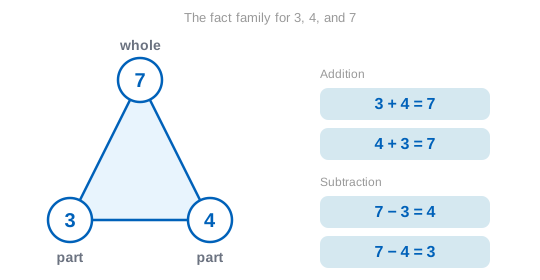 Fact family triangle for 3, 4, 7 with the four equations: 3+4=7, 4+3=7, 7-3=4, 7-4=3
For more on the part-whole thinking that makes fact families click, see What Is Decomposing Numbers? A Parent's Guide to Breaking Apart Numbers.
Doubles: The Family for 5, 5, and 10
Doubles are the one exception to the "four facts" rule. When the two parts are the same number, flipping them doesn't create a new fact, and the family only has two equations.
Step 1: Identify the parts and the whole. Parts: 5 and 5. Whole: 10.
Step 2: Write the addition fact. 5 + 5 = 10. (There's no "5 + 5" flipped — it's already symmetric.)
Step 3: Write the subtraction fact. 10 − 5 = 5. (Same reason — taking away either 5 leaves the other 5.)
So the doubles family for 5, 5, and 10 has just two facts: 5 + 5 = 10 and 10 − 5 = 5. Don't worry if your child writes only two — that's correct for doubles.
Multiplication and Division: The Family for 3, 4, and 12
Now fast-forward to 3rd grade. The triangle looks the same — but the operations have changed.
Step 1: Identify the three numbers. The biggest number is the product (the answer when you multiply). The two smaller numbers are the factors. Product: 12. Factors: 3 and 4.
Step 2: Write the two multiplication facts by switching the order of the factors. 3 × 4 = 12 and 4 × 3 = 12.
Step 3: Write the two division facts by starting with the product and dividing by each factor. 12 ÷ 3 = 4 and 12 ÷ 4 = 3.
If your 3rd grader already knows their times table, they have just earned a free division fact for every multiplication fact they know — that's the power of fact families.
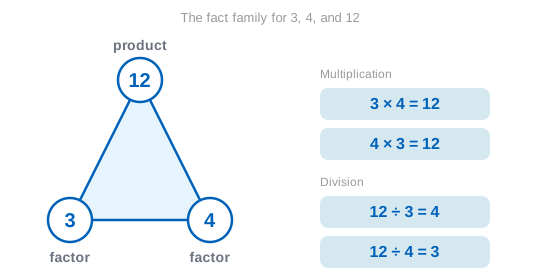 Fact family triangle for 3, 4, 12 with the four equations: 3×4=12, 4×3=12, 12÷3=4, 12÷4=3
For more on the visual that builds multiplication understanding, see What Are Arrays in Math? A Parent's Guide to Visualizing Multiplication.
From Number Bond to Fact Family
If your child has worked with number bonds, fact families are the natural next step. A number bond is the picture of the relationship; a fact family is the equations that come out of that picture.
Step 1: Start with the number bond. The whole 7 is split into the parts 3 and 4.
Step 2: Read the bond left-to-right and write the addition fact: 3 + 4 = 7. Read it right-to-left and you get 4 + 3 = 7.
Step 3: Now read the bond top-down — start with the whole and take a part away: 7 − 3 = 4. Take the other part away: 7 − 4 = 3.
The number bond and the fact family are the same idea wearing different outfits. That's why teachers introduce them in order — number bonds first, then fact families — so kids see the connection.
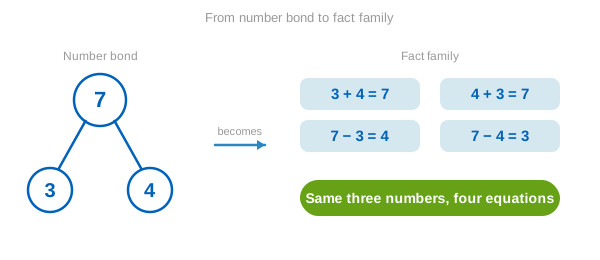 Number bond for 7 = 3 + 4 transforming into the four equations of the fact family
How Fact Families Connect to What You Already Know
You already use fact family thinking — you just don't call it that.
When you split a $20 bill at lunch and your share is $13, you don't actually subtract $20 − $13 from scratch. You think "$13 plus $7 makes $20," and you know your friend owes $7. That's a fact family in action: you used an addition fact to solve a subtraction problem.
When you measure a piece of trim and find that the wall is 84 inches but your trim is 60 inches, you might think "60 plus 24 is 84, so I need 24 more inches." Same move — adding up to find a missing part instead of subtracting.
When a recipe calls for 2 cups of flour and you've already added 3/4 of a cup, you probably think "3/4 plus 1 1/4 makes 2," not "2 minus 3/4 equals what?" The fact family in your head does the work for you.
When you're checking a division problem like "240 ÷ 12 = 20," your gut check is to multiply: "12 × 20 = 240, yep." That's the multiplication-division fact family doing exactly what it was designed to do.
The difference is that today's students are taught to recognize and name this strategy, so they can apply it deliberately rather than only stumbling into it when the numbers happen to be friendly.
Watch: Fact Families Explained
How to Help at Home
Use the words "fact family," "parts," and "whole"
These are the terms your child's teacher is using all day. Mirror them: "What's the whole in this family? What are the parts?" If your child says "the big number is 12," your job is to translate gently — "Right, 12 is the whole. So what are the parts?" Speaking the same language as the teacher is one of the highest-leverage things you can do.
Show that one fact gives you three more
If your child gets stuck on 11 − 4, ask "what plus 4 makes 11?" If they know 7 + 4 = 11, they already know the answer to 11 − 4 — they just have to flip it. This single move is what fact families are designed to teach, and naming it out loud helps it stick.
Practice with a fact family triangle
Draw a triangle on a piece of scrap paper, write three related numbers in the corners (the whole at the top, the two parts at the bottom), and ask your child to write the four equations. Five minutes a few times a week builds the kind of automatic recall that makes 2nd-grade math feel easy.
Don't correct their order
If your child writes "7 = 3 + 4" instead of "3 + 4 = 7," that's correct. Some classrooms specifically teach the equation written both ways to reinforce that the equals sign means "the same as," not "here comes the answer." Resist the urge to flip it.
Watch for missing-number problems
Once kids know fact families well, teachers introduce equations like "___ + 4 = 11" or "12 ÷ ___ = 3." These are fact families in disguise — the missing number is one of the three family members. Help your child notice that they're not "new" problems; they're the same family, just with a piece blank.
Let Methodwise walk through it
If your child is staring at a fact family problem and you can't remember whether to start with the whole or the part, open Methodwise and type or snap a photo of the problem. It will walk you and your child through it step by step — using the same vocabulary their teacher is using.
Common Mistakes to Watch For
Mixing up the whole and the parts
Some kids put the wrong number at the top of the fact family triangle — usually one of the smaller numbers. The whole always belongs at the top because it's the sum (in addition) or the product (in multiplication). A quick "which of these three numbers is the biggest? That's the whole" usually fixes it.
Forgetting the second addition fact
A child writes 3 + 4 = 7 but skips 4 + 3 = 7, treating them as the same fact. Technically the answer is the same, but the second equation is a separate fact in the family. Encourage them to write both; recognizing that 3 + 4 and 4 + 3 are equally valid is the commutative property quietly at work.
Subtracting in the wrong direction
A common mistake: writing "3 − 7 = 4" or "4 − 7 = 3." In subtraction fact families, you always start with the whole — the biggest number. If you start with one of the parts, the math doesn't work out (and in 1st grade, those answers don't exist yet). Point them back to the triangle: "What number is at the top?"
Treating multiplication and division families as separate units
Once 3rd grade brings multiplication and division fact families, some kids see them as a brand-new topic and forget to use the inverse relationship. They'll multiply 6 × 8 to get 48, then struggle with 48 ÷ 8 as if it's a totally new problem. A gentle reminder — "you just figured this out a second ago" — is usually enough.
Forgetting that doubles families have only two facts
When the parts are the same (5 + 5, 8 + 8, etc.), the family has just two equations, not four. Some kids try to force four facts and end up writing duplicates. Reassure them that doubles are the exception — and that two facts is the right answer for those families.
Practice Questions
Try these with your child. Answers are below.
Addition and subtraction fact families (Grades 1–2):
- Write the four facts for the family 2, 5, 7.
- Fill in the missing fact: 6 + 4 = 10, 4 + 6 = 10, 10 − 4 = 6, ___.
- Write the fact family for the doubles 6, 6, 12. (Hint: this one has only two facts.)
- The whole is 14. One part is 9. What is the other part, and what are the four facts?
Missing number problems (Grade 2):
- Solve using a fact family: 13 − ___ = 8.
- Solve using a fact family: ___ + 7 = 15.
Multiplication and division fact families (Grade 3):
- Write the four facts for the family 5, 6, 30.
- If 7 × 8 = 56, what is 56 ÷ 7? What is 56 ÷ 8?
- Write the fact family for the squares 9, 9, 81. (Hint: like doubles, this one has only two facts.)
- Solve using a fact family: 72 ÷ ___ = 8.
Answers
- 2 + 5 = 7, 5 + 2 = 7, 7 − 2 = 5, 7 − 5 = 2.
- 10 − 6 = 4.
- 6 + 6 = 12 and 12 − 6 = 6.
- The other part is 5. Facts: 9 + 5 = 14, 5 + 9 = 14, 14 − 9 = 5, 14 − 5 = 9.
- 8 + ___ = 13, so the missing number is 5. (Check: 13 − 5 = 8.)
- 15 − 7 = ___, so the missing number is 8. (Check: 8 + 7 = 15.)
- 5 × 6 = 30, 6 × 5 = 30, 30 ÷ 5 = 6, 30 ÷ 6 = 5.
- 56 ÷ 7 = 8 and 56 ÷ 8 = 7.
- 9 × 9 = 81 and 81 ÷ 9 = 9.
- 8 × ___ = 72, so the missing number is 9. (Check: 72 ÷ 9 = 8.)
Ready to try it with your child?
Open the chat, pick the subject and your child's grade, and get a step-by-step explanation you can use to help tonight.
Try 3 Questions Free — No Signup RequiredFrequently Asked Questions
What is a fact family triangle?
A fact family triangle is the visual format teachers use for fact family practice — a triangle with the whole at the top and the two parts at the bottom corners. It's also called a 'fact triangle' or 'math triangle.' Different curricula use different shapes (some use houses, some use circles), but the idea is the same: keep the three related numbers visible together so a child can see all four facts at once.
My child's teacher says 'related facts' instead of 'fact family.' Are they the same thing?
Yes. 'Related facts,' 'fact families,' 'number families,' and 'fact triangles' all describe the same concept: a small set of equations built from the same three numbers. The terminology varies by curriculum — Eureka Math, Bridges, Singapore Math, and Saxon each use slightly different names — but the underlying idea is identical. Use whichever word matches your child's classroom so the language stays consistent between home and school.
How long does it take for kids to 'get' fact families?
Most kids need two to four weeks of regular practice to internalize the four-fact pattern, then several more months to recall the facts automatically. The first leap — 'oh, these three numbers always make these four equations' — usually clicks fast. The second leap — pulling those facts up in seconds without drawing the triangle — takes longer and is the main focus of 2nd-grade math fluency work.
What's the best way to practice fact families at home?
Short, frequent practice beats long sessions. Five minutes a day with a fact family triangle drawn on scrap paper is far more effective than a 30-minute weekend session. Flashcards and games — like 'Salute,' where a child sees two numbers and has to figure out the missing third — build the same fluency without feeling like worksheets. If your child gets stuck on a specific homework problem, Methodwise can walk you through it using the same fact family language their teacher uses.
Do fact families only work with small numbers, or can my child use them for bigger ones?
Fact families work for any three related numbers — there's no upper limit. The family for 13, 7, and 20 is just as valid as the family for 3, 4, and 7. By 2nd and 3rd grade, students apply the same four-equation thinking to two-digit numbers (25 + 30 = 55, 30 + 25 = 55, 55 − 25 = 30, 55 − 30 = 25). The patterns are identical; only the size of the numbers changes.
Try Methodwise Free
When your child brings home fact family homework and you're not sure how to explain it the way their teacher would, Methodwise walks you through it — step by step, using the same method their teacher is using.
- Start with 3 free questions — no account needed
- Free plan: 15 questions/month after signup
- Plus plan: unlimited questions + saved chat history + 7-day free trial
- Step-by-step explanations the way teachers teach
Related Articles
-
What Are Number Bonds? A Parent's Guide to Making and Breaking Numbers
-
What Is Decomposing Numbers? A Parent's Guide to Breaking Apart Numbers
-
What Are Arrays in Math? A Parent's Guide to Visualizing Multiplication
-
What Is the Area Model? A Parent's Guide to Box Multiplication
-
What Is a Number Line? A Parent's Guide to How Teachers Use It
-
What Is Partial Sums Addition? A Parent's Guide to Why Your Child Doesn't 'Carry the One' Anymore
-
What Is Partial Quotients Division? A Parent's Guide to the New Way Kids Learn Long Division
-
What Is a Tape Diagram? A Parent's Guide to Visualizing Word Problems
-
What Is a Ten Frame? A Parent's Guide to the Box That Builds Number Sense
-
What Are Common Core Math Methods? A Parent's Guide to How Math Is Taught Today
-
Homework Help Tools: Built for Kids vs. Built for Parents — What's the Difference?
-
What Is the Standard Algorithm? A Parent's Guide to Why Your Child Learns the 'Long Way' First
-
Fractions on a Number Line: A Parent's Guide to Why Pie Charts Aren't Enough
-
What Are Ratios and Proportional Reasoning? A Parent's Guide to Middle School Math
-
What Is Skip Counting? A Parent's Guide to How Counting by 2s, 5s, and 10s Becomes Times Tables
-
What Math Will My Child Learn This Year? A Parent's Guide to K-8 Math Methods by Grade
-
What Are Mental Math Strategies? A Parent's Guide to How Kids Add and Subtract in Their Heads
Have questions about fact families? Email me at hello@methodwise.co
About the Author
Samantha Black is the founder of Methodwise and an educator with over 15 years in higher education and instructional design. She built Methodwise after experiencing the homework gap firsthand as a parent of two K–8 daughters. Learn more about why we built Methodwise →