
What Are Mental Math Strategies? A Parent's Guide to How Kids Add and Subtract in Their Heads
June 29, 2026
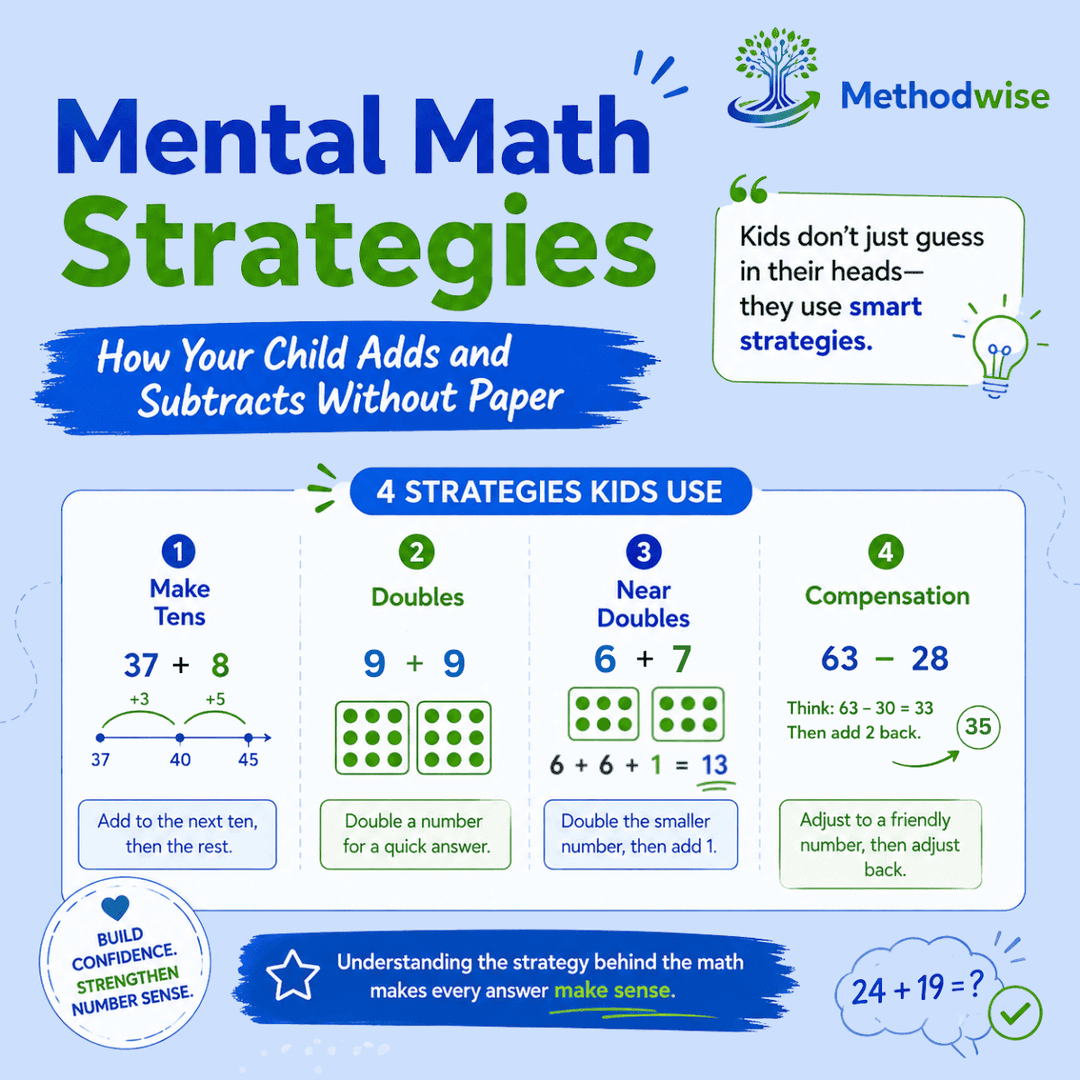
If your child came home talking about "making a ten" to add 8 + 5, or wrote 6 + 7 as 6 + 6 + 1, you're seeing mental math strategies. These are the named methods kids use to add and subtract in their heads, and they show up on homework as little notes, arrows, or broken-apart numbers that can look like the long way around a problem you'd just answer instantly. The strategies have names now, and that's the part that throws most parents.
What Are Mental Math Strategies?
Mental math strategies are reliable ways to add and subtract by reshaping numbers into easier ones instead of counting one at a time. A child solving 8 + 5 turns it into 10 + 3 because tens are easy to work with. A child solving 6 + 7 leans on the double they already know, 6 + 6, and adds one more. Each strategy is a small, repeatable move that makes the numbers friendlier before the child does the actual adding.
The four your child will meet most often are making a ten, doubles, near doubles, and compensation. Together they're the toolkit for thinking through a problem rather than reaching for a pencil.
Stuck on tonight's homework?
Paste in the problem and get a step-by-step explanation in your child's grade level — using the same method their teacher uses.
Try 3 Questions Free — No Signup RequiredWhy Do Teachers Teach Mental Math Strategies?
Most of us learned addition as a single procedure: line up the numbers, add each column, carry when you need to. It works, and your child will learn it too. But it treats every problem the same way and gives a child nothing to fall back on when there's no paper.
Mental math strategies build the other half of the skill: flexible number sense. A child who can turn 8 + 5 into 10 + 3 understands that numbers can be taken apart and put back together to suit the problem. That understanding is what makes later math, like adding two-digit numbers or estimating whether an answer is reasonable, feel manageable instead of mysterious. Teachers introduce the strategies first so fluency grows out of understanding, and the memorized facts that follow have something solid underneath them.
What Grade Are Mental Math Strategies Taught?
These strategies follow a deliberate progression from kindergarten through the early elementary grades, each one building on the last.
Kindergarten: Building the foundation
Kindergartners work on the pieces that make mental strategies possible later. They learn the pairs that make ten (the number bonds for 10) and practice adding and subtracting within 5 using objects and fingers. The strategies themselves aren't named yet, but the number sense behind them is being built.
1st Grade: The strategies get names
This is where making a ten and doubles arrive by name. A 1st grader solving 9 + 6 learns to take 1 from the 6 to make 9 into 10, then add the leftover 5. They memorize doubles facts (7 + 7, 8 + 8) and start using them to reason about near doubles. Common Core ties making a ten directly to this grade.
2nd Grade: Fluency within 20
By the end of 2nd grade, kids are expected to add and subtract within 20 fluently using these mental strategies, and to know the facts within 20 from memory. Compensation enters here as numbers grow past ten, and children start applying the same moves to two-digit problems like 39 + 25.
Grades 3 and Up: Bigger numbers, same moves
Older students stretch the strategies to larger numbers and to multiplication. Compensation that started with 39 + 25 becomes a tool for 398 + 247. The thinking doesn't change; the numbers just get bigger.
If your child is working with mental math strategies at any of these stages, it's developmentally appropriate and part of a deliberate progression.
How Mental Math Strategies Work
Here are the three strategies that show up most on homework, each worked the way a student would think through it.
Making a ten
Tens are the easiest numbers to add, so this strategy reshapes a problem to include one. Take 8 + 5.
Step 1: Look at the larger number, 8. Ask how many more it needs to reach 10. The answer is 2.
Step 2: Break the 5 into 2 and 3. Give the 2 to the 8 to make 10.
Step 3: Add the leftover 3. Now the problem is 10 + 3 = 13.
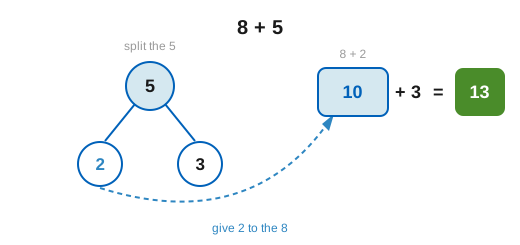 Making a ten for 8 plus 5: the 5 splits into 2 and 3, the 2 joins 8 to make 10, then 10 plus 3 equals 13
The reason this works is that the child isn't counting up from 8 five times. They're trading their way to a friendly number and finishing in one easy step. This is the same part-and-whole thinking behind number bonds, just applied in the moment.
For more on the part-whole thinking behind this, see What Are Number Bonds? A Parent's Guide to Making and Breaking Numbers.
Doubles and near doubles
Kids memorize doubles early because they come up constantly: 6 + 6, 7 + 7, 8 + 8. Once a double is automatic, any problem one step away becomes easy. Take 6 + 7.
Step 1: Notice that 6 + 7 is almost 6 + 6, a double you already know equals 12.
Step 2: Since 7 is one more than 6, add one more to the double: 12 + 1 = 13.
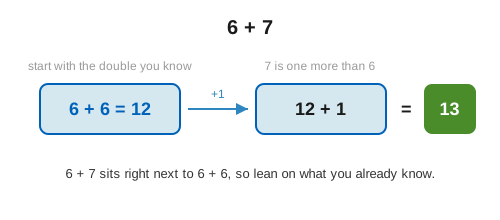 Near doubles for 6 plus 7: start from the known double 6 plus 6 equals 12, then add 1 to get 13
A near double is any fact sitting right next to a double, usually one or two away. Instead of treating 6 + 7 as a brand-new fact to memorize, the child anchors it to something solid and adjusts. The ten frame is where many kids first see doubles as two equal rows, which is what makes this click.
For more on the tool that makes doubles visible, see What Is a Ten Frame? A Parent's Guide to the Box That Builds Number Sense.
Compensation
Compensation nudges a number to something friendlier, then corrects for the nudge at the end. It shines with two-digit numbers. Take 39 + 25.
Step 1: 39 is close to 40, an easy number to add. Bump it up by 1 to make 40.
Step 2: Add the friendly version: 40 + 25 = 65.
Step 3: You added 1 extra at the start, so take it back out: 65 − 1 = 64.
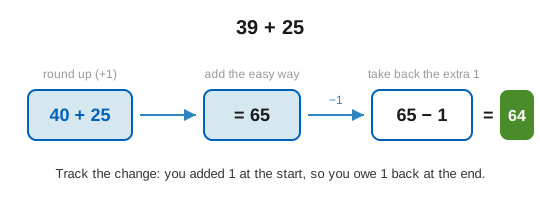 Compensation for 39 plus 25: round 39 up to 40, add to get 65, then subtract the extra 1 to land on 64
The move that separates compensation from a rough estimate is Step 3. The child doesn't just round and guess; they track exactly how much they changed and undo it to land on the precise answer. The same idea works for subtraction: to do 64 − 28, subtract 30 to get 34, then add the extra 2 back to reach 36. Breaking numbers apart by place value like this is the heart of decomposing.
For more on breaking numbers apart this way, see What Is Decomposing Numbers? A Parent's Guide to Breaking Apart Numbers.
How Mental Math Strategies Connect to What You Already Know
You use these strategies all the time without naming them.
When you figure a 20% tip on a $40 check, you probably find 10% ($4) and double it rather than multiplying 40 by 0.2. That's compensation and doubling working together.
When a coffee costs $4.60 and you hand over a five, you count up: 40 cents gets you to $5. That's making a friendly number, the same move as making a ten.
When you realize two items at $19.99 cost "basically $40," you've rounded 19.99 up to 20, doubled it, and trusted the few cents will wash out. That's compensation again.
When you split a $63 dinner check three ways and land on $21 each, you reach for the double or near-double of a number you know rather than dividing on paper.
The difference is that today's students are taught to recognize and name these strategies, so they can apply them deliberately rather than only stumbling into them when the numbers happen to be friendly.
Watch: Mental Math Strategies Explained
How to Help at Home
You don't need to teach these strategies. You need to recognize them so you can support the thinking your child is already practicing.
Use the same words the teacher uses
When your child says "make a ten," use that phrase back instead of "carry" or "borrow." Matching the classroom vocabulary keeps homework from turning into a translation problem on top of a math problem. If you're not sure what term the teacher uses, check the worksheet heading or ask your child to show you "the way you learned it at school."
Ask how they got it, not just what they got
A quick "how did you figure that out?" tells you which strategy your child reached for and whether they understand it or guessed. It also gives them practice putting the reasoning into words, which is half of what these strategies are meant to build.
Don't replace their method with yours
If your child solves 8 + 5 by making a ten and you jump in with "just memorize it," you've cut off the reasoning the homework is building. Let the strategy run its course first. Once your child can explain a method and use it reliably, that's the moment the facts start becoming automatic on their own.
Practice doubles until they're instant
Near doubles and making a ten both lean on doubles being effortless. A minute of "what's 7 plus 7? 8 plus 8?" in the car does more for mental math than a worksheet. When doubles are automatic, the strategies that depend on them stop feeling like extra steps.
Keep it out loud and low-stakes
Mental math grows from talking through numbers, not silent drilling. Toss out a problem while you're cooking or driving and let your child reason aloud, mistakes and all. The goal is flexible thinking, and that only develops when a child feels free to try a move and adjust.
Let Methodwise walk through it
When your child is stuck on a problem and you can't remember which strategy the teacher wants, Methodwise walks through it step by step using the same method their teacher is using, so you can help without guessing.
Common Mistakes to Watch For
These are the conceptual snags that trip kids up, not simple slips.
Forgetting to adjust in compensation
A child rounds 39 up to 40, adds to get 65, then writes 65 as the answer and forgets to subtract the extra 1. The fix is to name the adjustment out loud before adding: "I added 1, so I owe 1 back at the end." Tracking the change is the whole strategy.
Adjusting the wrong direction
In subtraction, compensation flips the correction, and that catches kids. For 64 − 28, they subtract 30 instead of 28, then subtract 2 more instead of adding it back. Walk through why: taking away 30 removes too much, so the 2 has to come back. A number line helps here, since you can see the jump went too far.
Treating near doubles as new facts
A child who hasn't locked in doubles can't use near doubles, so 6 + 7 becomes counting on fingers instead of "12 plus 1." If near doubles feel slow, the real gap is usually the doubles underneath. Shore those up first.
Breaking the wrong number when making a ten
For 8 + 5, a child sometimes tries to break the 8 instead of the 5, or splits the 5 into pieces that don't complete the ten. The anchor is the larger number: figure out what it needs to reach 10 first, then split the other number to supply exactly that.
Thinking the strategy is the answer
Some kids write all the steps but lose the final sum, treating the strategy as the destination. Remind them the moves are a path to a single number. Ending every problem by stating the answer keeps the purpose in view.
Practice Questions
Try these with your child. Answers are below.
Making a ten (Grade 1):
- Solve 8 + 6 by making a ten. What number do you take from the 6, and what's left?
- Solve 9 + 4 by making a ten.
Doubles and near doubles (Grades 1–2):
- You know 7 + 7 = 14. Use it to solve 7 + 8.
- You know 5 + 5 = 10. Use it to solve 5 + 6.
Compensation (Grades 2–3):
- Solve 49 + 23 by making 49 into 50 first.
- Solve 72 − 19 by subtracting 20 first, then adjusting.
Answers
- Take 2 from the 6 to make 8 into 10, leaving 4. Then 10 + 4 = 14.
- Take 1 from the 4 to make 9 into 10, leaving 3. Then 10 + 3 = 13.
- 7 + 8 is one more than 7 + 7, so 14 + 1 = 15.
- 5 + 6 is one more than 5 + 5, so 10 + 1 = 11.
- 50 + 23 = 73, then subtract the extra 1: 73 − 1 = 72.
- 72 − 20 = 52, then add 1 back because you subtracted one too many: 52 + 1 = 53.
Ready to try it with your child?
Open the chat, pick the subject and your child's grade, and get a step-by-step explanation you can use to help tonight.
Try 3 Questions Free — No Signup RequiredFrequently Asked Questions
Is mental math the same as memorizing math facts?
No. Memorizing means recalling 8 + 5 = 13 with no steps in between. Mental math strategies are the reasoning a child uses to get there before the fact is memorized, like turning 8 + 5 into 10 + 3. The strategies come first and build the number sense that makes memorization stick. By the end of 2nd grade, most kids know their facts within 20 from memory, but the strategy work is what got them there.
Should I let my child use fingers for these problems?
Yes, especially in kindergarten and 1st grade. Fingers are a concrete way to model making a ten or counting on, and they support the same reasoning the written strategies use. Most kids move away from fingers on their own as the facts become automatic. Pushing a child off fingers before they're ready usually leads to guessing, not fluency.
My child gets the right answer a different way than the homework shows. Is that a problem?
Not usually. If your child reliably gets correct answers with a method that makes sense to them, that method is valid. The homework is showing one strategy so your child has it in their toolkit, not declaring it the only acceptable route. It helps to learn the named strategy too, because later problems are built to reward it, but a working method your child understands is the goal.
What's the difference between compensation and just rounding?
Rounding gives an estimate and stops there. Compensation uses the same first move, adjusting a number to something friendlier, but then tracks the adjustment and corrects for it to land on the exact answer. For 39 + 25, rounding might say 'about 65.' Compensation says 40 + 25 = 65, then subtracts the extra 1 to get exactly 64.
Are kids allowed to use these strategies on tests?
Yes. Mental strategies are part of the standards being assessed, not a workaround. On many state tests and classroom assessments, students are expected to add and subtract within 20 fluently using exactly these strategies, and showing strategy work is often part of the credit on multi-step problems.
Try Methodwise Free
When your child brings home mental math homework and you're not sure how to explain it the way their teacher would, Methodwise walks you through it, step by step, using the same method their teacher is using.
- Start with 3 free questions, no account needed
- Free plan: 15 questions/month after signup
- Plus plan: unlimited questions + saved chat history + 7-day free trial
- Step-by-step explanations the way teachers teach
Related Articles
-
What Are Number Bonds? A Parent's Guide to Making and Breaking Numbers
-
What Is a Ten Frame? A Parent's Guide to the Box That Builds Number Sense
-
What Is Decomposing Numbers? A Parent's Guide to Breaking Apart Numbers
-
What Is Skip Counting? A Parent's Guide to How Counting by 2s, 5s, and 10s Becomes Times Tables
-
What Are Fact Families? A Parent's Guide to How Addition and Subtraction Connect
-
What Is a Number Line? A Parent's Guide to How Teachers Use It
-
What Is Partial Sums Addition? A Parent's Guide to Why Your Child Doesn't 'Carry the One' Anymore
-
What Are Arrays in Math? A Parent's Guide to Visualizing Multiplication
-
What Is the Area Model? A Parent's Guide to Box Multiplication
-
What Is Partial Quotients Division? A Parent's Guide to the New Way Kids Learn Long Division
-
Fractions on a Number Line: A Parent's Guide to Why Pie Charts Aren't Enough
-
What Is a Tape Diagram? A Parent's Guide to Visualizing Word Problems
-
What Is the Standard Algorithm? A Parent's Guide to Why Your Child Learns the 'Long Way' First
-
What Are Ratios and Proportional Reasoning? A Parent's Guide to Middle School Math
-
What Math Will My Child Learn This Year? A Parent's Guide to K-8 Math Methods by Grade
-
What Are Common Core Math Methods? A Parent's Guide to How Math Is Taught Today
-
Homework Help Tools: Built for Kids vs. Built for Parents — What's the Difference?
Have questions about mental math strategies? Email me at hello@methodwise.co
About the Author
Samantha Black is the founder of Methodwise and an educator with over 15 years in higher education and instructional design. She built Methodwise after experiencing the homework gap firsthand as a parent of two K–8 daughters. Learn more about why we built Methodwise →