
What Are Ratios and Proportional Reasoning? A Parent's Guide to Middle School Math
May 28, 2026
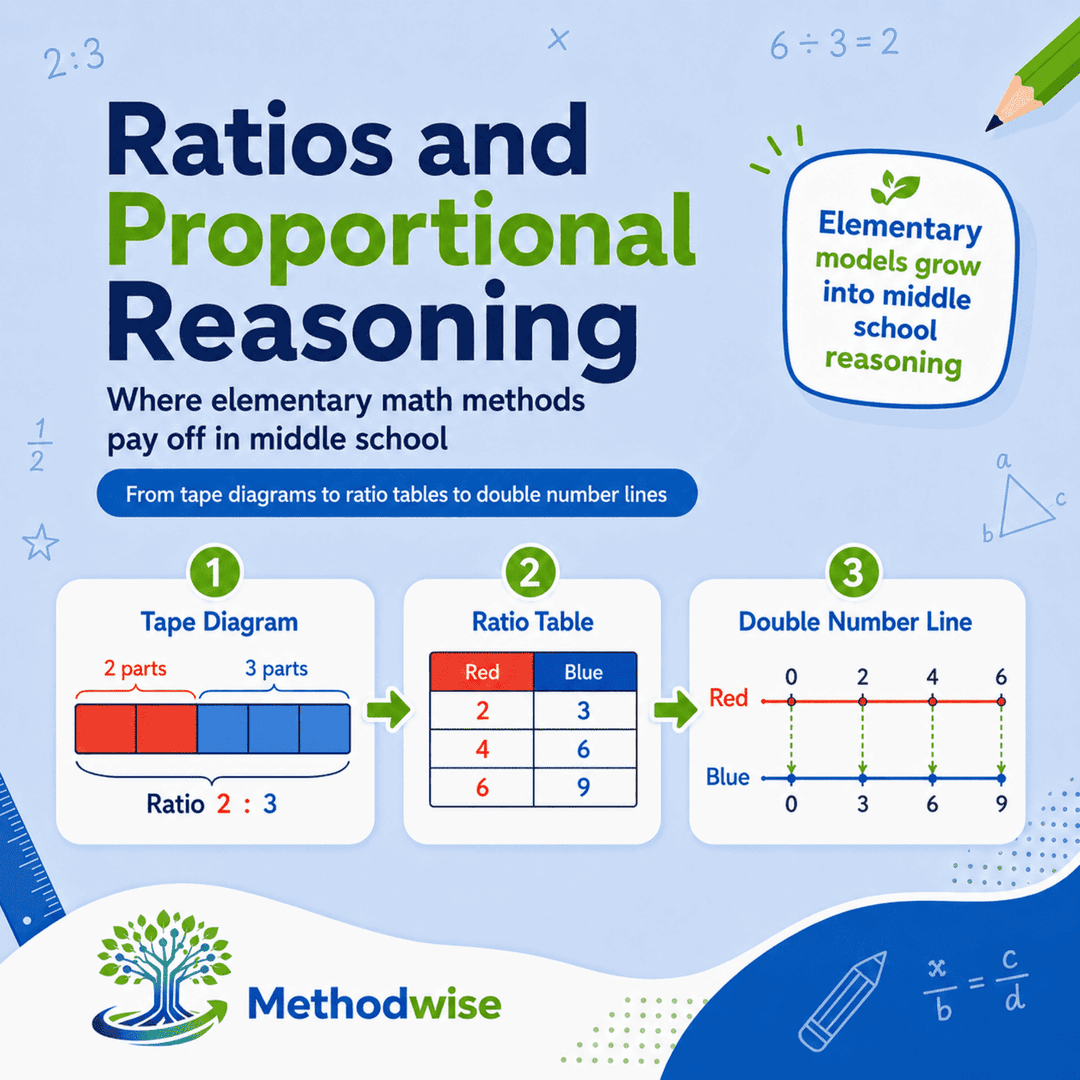
If your middle schooler comes home with homework that has rows of numbers in a little table, two number lines stacked on top of each other, or what looks like a big rectangle split into chunks, and the topic is "ratios," you're looking at the moment when all of those elementary school methods finally come together. The visual strategies your child learned in 2nd, 3rd, and 4th grade were the groundwork for the proportional reasoning that takes over in 6th, 7th, and 8th grade.
What Are Ratios and Proportional Reasoning?
A ratio is a comparison of two quantities. "Three cups of flour to four cups of milk" is a ratio. So is "12 miles in 2 hours," "5 girls for every 3 boys," and "$2.50 per pound."
Proportional reasoning is the ability to scale a relationship up or down while keeping the ratio the same. If 2 cups of flour makes 12 cookies, your child should be able to figure out (without being taught a specific formula for it) that 4 cups makes 24 cookies, and 1 cup makes 6. That's multiplicative reasoning at work.
That shift from additive thinking ("add 12 more cookies") to multiplicative thinking ("double it") is a major leap in middle school math. Almost everything that comes after, including algebra, slope, percent change, scale drawings, unit conversion, and even chemistry, builds on it.
Stuck on tonight's homework?
Paste in the problem and get a step-by-step explanation in your child's grade level — using the same method their teacher uses.
Try 3 Questions Free — No Signup RequiredWhy Do Teachers Use Ratio Tables and Double Number Lines?
If you learned ratios as "set up a proportion, cross multiply, and solve for x," you're not wrong. That method works. But it often gives students an answer before they understand the relationship. They can solve the problem on the worksheet and then miss the same idea when it shows up as a word problem, a graph, or a recipe.
Today's middle school methods slow that down. Tape diagrams, ratio tables, and double number lines are visual tools that make the relationship between two quantities visible before any equation is written. Students see that doubling one side means doubling the other. They see what "for every" actually looks like. By the time they meet the algebraic shortcut (cross multiplication or y = kx), they already know what it represents.
The other reason: these tools all evolved from the methods kids have been using since early elementary school. A tape diagram in 3rd grade looks almost identical to a ratio table in 6th grade, just with the rows rotated and a few extra columns added. The continuity is intentional.
What Grade Are Ratios and Proportional Reasoning Taught?
Grades 3–5: The Setup
Your child doesn't see the word "ratio" much before 6th grade, but they're building the foundation. Multiplication as equal groups, tape diagrams for word problems, fractions on a number line, and the area model for multiplication all teach the same underlying idea: quantities can be scaled while their relationship stays the same.
Grade 6: Ratios Get Named
Sixth graders learn the vocabulary: ratio, rate, unit rate, equivalent ratios. They use ratio tables and tape diagrams to compare quantities and find missing values. Most problems involve whole numbers and friendly scale factors. A typical question: "If 3 pounds of apples cost $6, how much do 7 pounds cost?"
Grade 7: Proportional Relationships
Seventh grade is where the reasoning deepens. Students work with non-whole-number scale factors, percent problems, scale drawings, and the constant of proportionality. Double number lines become a standard tool. A typical question: "A map has a scale of 1 inch = 25 miles. Two cities are 3.5 inches apart on the map. How far apart are they in real life?"
Grade 8: Slope and Linear Relationships
Eighth graders see proportional relationships graphed as straight lines through the origin. The slope of that line is the unit rate. They start comparing proportional and non-proportional relationships and writing equations of the form y = kx. A typical question: "A printer prints 4 pages every 10 seconds. Write an equation for the number of pages printed in t seconds."
If your child is working with ratios at any of these stages, it's part of a deliberate K–8 progression, not a one-off topic.
How Ratios and Proportional Reasoning Work
The three visuals you're most likely to see on middle school homework are the ratio table, the double number line, and the tape diagram. Each one shows a proportional relationship in a slightly different way.
Tape diagrams grow up into ratio tables
In elementary school, a tape diagram is a long rectangle split into equal boxes to represent a word problem. A 6th grader still uses tape diagrams, but they start stacking them: one strip for each quantity in the ratio, with the same number of boxes per "unit."
A ratio of 3:4 (say, 3 cups of flour to 4 cups of milk) can be drawn as a tape diagram with 3 boxes on top and 4 boxes underneath. If each box represents 2 cups, the recipe scales to 6 cups of flour and 8 cups of milk. If each box represents 5 cups, it scales to 15 and 20. The "each box equals" idea is exactly what becomes a ratio table: a row of numbers showing every equivalent ratio side by side.
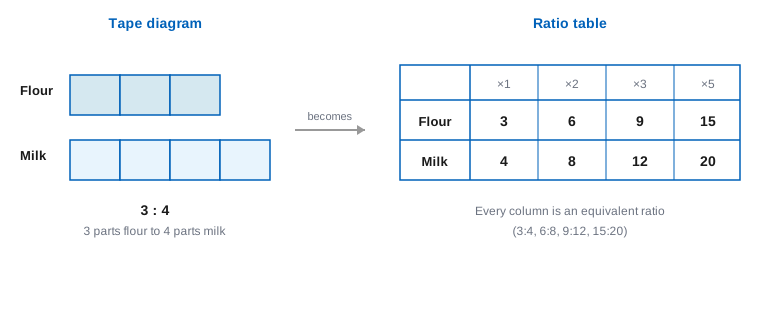 Tape diagram showing 3 boxes of flour above 4 boxes of milk, with an arrow leading to a ratio table that lists scale factors of 1, 2, 3, and 5 for the same ratio
The ratio table moves faster on paper, and the tape diagram is what makes "equivalent ratios" make sense in the first place. If your child is stuck on a ratio table, asking them to sketch the tape diagram first usually unblocks them.
Double number lines line up two quantities at once
A double number line is two parallel number lines stacked on top of each other, with matching tick marks. The top line shows one quantity (miles, dollars, cookies); the bottom shows the other (hours, pounds, batches). When the tick marks line up, the two quantities are equivalent.
Suppose a car travels 60 miles in 1 hour. You can place 60 above 1, then mark 120 above 2, 180 above 3, and so on. To find how far the car goes in 4.5 hours, you slide along the line and read the value above 4.5 (270 miles). To find how long it takes to go 90 miles, you find 90 on the top and read the value below (1.5 hours).
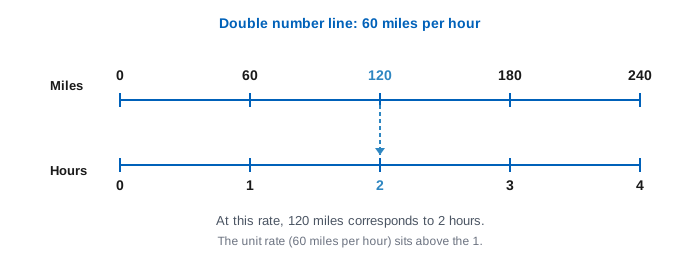 Double number line with miles labeled 0, 60, 120, 180, 240 on the top line and hours labeled 0, 1, 2, 3, 4 on the bottom line, with a vertical arrow showing that 120 miles corresponds to 2 hours
Double number lines are especially good for problems with unit rates (per hour, per pound, per page). The unit rate is the value sitting above 1.
For a refresher on how teachers introduce number lines in elementary school (the foundation double number lines build on), see What Is a Number Line? A Parent's Guide to How Teachers Use It.
Ratio tables let you scale by any factor
A ratio table is just a small two-row table. The top row holds one quantity, the bottom row holds the other, and each column is an equivalent ratio. You can scale by multiplying any column by a number, or by adding two columns together.
For a recipe with 2 cups of flour and 3 cups of milk, the first column reads 2 over 3. Doubling gives 4 over 6. Tripling gives 6 over 9. To find how much milk goes with 5 cups of flour, you can either compute the unit rate (1 cup of flour to 1.5 cups of milk, then multiply by 5) or scale the table by 2.5 (5 cups of flour to 7.5 cups of milk). Both work, and a fluent student can pick the easier path for the numbers they have.
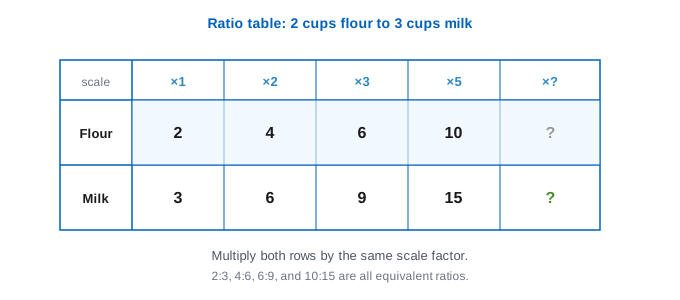 Ratio table for a recipe with column headers showing scale factors of times 1, times 2, times 3, and times 5, a flour row with values 2, 4, 6, 10, and a milk row with values 3, 6, 9, 15
The connection back to elementary methods is direct: a ratio table is a tape diagram with the boxes replaced by numbers, a double number line is a tape diagram stretched out and labeled, and cross multiplication is what happens algebraically when you take any two columns of a ratio table.
For more on how the area model sets up this kind of multiplicative thinking in earlier grades, see What Is the Area Model? A Parent's Guide to Box Multiplication.
How Ratios and Proportional Reasoning Connect to What You Already Know
You use proportional reasoning constantly without naming it.
You scale a recipe up for a bigger crowd; that's a ratio table in your head. You estimate how long a road trip will take based on the speed limit; that's a double number line. You convert dollars to euros on vacation, figure out the better deal between a 12-pack and a 24-pack, or guess how much paint you need based on how much covered the last room. All of it is proportional reasoning.
Sports stats are another everyday example. Batting averages, free-throw percentages, miles per gallon, points per game: these are all unit rates. A driver who gets 30 miles per gallon and a driver who gets 25 are in a proportional comparison your brain does without thinking.
The difference is that today's students are taught to recognize and name the structure, so they can apply it deliberately rather than only using it when the numbers happen to be friendly.
Watch: Ratios and Proportional Reasoning Explained
How to Help at Home
Use the language your child's teacher uses
If the homework says "ratio table," don't call it a chart. If it says "unit rate," don't call it "the per-one number." Matching the teacher's vocabulary makes it easier for your child to connect what you say at the kitchen table to what they hear in class.
Ask your child to draw before they calculate
When your child gets stuck on a ratio problem, the fastest way back in is to ask them to draw what's happening: a tape diagram, a double number line, or a ratio table. The visual usually surfaces the relationship faster than rereading the problem.
Don't rush them to cross multiplication
If your child can solve a proportion with a ratio table, that counts. Cross multiplication is a great shortcut, and it can quietly replace understanding with procedure if it arrives too early. Once the reasoning is solid, the shortcut sticks. If it isn't, the shortcut becomes a magic trick that doesn't transfer to the next problem.
Catch proportional reasoning in everyday moments
When you're scaling a recipe, splitting a bill, comparing prices, or figuring out how long a trip will take, narrate the math. "Two cups of rice fed three of us last time, so for six people I'll need…" gives your child a model for how proportional thinking sounds out loud.
Validate the method before redirecting
If your child draws a ratio table when you would have set up a proportion, resist the urge to "fix" it. Ratio tables, double number lines, and proportions all reach the same answer. Let them finish their method, then ask if they can also solve it your way. Comparing methods is the point.
Let Methodwise walk through it
When the homework lands somewhere between "I sort of get this" and "I have no idea," paste the problem into Methodwise. Set your child's grade, and you'll get a step-by-step explanation that uses ratio tables, double number lines, or tape diagrams, whichever matches the way their teacher is teaching it.
Common Mistakes to Watch For
Adding instead of multiplying
A student sees the ratio 2:3, knows they need to get to 6 on top, and writes 7 on the bottom instead of 9. They added 4 to both sides instead of multiplying both sides by 3. If your child gets a ratio answer that "feels close," check whether they added when they should have scaled.
Mixing up the order of the two quantities
If the ratio is "3 cups of flour to 4 cups of milk," reversing the order changes what the answer means. 4:3 is a different relationship from 3:4. Encourage your child to label both rows of their ratio table or both lines of their double number line, even on scratch work.
Treating a non-proportional relationship as proportional
Not every comparison is a ratio. "A taxi charges $3 plus $2 per mile" is not a proportional relationship, because the $3 starting fee doesn't scale with distance. Students who learn proportional reasoning sometimes apply it to problems where it doesn't fit. A quick check: does doubling the input double the output? If not, it isn't proportional.
Forgetting what "per" means
"Per" almost always signals a unit rate. "Miles per hour" means miles for every one hour. "Dollars per pound" means dollars for every one pound. If your child can't figure out what to divide by what, having them rewrite the rate as "X for every 1 Y" usually clears it up.
Reading a ratio table column-by-column instead of as relationships
Some students read a ratio table left to right like a sequence: "2, 4, 6, 10, what comes next?" That works for some patterns and fails for others. Each column is its own equivalent ratio; the relationship between the top row and the bottom row is what the table is showing. Asking "what's the relationship between the top and the bottom?" gets at the right idea.
Practice Questions
Try these with your child. Answers are at the bottom.
Grade 6: Ratios and equivalent ratios:
- A fruit punch recipe calls for 2 cups of orange juice and 5 cups of pineapple juice. If you use 10 cups of orange juice, how much pineapple juice do you need?
- Write the ratio 18:24 in simplest form.
- There are 15 boys and 12 girls in a class. What is the ratio of boys to girls? What is the ratio of girls to total students?
Grade 7: Proportional relationships and unit rates:
- A printer prints 90 pages in 6 minutes. At this rate, how many pages does it print in 15 minutes? What is the unit rate?
- On a map, 1 inch represents 40 miles. Two towns are 3.5 inches apart on the map. How far apart are they in real life?
- A jacket originally costs $80 and is on sale for 25% off. What is the sale price?
Grade 8: Proportional equations and slope:
- A taxi service charges $2.50 per mile, with no flat starting fee. Write an equation for the cost (y) of a ride of x miles. Is this a proportional relationship? How can you tell from the equation?
- The graph of a proportional relationship passes through the point (4, 10). What is the constant of proportionality? Write an equation for the relationship.
- Maria reads 36 pages in 45 minutes. At this rate, how many pages will she read in 2 hours?
Answers
Grade 6:
- 25 cups of pineapple juice (scale by 5: 2×5 = 10, 5×5 = 25)
- 3:4 (divide both by 6)
- Boys to girls = 15:12 = 5:4. Girls to total = 12:27 = 4:9
Grade 7:
- 225 pages. Unit rate = 15 pages per minute
- 140 miles (3.5 × 40)
- $60 sale price (25% of $80 = $20 off; $80 − $20 = $60)
Grade 8:
- y = 2.5x. Yes, it is proportional, because the equation has no constant term added on. It's in the form y = kx with k = 2.5.
- Constant of proportionality = 2.5 (because 10 ÷ 4 = 2.5). Equation: y = 2.5x
- 96 pages. Unit rate = 36/45 = 0.8 pages per minute. 2 hours = 120 minutes. 0.8 × 120 = 96.
Ready to try it with your child?
Open the chat, pick the subject and your child's grade, and get a step-by-step explanation you can use to help tonight.
Try 3 Questions Free — No Signup RequiredFrequently Asked Questions
Is proportional reasoning the same as fractions?
They're closely related but not the same. A fraction names a part of a single whole (3/4 of a pizza). A ratio compares two quantities to each other (3 cups of flour to 4 cups of milk). Proportional reasoning is the multiplicative thinking that connects them, since both rely on the idea that you can scale a relationship up or down without changing it. Once your child can move comfortably between fractions, ratios, and percents, they're doing proportional reasoning.
Should I teach my child the cross multiplication 'butterfly' method?
Cross multiplication is a useful shortcut, but it's worth holding off until your child can solve proportions with a ratio table or double number line first. Cross multiplication gives the right answer without showing why it works. Middle school teachers often delay the shortcut on purpose so students build the underlying reasoning. Once that's solid, the shortcut clicks faster, and it stays correct under pressure.
My child can solve ratio problems but can't explain how. Should I worry?
Not necessarily, but it's worth a check-in. Plenty of kids find a procedure that works and stop asking why. The risk is that when the problem gets reworded (comparing rates instead of recipes, or working with non-whole-number scale factors), the procedure breaks. Ask your child to draw what's happening, not just calculate. If they can sketch a tape diagram or ratio table that matches their work, they're in good shape.
When does proportional reasoning turn into algebra?
In 7th and 8th grade, proportional relationships get written as equations of the form y = kx, where k is the constant of proportionality. That equation is the algebraic version of what a ratio table or double number line shows visually. By high school, the same idea shows up in slope, similar figures, scale drawings, and most of physics and chemistry. The reasoning doesn't go away. It just gets new notation.
My child's older sibling learned ratios with cross multiplication first. Should the younger one unlearn it?
No need to unlearn it. Cross multiplication tells your child what the missing number is; a ratio table or double number line shows them why it works. If your older child can already cross-multiply confidently, they're in good shape. Just make sure they can sketch a tape diagram or ratio table for the same problem if a teacher asks for it. The newer methods make the reasoning visible; the shortcut still has a place once the reasoning is solid.
Try Methodwise Free
When your child brings home a ratio table, a double number line, or a proportional reasoning problem and you're not sure how to explain it the way their teacher would, Methodwise walks you through it, step by step, using the same method their teacher is using.
- Start with 3 free questions, no account needed
- Free plan: 15 questions/month after signup
- Plus plan: unlimited questions + saved chat history + 7-day free trial
- Step-by-step explanations the way teachers teach
Related Articles
-
What Is a Number Line? A Parent's Guide to How Teachers Use It
-
Fractions on a Number Line: A Parent's Guide to Why Pie Charts Aren't Enough
-
What Is a Tape Diagram? A Parent's Guide to Visualizing Word Problems
-
What Is the Area Model? A Parent's Guide to Box Multiplication
-
What Is Decomposing Numbers? A Parent's Guide to Breaking Apart Numbers
-
What Are Number Bonds? A Parent's Guide to Making and Breaking Numbers
-
What Is Partial Sums Addition? A Parent's Guide to Why Your Child Doesn't 'Carry the One' Anymore
-
What Is Partial Quotients Division? A Parent's Guide to the New Way Kids Learn Long Division
-
What Are Arrays in Math? A Parent's Guide to Visualizing Multiplication
-
What Is a Ten Frame? A Parent's Guide to the Box That Builds Number Sense
-
What Are Fact Families? A Parent's Guide to How Addition and Subtraction Connect
-
What Is the Standard Algorithm? A Parent's Guide to Why Your Child Learns the 'Long Way' First
-
What Are Common Core Math Methods? A Parent's Guide to How Math Is Taught Today
-
Homework Help Tools: Built for Kids vs. Built for Parents — What's the Difference?
-
What Is Skip Counting? A Parent's Guide to How Counting by 2s, 5s, and 10s Becomes Times Tables
-
What Math Will My Child Learn This Year? A Parent's Guide to K-8 Math Methods by Grade
-
What Are Mental Math Strategies? A Parent's Guide to How Kids Add and Subtract in Their Heads
Have questions about ratios or proportional reasoning? Email me at hello@methodwise.co
About the Author
Samantha Black is the founder of Methodwise and an educator with over 15 years in higher education and instructional design. She built Methodwise after experiencing the homework gap firsthand as a parent of two K–8 daughters. Learn more about why we built Methodwise →