
What Are Story Elements? A Parent's Guide to Characters, Setting, Problem, and Solution
July 13, 2026
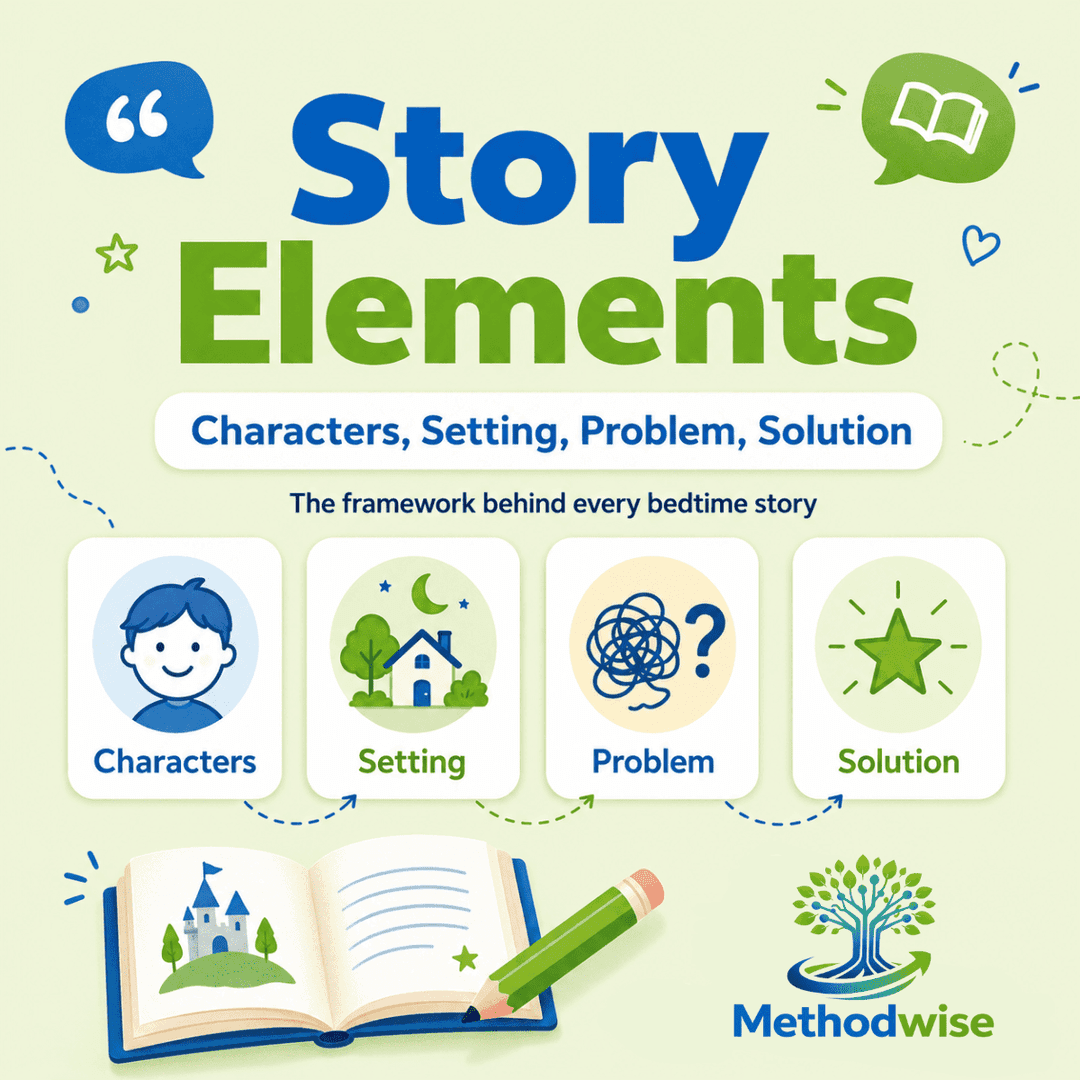
Your first grader brings home a worksheet split into four boxes. The labels read Characters, Setting, Problem, and Solution, and there's a wobbly drawing of a pig in the first box and nothing in the other three. Or the teacher sends a note: "We're working on retelling. At home, ask your child who the story was about, where it happened, what went wrong, and how it got fixed." That four-part framework has a name. It's called story elements, and it's the scaffolding underneath almost everything your child will do in reading for years.
The good news for read-aloud time: you already use this framework every time you tell someone about a movie. Your child is just learning to name the parts.
What Are Story Elements?
Story elements are the building blocks every story is made of: the characters (who it's about), the setting (where and when it happens), the problem (what goes wrong), and the solution (how it gets resolved). Some teachers add a fifth piece, the events or plot, which is everything that happens between the problem and the solution.
When a teacher asks a child to identify the story elements, they're asking the child to sort a story into these parts rather than repeat it line by line. A parent who reads this section can explain story elements to another parent in one sentence: they're the who, where, what-went-wrong, and how-it-got-fixed of any story.
Stuck on tonight's homework?
Paste in the problem and get a step-by-step explanation in your child's grade level — using the same method their teacher uses.
Try 3 Questions Free — No Signup RequiredWhy Do Teachers Use Story Elements?
You learned to talk about stories too. You may have called it "beginning, middle, and end," or answered questions about who and what and where. Story elements is that same instinct made explicit and given steady names, so a child in kindergarten and a child in third grade are building the same mental model at different depths.
The reason teachers lean on the framework is that it gives a child somewhere to put information. Ask a five-year-old "what was the story about?" and you often get a breathless recap of every page in order. Story elements replaces that firehose with four buckets. The child stops trying to hold the whole story at once and starts sorting it: this part is the setting, this part is the problem.
That sorting is what later reading skills are built on. Summarizing, finding the theme, making inferences about why a character acted, analyzing plot in a novel. Every one of them assumes a child can already break a story into its parts. Story elements is where that ability starts.
What Grade Is Story Elements Taught?
Story elements appear in the reading standards from the first year of school and grow more demanding each year. Here's how the progression usually unfolds.
Kindergarten: Identifying the pieces with help
Kindergartners work on identifying characters, settings, and major events "with prompting and support," which is the exact language of the standard (RL.K.3). In practice, that means the teacher does a lot of the pointing. During a read-aloud she'll ask, "Who is this story about? Where are they?" and the class answers together, usually with the pictures right in front of them. The goal is recognition, not independence.
First Grade: Describing with details
First graders move from naming to describing (RL.1.3). Instead of just "a girl," a child is expected to say "a girl named Goldilocks who goes into the bears' house." The homework often looks like a simple story map with a box for each element, filled in with a word or a short phrase and a drawing. Major events start to matter here too, not just who and where.
Second Grade: The shape of the whole story
Second grade is where problem and solution become explicit. Students describe the overall structure of a story, including how the beginning introduces it and the ending wraps it up (RL.2.5). They also start explaining how characters respond to the problems they face (RL.2.3). A second grader should be able to say what went wrong in the story and how it got fixed, in that order.
Third Grade: Why characters do what they do
Third graders describe characters by their traits, motivations, and feelings, and explain how a character's actions move the story along (RL.3.3). The question shifts from "what happened?" to "why did she do that, and what did it cause?" This is the first real step toward the kind of analysis your child will do with novels in later grades.
If your child is working with story elements at any of these stages, it's developmentally appropriate and part of a deliberate progression.
How Story Elements Works
The clearest way to see the framework is to watch it turn a familiar story into a few organized parts. Here are three ways it shows up on homework, from a simple map to a look inside a character's head.
Mapping a familiar story
Take a story your child already knows, like "The Three Little Pigs," and drop each piece into its box. Who is it about? The three pigs and the wolf. Where and when? In the woods, long ago. What's the problem? The wolf wants to blow the houses down. How is it solved? The pigs stay safe in the brick house. That's the whole story sorted into four parts.
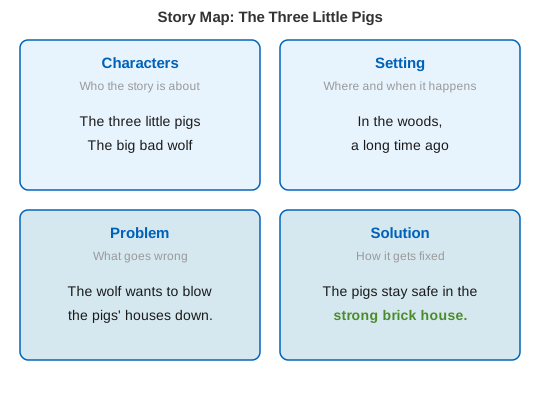 Story map for The Three Little Pigs, with Characters, Setting, Problem, and Solution filled into four boxes
Notice that filling in the four boxes is already a short retell. This is why story elements and retelling are taught side by side: the map is the skeleton, and a good retelling is that skeleton with a little muscle on it.
For more on this connection, see Summarizing vs. Retelling: A Parent's Guide to Why the Teacher Keeps Saying "Too Many Details."
The shape of a story: beginning, middle, end
By second grade, the four boxes get arranged along the shape of the story. The beginning introduces the characters and setting. The middle is where the problem shows up and the characters have to act. The end is where the problem gets solved and things settle down.
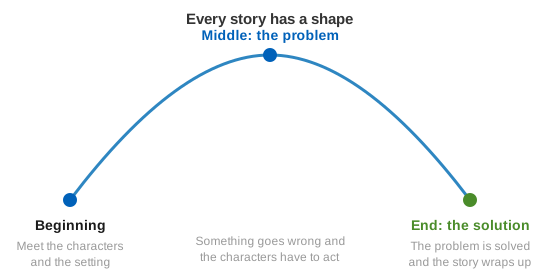 A story arc showing the beginning where characters are introduced, the middle where the problem appears, and the end where the solution resolves it
Seeing a story as a shape helps a child understand that the problem belongs in the middle and the solution comes near the end. It also plants the seed for finding a story's bigger meaning later on, since a theme usually lives in how the problem gets solved.
For where this leads, see Main Idea vs. Theme: What Your Child's Teacher Actually Means.
Looking closely at a character
Third grade zooms in on the characters themselves. A student learns to name a character's traits and figure out what that character wants, then trace how those wants drive what happens. Little Red Riding Hood is curious and brave. She wants to visit her grandmother. So she takes the path through the woods, and that choice is what leads her to meet the wolf.
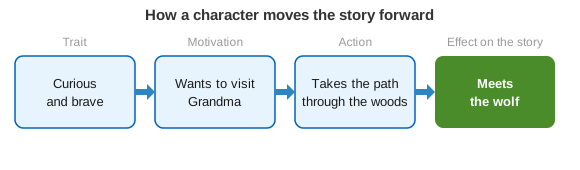 A flow showing a character's trait leading to a motivation, then an action, then its effect on the story
Working out what a character wants often means reading between the lines, since a book rarely states a character's feelings outright. That's the same skill as inference, which is why the two get practiced together.
For more on this skill, see What Is Making Inferences? A Parent's Guide to Reading Between the Lines.
How Story Elements Connects to What You Already Know
You use this framework constantly without naming it.
When a friend asks how a movie was, you don't recite it scene by scene. You say who it was about, where it took place, the trouble the main character got into, and how it worked out. That's characters, setting, problem, and solution, delivered in about fifteen seconds.
The same thing happens when you recap your day at dinner. There were the people involved, the place it happened, the thing that went sideways, and how you handled it. Your brain sorts the day into those parts automatically.
Even the way your child narrates a trip to the park follows the shape: "We went to the park, and then Jordan lost his shoe in the sandbox, and we had to dig for it." Setting, problem, solution, told without a single worksheet.
The difference is that today's students are taught to recognize and name these elements, so they can apply the framework deliberately rather than only noticing a story's shape when someone points it out to them.
Watch: Story Elements Explained
How to Help at Home
Ask the four questions during read-alouds
At the end of a bedtime story, ask who the story was about, where it happened, what the problem was, and how it got solved. You don't need a worksheet or a printout. The four questions are the whole tool, and asking them turns any picture book into comprehension practice.
Use the words the teacher uses
Say "characters," "setting," "problem," and "solution" out loud, even with a five-year-old. When your child hears the same vocabulary at home that they hear at school, the classroom lesson has a familiar place to land, and the words stop feeling like test language.
Pause at the problem
Stop reading right when things go wrong and ask, "What's the problem here? What do you think they'll do about it?" The problem is the part kids most often rush past, and pausing there builds prediction at the same time you're practicing story elements.
Let your child retell it their way first
When your child retells a story out of order or starts in the middle, resist the urge to fix the sequence on the spot. Let them finish. Then ask about whatever element they left out: "You told me what happened. Now, who was it about?" Their instinct to retell is worth protecting, and you can guide the structure without red-penciling it.
Point out story elements in shows and movies
The framework works on anything with a plot. After an episode of a favorite cartoon, ask the same four questions you'd ask about a book. Screen time becomes a low-pressure chance to practice the exact skill that shows up on the worksheet.
Let Methodwise walk through it
When your child is stuck on a story-elements worksheet and you're not sure how the teacher wants it answered, Methodwise walks through it step by step using the same language your child's teacher uses. Ask it to explain the difference between the problem and the setting, or to model a retell of the story your child is reading, and it responds the way the classroom lesson would.
Common Mistakes to Watch For
Listing every event instead of naming the problem
Ask a child what a story was about and you'll often get every single thing that happened, page by page. The skill is sorting, not reciting. Steer them toward the one thing that mattered: "Out of everything that happened, what was the big problem the characters had to fix?"
Confusing the setting with the problem
A child will sometimes say the problem is "the forest" or "it was dark out." Setting is where and when the story happens; the problem is what goes wrong inside it. If your child blends the two, ask them separately: "Where does this take place?" and then "What's the trouble in this story?"
Stopping at the problem and forgetting the solution
Kids get so caught up in what went wrong that they leave off how it got fixed, and a retell without a solution feels unfinished. Ask straight out: "So how did it end? How did they solve it?" Getting to the solution is what makes the retell complete.
Assuming every problem has a villain
Not every story has a big bad wolf. Sometimes the problem is a feeling or a wish: a character is lonely, or lost, or wants something they can't have. When there's no obvious bad guy, help your child look inward with, "What does this character want, and what's getting in the way?"
Naming only the main character
Ask "who are the characters?" and many kids name just the hero. Remind them that characters means everyone the story is about, including the friend, the little sister, or the talking animal who shows up halfway through.
Practice Questions
Try these with your child. Use a book you've read together, or lean on "The Three Little Pigs" for the examples. Answers are below.
Characters and setting (Kindergarten–1st grade):
- Who are the characters in the story?
- Where does the story take place? Is it daytime or nighttime?
- Name one thing from the story that tells you about the setting.
Problem and solution (2nd grade):
- What is the problem in "The Three Little Pigs"?
- How do the pigs solve the problem?
- What happens at the very end of the story?
Character and cause (3rd grade):
- Describe the wolf. What is he like, and what does he want?
- How do the wolf's actions cause the events of the story?
- Pick a character from a book you're reading now. Name one trait that helps explain something they do.
Answers
Characters and setting (Kindergarten–1st grade):
- In "The Three Little Pigs," the characters are the three pigs and the wolf.
- It takes place outdoors near the pigs' houses. Any reasonable answer a child can point to in the story works.
- Sample answer: the houses made of straw, sticks, and bricks tell us the story happens in a place where the pigs are building homes.
Problem and solution (2nd grade):
- The problem is that the wolf wants to blow the pigs' houses down and catch them.
- The pigs solve it by taking shelter in the house built of bricks, which the wolf can't blow down.
- At the end, the wolf gives up (or, in some versions, falls down the chimney), and the pigs are safe.
Character and cause (3rd grade):
- The wolf is hungry, determined, and sneaky. He wants to eat the pigs.
- Because the wolf keeps chasing and huffing and puffing, the pigs have to keep running and building sturdier houses, which drives the whole story forward.
- Answers will vary. Look for a real trait (brave, stubborn, kind) paired with an action it explains, such as "She's stubborn, so she refused to apologize."
Ready to try it with your child?
Open the chat, pick the subject and your child's grade, and get a step-by-step explanation you can use to help tonight.
Try 3 Questions Free — No Signup RequiredFrequently Asked Questions
Is plot the same thing as story elements?
Plot is one of the story elements, not a replacement for them. Plot is the sequence of events that happens between the problem and the solution. Story elements is the bigger set that plot belongs to: characters, setting, problem, solution, and the events that connect them. When a teacher asks for the plot, they want the what-happened sequence; when they ask for story elements, they want the child to sort the whole story into its parts.
My child's teacher uses a story map or a story mountain. Are those the same as story elements?
Yes. Those are graphic organizers that hold the same elements in different shapes. A story map is usually the four-box grid with Characters, Setting, Problem, and Solution. A story mountain arranges the events along a rising-and-falling line so students can see where the problem builds and where it gets resolved. Both are tools for the same underlying skill.
Is this the same as the five W's?
They overlap but aren't identical. Who maps to characters, where and when map to setting, and what maps to the problem and events. Story elements adds the solution and, in the older grades, the why behind a character's choices. The five W's show up more often in nonfiction and news writing, while story elements are used for narratives and fiction.
Do nonfiction books have story elements?
Usually not. Story elements describe narratives, meaning stories with characters and a plot. When your child reads an information book about volcanoes or the solar system, teachers reach for text structure and text features instead, since that kind of book is organized by ideas rather than by a problem and a solution.
When do problem and solution turn into conflict and resolution?
Around fourth and fifth grade, and more so in middle school, the same ideas get renamed. Problem becomes conflict, and solution becomes resolution. Students also start noticing that a story can have more than one problem, and that some conflicts are internal, meaning a character struggling with a feeling or a decision rather than an outside villain.
Try Methodwise Free
When your child brings home story-elements homework and you're not sure how to explain it the way their teacher would, Methodwise walks you through it, step by step, using the same method their teacher is using.
- Start with 3 free questions, no account needed
- Free plan: 15 questions/month after signup
- Plus plan: unlimited questions + saved chat history + 7-day free trial
- Step-by-step explanations the way teachers teach
Related Articles
-
Summarizing vs. Retelling: A Parent's Guide to Why the Teacher Keeps Saying 'Too Many Details'
-
What Is Making Inferences? A Parent's Guide to Reading Between the Lines
-
Main Idea vs. Theme: What Your Child's Teacher Actually Means
-
What Is Close Reading? A Parent's Guide to Deeper Comprehension
-
Reading Comprehension Strategies: A Parent's Guide to How Teachers Teach Reading
-
What Is Citing Evidence? A Parent's Guide to Text Evidence in Reading and Writing
-
Opinion Writing vs. Argument Writing: A Parent's Guide to the K–8 Writing Progression
-
Author's Purpose vs. Point of View: A Parent's Guide to PIE, Narrators, and Perspective
-
What Is Text Structure? A Parent's Guide to How Nonfiction Is Organized
-
What Are Text Features? A Parent's Guide to Nonfiction Reading
-
Reading Levels Explained: Lexile, F&P, and DRA in Plain English
-
What Are Context Clues? A Parent's Guide to How Kids Figure Out New Words Without a Dictionary
-
Homework Help Tools: Built for Kids vs. Built for Parents — What's the Difference?
-
What Is Phonemic Awareness? A Parent's Guide to Playing With Sounds Before Reading
Have questions about story elements? Email me at hello@methodwise.co
About the Author
Samantha Black is the founder of Methodwise and an educator with over 15 years in higher education and instructional design. She built Methodwise after experiencing the homework gap firsthand as a parent of two K–8 daughters. Learn more about why we built Methodwise →