
What is the Area Model? A Parent's Guide to Box Multiplication
March 11, 2026
If your child came home with a multiplication problem that looked nothing like what you learned — a box divided into sections with numbers inside — you're not alone.
That box is called the area model. And once you understand what it's doing, it actually makes more sense than the method most of us learned growing up.
What is the Area Model?
The area model is a way of multiplying numbers by breaking them into smaller, more manageable pieces using a rectangle.
Instead of stacking numbers in columns and carrying digits, students draw a box, split it by place value, multiply each section separately, and then add the results together.
The answer is the same. But the process shows why it works — not just how to get there.
Why Do Teachers Use It?
The standard algorithm — the column method most parents learned — is efficient, but it hides what's actually happening mathematically. When you "carry the one," do you know why? Most of us don't. We just learned the steps.
The area model makes the math visible. It shows students that multiplying 34 × 7 is really the same as multiplying (30 × 7) + (4 × 7) and adding those two results together. That's the distributive property — and understanding it is what allows students to do mental math, check their work, and eventually handle algebra.
Teachers use the area model because it builds number sense, not just answer-getting.
Stuck on tonight's homework?
Paste in the problem and get a step-by-step explanation in your child's grade level — using the same method their teacher uses.
Try 3 Questions Free — No Signup RequiredWhat Grade is the Area Model Taught?
The area model appears at every level of elementary and middle school math, with increasing complexity:
Grades 2–3 — Foundations
Students are introduced to the concept of area (length × width) and learn to work with arrays — rows and columns of objects. This builds the visual intuition that multiplication is about covering a rectangular space, which is exactly what the area model makes explicit.
Grade 4 — Major Focus
This is when most students formally learn the area model for multi-digit multiplication. It becomes a primary strategy for solving problems like 34 × 27 — and teachers also use it as a way into division, helping students see that dividing is the reverse of finding an unknown side of a rectangle.
Grades 5–6 — Deepening Understanding
The area model extends to multiplying fractions and decimals. A student multiplying ½ × ¾ can visualize it as a rectangle with fractional side lengths — and the area model makes that abstract concept concrete.
If your child is anywhere in this range and encountering this method, it's exactly where it should be in their math progression.
How the Area Model Works
Let's walk through an example: 23 × 8
Step 1: Break the larger number apart by place value 23 = 20 + 3
Step 2: Draw a rectangle divided into two sections One section for the tens (20), one for the ones (3).
Step 3: Multiply each section by 8
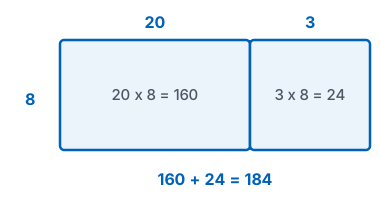 Area model for 23 × 8: box split into 20×8=160 and 3×8=24, totaling 184
Step 4: Add the two products together 160 + 24 = 184
So 23 × 8 = 184.
Breaking 23 into 20 and 3 made the multiplication manageable. That's the whole point of the area model — turn one hard problem into two easier ones.
Two-Digit by Two-Digit Multiplication
Once students are comfortable with one-digit multipliers, teachers extend the area model to two-digit by two-digit multiplication.
Example: 34 × 27
Step 1: Break both numbers apart by place value 34 = 30 + 4 and 27 = 20 + 7
Step 2: Draw a rectangle divided into four sections
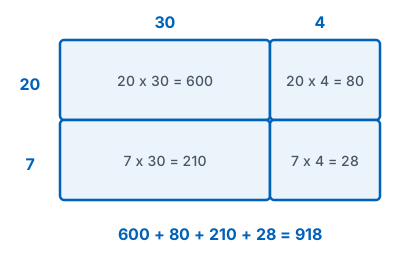 Area model for 34 × 27: 2×2 box with partial products 600, 80, 210, 28 totaling 918
Step 3: Add all four products together 600 + 80 + 210 + 28 = 918
So 34 × 27 = 918.
It looks like more steps — and it is. But each individual multiplication is simple, and students can see exactly where every part of the answer came from.
How the Area Model Connects to What You Already Know
If you learned math the traditional way, the area model might look like extra work. But the math underneath is the same — the area model just makes the steps visible.
The standard algorithm hides the distributive property. When you multiply 34 × 7 using the column method, you're actually doing (30 × 7) + (4 × 7) = 210 + 28 = 238. The area model draws that out explicitly so students understand why the steps work — not just how to follow them.
Carrying digits is partial product addition. When you "carry the 2" in a multiplication problem, you're adding partial products. The area model does the same thing, but keeps each part visible in its own section of the box before combining.
The standard algorithm is faster once a student understands what they're doing. The area model is how they get there.
Watch: What is the Area Model? A Parent's Guide to Box Multiplication
How to Help at Home
Let them draw the box
If your child is staring at the problem, ask them to draw a rectangle first. Getting the visual structure on paper is often enough to get unstuck. Don't jump to the numbers — start with the box.
Focus on the place value split
The most common point of confusion is breaking the number apart correctly. Ask: "What are the tens? What are the ones?" before touching the multiplication. If place value is shaky, that's the thing to address first.
For a deeper dive on place value, see What Is Expanded Form? A Parent's Guide to Place Value.
Check the addition at the end
Students who get the multiplication right often make errors when adding the partial products. Walk through the final addition step separately — it's easy to overlook.
Let Methodwise walk through it
If your child is stuck on a specific problem, Methodwise explains the area model using the same approach their teacher uses — step by step, in plain language, with a knowledge check to make sure the foundation is solid before moving forward.
Common Mistakes to Watch For
Forgetting to break by place value
The most common error is splitting the number incorrectly — writing 34 as 3 and 4 instead of 30 and 4. Reinforce: "What is that digit actually worth in that spot?"
Skipping sections in the two-digit model
With a 2×2 box, students need to fill in all four sections. Missing one means a partial product gets lost. Encourage your child to fill in every box before adding.
Adding partial products too early
Some students try to combine as they go instead of filling in all sections first. The safest habit: complete the box, then add.
Reverting to the standard algorithm under pressure
If a child knows both methods, they may rush to the column method on a test and skip showing work. If the teacher requires the area model, the steps need to be visible — even if the student could do it faster another way.
Practice Questions
Try these with your child. Answers are below.
One-digit multiplier:
- Use the area model to solve 45 × 6
- Use the area model to solve 78 × 4
Two-digit multiplier: 3. Use the area model to solve 23 × 14 4. Use the area model to solve 31 × 25
Challenge (Grades 5–6): 5. Use the area model to solve 1.2 × 3.4 6. Use the area model to solve ½ × ¾
Answers
- 45 × 6: (40 × 6) + (5 × 6) = 240 + 30 = 270
- 78 × 4: (70 × 4) + (8 × 4) = 280 + 32 = 312
- 23 × 14: (20 × 10) + (20 × 4) + (3 × 10) + (3 × 4) = 200 + 80 + 30 + 12 = 322
- 31 × 25: (30 × 20) + (30 × 5) + (1 × 20) + (1 × 5) = 600 + 150 + 20 + 5 = 775
- 1.2 × 3.4: (1 × 3) + (1 × 0.4) + (0.2 × 3) + (0.2 × 0.4) = 3 + 0.4 + 0.6 + 0.08 = 4.08
- ½ × ¾: The rectangle has sides ½ and ¾ — the area is 3/8
Ready to try it with your child?
Open the chat, pick the subject and your child's grade, and get a step-by-step explanation you can use to help tonight.
Try 3 Questions Free — No Signup RequiredFrequently Asked Questions
What grade is the area model taught?
The area model is introduced in Grades 2–3 through arrays, becomes a major focus in Grade 4 for multi-digit multiplication, and extends to fractions and decimals in Grades 5–6.
What is box multiplication?
Box multiplication is the informal name for the area model. Students draw a rectangle divided into sections by place value, multiply each section separately, then add the partial products together to get the final answer.
Is the area model the same as box multiplication?
Yes — box multiplication is just the informal name for the same method. Some teachers and curricula use one term, some use the other. The box, the rectangle, the area model — they all refer to the same strategy.
Will my child always have to use the area model, or will they learn the standard method too?
They will learn the standard algorithm — typically in 4th or 5th grade once the area model has built the conceptual foundation. The area model isn't a replacement for traditional multiplication; it's the step that helps students understand why the traditional method works before they use it automatically.
My child's teacher calls it something different — is it the same thing?
Probably, yes. Box method, rectangle model, partial products model, and area model are all names for variations of the same strategy. If you're unsure, look at the worksheet — if it involves a rectangle divided into sections with place value numbers along the top and side, it's the area model.
What if my child can already get the right answer with the standard algorithm — do they still need to learn this?
Yes, and here's why: the area model builds the understanding that makes the standard algorithm reliable. A student who only knows the steps is more likely to make errors they can't catch. A student who understands the distributive property behind it can check their work and recover when they make a mistake.
How is the area model related to arrays?
Arrays are the visual precursor. In 2nd and 3rd grade, students arrange objects in rows and columns to understand multiplication. The area model takes that same visual — a rectangle — and scales it to multi-digit numbers by replacing the individual objects with place value sections.
Try Methodwise Free
When your child brings home an area model problem and you're not sure where to start, Methodwise walks you through it — step by step, using the same method their teacher is using.
Try 3 Questions Free — No Signup Required →
- Start with 3 free questions — no account needed
- Free plan: 15 questions/month after signup
- Plus plan: unlimited questions + saved chat history + 7-day free trial
- Step-by-step explanations the way teachers teach
Related Articles
-
What Is Decomposing Numbers? A Parent's Guide to Breaking Apart Numbers
-
What Is a Number Line? A Parent's Guide to How Teachers Use It
-
What Are Number Bonds? A Parent's Guide to Making and Breaking Numbers
-
What Is Partial Sums Addition? A Parent's Guide to Why Your Child Doesn't 'Carry the One' Anymore
-
What Is a Tape Diagram? A Parent's Guide to Visualizing Word Problems
-
What Is a Ten Frame? A Parent's Guide to the Box That Builds Number Sense
-
What Is Partial Quotients Division? A Parent's Guide to the New Way Kids Learn Long Division
-
What Are Common Core Math Methods? A Parent's Guide to How Math Is Taught Today
-
What Are Arrays in Math? A Parent's Guide to Visualizing Multiplication
-
Homework Help Tools: Built for Kids vs. Built for Parents — What's the Difference?
-
What Are Fact Families? A Parent's Guide to How Addition and Subtraction Connect
-
What Is the Standard Algorithm? A Parent's Guide to Why Your Child Learns the 'Long Way' First
-
Fractions on a Number Line: A Parent's Guide to Why Pie Charts Aren't Enough
-
What Are Ratios and Proportional Reasoning? A Parent's Guide to Middle School Math
-
What Is Skip Counting? A Parent's Guide to How Counting by 2s, 5s, and 10s Becomes Times Tables
-
What Math Will My Child Learn This Year? A Parent's Guide to K-8 Math Methods by Grade
-
What Are Mental Math Strategies? A Parent's Guide to How Kids Add and Subtract in Their Heads
Have questions about the area model or other math methods? Email me at hello@methodwise.co
About the Author
Samantha Black is the founder of Methodwise and an educator with over 15 years in higher education and instructional design. She built Methodwise after experiencing the homework gap firsthand as a parent of two K–8 daughters. Learn more about why we built Methodwise →