
What Is Citing Evidence? A Parent's Guide to Text Evidence in Reading and Writing
April 27, 2026
If your child has come home with a reading assignment that says "use evidence from the text" or "cite a quote to support your answer," and they're staring at the page with no idea where to start — you're in the right place. You may also have heard them mention "RACE" or "ACE" and wondered if that's a new grading system. It's not. It's a strategy, and once you understand it, you can help your child write stronger answers in minutes instead of hours.
Citing evidence is one of the most important skills in elementary and middle school reading. It shows up on state tests, in writing assignments, in science class, and in social studies. It's also the skill that carries all the way into high school essays and college research papers. The good news: the core idea is simple, and there's a clear formula teachers use.
What Is Citing Evidence?
Citing evidence means using a specific part of a text — a direct quote, a detail, or a page reference — to support an answer or claim. Instead of just saying what you think, you back it up with proof from the book, article, or passage.
In elementary and middle school classrooms, citing evidence usually looks like this: a student answers a question, then writes a sentence that starts with "The text says..." or "On page 12, it says..." followed by words taken directly from what they read. The goal is to show that the answer isn't a guess — it comes from the text itself.
Why Do Teachers Use Citing Evidence?
You may have grown up in an era where reading comprehension questions were mostly recall: What color was the dog? Where did the story take place? You either remembered or you didn't. Today's standards ask for something deeper. Students are expected to make claims and inferences — and then prove them.
The shift comes from the Common Core State Standards, which added "cite textual evidence" to reading expectations starting as early as kindergarten (in simpler forms). The reasoning is practical: in the real world, thoughtful adults don't just say "I think this is true" — they point to where they got their information. Teachers are training that habit early, so students can write persuasive essays in middle school, defend arguments in high school, and cite sources in college and at work.
It's also a check against guessing. When a student has to quote the text, they can't just make up an answer. They have to go back, reread, and find the proof. That slows them down in a good way.
Stuck on tonight's homework?
Paste in the problem and get a step-by-step explanation in your child's grade level — using the same method their teacher uses.
Try 3 Questions Free — No Signup RequiredWhat Grade Is Citing Evidence Taught?
Kindergarten–1st Grade — Point and Show
At this age, "citing evidence" is mostly verbal and visual. A teacher reads a book aloud and asks, "How do you know the bear is sad?" The child points to the picture or repeats a line from the story. The skill here is noticing that answers come from somewhere specific in the text — not from the student's imagination.
2nd–3rd Grade — Quote the Text
Students start writing short answers with direct quotes. A typical prompt: "Why did Sam hide the letter? Use words from the story in your answer." The expected answer might be: Sam hid the letter because he didn't want his sister to read it. The story says, "He tucked it under his pillow so no one would find it." Teachers also start using sentence starters like "The text says..." and "The author wrote..."
Grades 4–5 — RACE or ACE
This is where most parents first hear the strategy named. RACE stands for Restate, Answer, Cite, Explain. ACE (used in some districts) is the same idea without the "restate" step. Students are expected to write a short paragraph that follows the formula, with a quote in quotation marks and at least one sentence explaining how the quote supports their answer.
Grades 6–8 — Multiple Sources and Proper Citation
Middle school adds complexity. Students are asked to use two or more pieces of evidence in a single response, sometimes from different texts. They start using paragraph numbers or page numbers in parentheses — "(paragraph 3)" or "(p. 47)" — and they're graded on whether the evidence they chose actually supports the claim they made. Weak evidence loses points.
If your child is working with citing evidence at any of these stages, it's developmentally appropriate and part of a deliberate progression.
How Citing Evidence Works
Most teachers lean on one of two acronyms. RACE is the more common one. Here's what each step looks like in practice.
The RACE Strategy
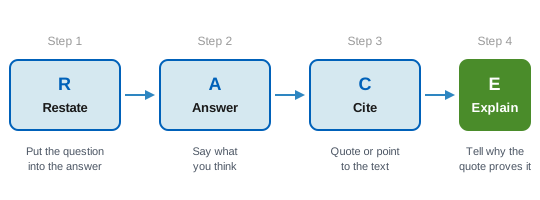 RACE strategy flow showing four steps: Restate the question, Answer it, Cite the text, Explain how the evidence supports the answer
Step 1 — Restate: Turn the question into a statement. If the question is "Why is Maya nervous?", the student starts with "Maya is nervous because..."
Step 2 — Answer: Give the answer in the same sentence or the next one. "Maya is nervous because she has never jumped off the high dive before."
Step 3 — Cite: Include a quote or paraphrase from the text. "The text says, 'her hands still shook' (paragraph 1)."
Step 4 — Explain: Connect the evidence back to the answer. "Shaking hands show she is scared, even though she is trying to be brave."
Some schools use ACE — Answer, Cite, Explain — which skips the "restate" step. The substance is the same.
For related reading strategy background, see What Is Close Reading? A Parent's Guide to Reading Deeply.
A Worked Example
Here's what a full response looks like when a 4th or 5th grader uses RACE on a short passage.
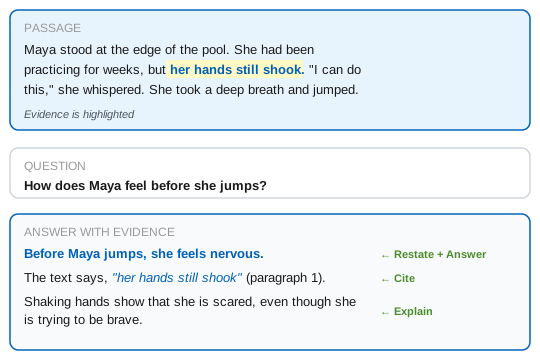 Worked example showing a passage about Maya at the pool with evidence highlighted and a RACE-format response with labeled parts
Notice what the student did: she didn't just say "Maya is nervous." She pointed to the exact words that prove it — "her hands still shook" — and then explained why those specific words matter. The quote does the work. The explanation shows the reader what the quote reveals.
Sentence Starters
Teachers usually give students a bank of sentence starters to make citing evidence less intimidating. These are the same phrases parents can use at home.
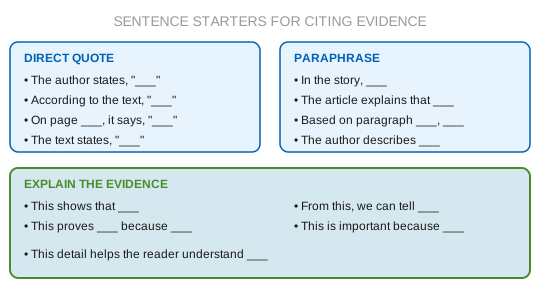 Sentence starter card showing phrases for direct quotes, paraphrasing, and explaining evidence
The sentence starters are training wheels. Over time, students internalize the pattern and stop needing them. But in 3rd through 6th grade especially, using the starters is a signal of strong writing, not weak writing.
For more on summarizing vs. finding a main idea, see Main Idea vs. Theme: A Parent's Guide.
How Citing Evidence Connects to What You Already Know
You already cite evidence constantly. You may not call it that, but you do it every day.
When you tell your partner "You said we were leaving at seven — I heard you say it in the kitchen" — that's citing evidence. You're pointing to a specific moment and source to support a claim. When you read a news article and say "The Times reported that the bill passed 54 to 46" — that's citing evidence. When you forward a text message screenshot to a friend and say "Look — she literally said this" — that's citing evidence with a direct quote.
The skill your child is learning is the same one you use when you're trying to be taken seriously. You don't just assert things. You show where the proof came from.
The difference is that today's students are taught to recognize and name this strategy — to mark it with sentence starters and acronyms like RACE — so they can apply it deliberately in writing rather than only using it when an argument gets heated.
Watch: Citing Evidence Explained
How to Help at Home
Ask "How do you know?" instead of giving the answer
When your child reads something — a chapter book, a cereal box, a social media post — occasionally ask "How do you know?" or "Where does it say that?" You're not quizzing them. You're training them to go back to the source. If they can point to a line, they're doing the work.
Use the teacher's vocabulary
If your child's teacher uses RACE, you use RACE. If they use ACE or TEE or any other acronym, match it. Walk through the letters with your child: "Okay, we answered it. Now we need to cite. What part of the text supports this?" Using the same words their teacher uses reduces confusion and makes homework feel consistent.
Don't let them write the answer first and find evidence second
A common shortcut is to write a big general answer, then hunt for a sentence that sort of matches. This almost always produces weak evidence. Instead, have your child find the evidence first — point to the proof in the text — and then write the answer. The answer should come out of the evidence, not the other way around.
Teach the difference between summary and evidence
If the question asks "How does the main character feel?" the answer isn't a plot summary. It's one specific moment that shows the feeling. Practice this with TV shows: "The character seemed angry — what exactly did she say or do that tells you that?" Pinpointing the moment is the skill.
Check that the quote actually proves the answer
Before your child turns in a response, read it out loud together. Does the quote they picked really support what they said? Or is it close but not quite right? This is the single most common mistake in upper elementary and middle school — picking a quote that's near the topic but doesn't actually prove the claim. A 30-second check catches it.
Let Methodwise walk through it
If your child is stuck on a reading response and doesn't know how to find or cite evidence, open the Methodwise chat, paste or describe the passage and the question, and ask for help using the RACE or ACE strategy. Methodwise will model how to find the evidence and build the response step by step — using the same vocabulary the teacher uses.
Common Mistakes to Watch For
Writing a summary instead of citing evidence
The question asks for proof of a specific point, and the student writes a three-sentence retelling of the plot. The fix is to re-read the question and find the one detail that answers that question — not a general recap.
Choosing evidence that's "near" the answer but doesn't prove it
A child might grab any sentence that mentions the character in question, even if it doesn't support the claim. Read the quote out loud and ask: "Does this sentence actually prove what we said?" If not, keep looking.
Quoting too much
Some kids copy whole paragraphs as their evidence. Teachers want a precise, short quote — usually one sentence or less. The skill is finding the exact words that matter, not copying everything nearby.
Forgetting the explanation
RACE has four steps for a reason. A quote alone isn't a complete answer. The student has to explain why that quote supports the answer. Without the explanation, the response feels incomplete and usually loses points.
Not using quotation marks
Once a student is writing direct quotes, the words have to be in quotation marks — with the punctuation on the correct side. It's a small thing, but teachers notice, and it's the start of a habit that matters in middle school and high school.
Practice Questions
Try these with your child. Read the short passage, answer the question, and see if you can cite evidence correctly. Answers are below.
Passage:
Ben pressed his nose against the window. Outside, snow was falling in thick white sheets. "No school tomorrow!" he shouted. He ran to get his sled out of the closet before his mom could stop him.
Grades 2–3 — Short answer with a quote:
- Why is Ben excited? Find one sentence from the passage that shows it.
Grades 4–5 — Full RACE response:
- How does Ben feel about the snow? Use the RACE strategy to answer.
Grades 6–8 — Two pieces of evidence:
- What two details from the passage show that Ben expects school to be canceled? Explain why each detail supports the answer.
Answers
-
Ben is excited because it's snowing a lot. The passage says, "'No school tomorrow!' he shouted."
-
Ben feels excited about the snow. The text says, "'No school tomorrow!' he shouted" (paragraph 1). This shows he is excited because he is yelling and assuming school will be canceled. He is also already getting his sled, which shows he's eager to play in it.
-
Two details show Ben expects school to be canceled. First, the text says, "'No school tomorrow!' he shouted," which shows he is making a prediction about school. Second, the passage says "snow was falling in thick white sheets," which suggests the weather is bad enough to close schools. Together, these details show Ben is confident school will be canceled because of the heavy snow.
Ready to try it with your child?
Open the chat, pick the subject and your child's grade, and get a step-by-step explanation you can use to help tonight.
Try 3 Questions Free — No Signup RequiredFrequently Asked Questions
What if the text doesn't directly say the answer — can my child still cite evidence?
Yes. Not all evidence is explicit. If the question asks 'How does the character feel?' and the text never says 'she was sad,' students can still cite evidence by pointing to specific actions, words, or details that imply the feeling — like 'her eyes filled with tears.' This is called inferential evidence, and teachers expect it starting around 3rd or 4th grade.
Should my child use a direct quote, or is paraphrasing okay?
Both are acceptable. A direct quote (with quotation marks) shows teachers the student pulled exact words from the text. Paraphrasing — putting the text in your own words — is also valid, especially when a useful detail is spread across several sentences. Upper elementary and middle school students often do both in one response: paraphrase the setup, then quote the exact detail that proves the point.
How long should an evidence-based answer be?
It depends on the grade and the question. In 2nd or 3rd grade, two or three sentences is usually enough. By 4th or 5th grade using RACE, expect four or five sentences. In middle school, evidence-based answers often stretch into short paragraphs with two or more quotes. If a response is only one sentence long, it's almost always missing the explanation step.
Do teachers use this strategy in science and social studies too?
Yes. RACE and ACE are used across subjects. In science, a student might cite data from a chart or a line from a lab reading. In social studies, they might quote from a primary source, textbook section, or map. The skill is the same: make a claim, point to where you got your information, and explain how the two connect.
What's the difference between 'text evidence' and 'citing evidence'?
They're the same idea with slightly different phrasing. 'Text evidence' (sometimes called 'textual evidence') refers to the proof itself — the quote or detail from the text. 'Citing evidence' is the action of using that proof in an answer. You'll hear both in your child's classroom, and teachers often use them interchangeably.
Can Methodwise help with citing evidence?
Yes. If your child is stuck on a reading response and doesn't know how to find or cite evidence, Methodwise can walk through the passage and model how to use the RACE or ACE strategy step by step — using the same vocabulary the teacher uses.
Try Methodwise Free
When your child brings home a reading assignment that says "cite evidence" and you're not sure how to help them do it the way their teacher expects, Methodwise walks you through it — step by step, using the same strategy their teacher is using.
- Start with 3 free questions — no account needed
- Free plan: 15 questions/month after signup
- Plus plan: unlimited questions + saved chat history + 7-day free trial
- Step-by-step explanations the way teachers teach
Related Articles
-
What Are Text Features? A Parent's Guide to Nonfiction Reading
-
Reading Comprehension Strategies: A Parent's Guide to How Teachers Teach Reading
-
Main Idea vs. Theme: What Your Child's Teacher Actually Means
-
What Is Close Reading? A Parent's Guide to Deeper Comprehension
-
Reading Levels Explained: Lexile, F&P, and DRA in Plain English
-
Homework Help Tools: Built for Kids vs. Built for Parents — What's the Difference?
-
What Is Making Inferences? A Parent's Guide to Reading Between the Lines
-
Author's Purpose vs. Point of View: A Parent's Guide to PIE, Narrators, and Perspective
-
What Are Context Clues? A Parent's Guide to How Kids Figure Out New Words Without a Dictionary
-
What Is Text Structure? A Parent's Guide to How Nonfiction Is Organized
-
Opinion Writing vs. Argument Writing: A Parent's Guide to the K–8 Writing Progression
-
Summarizing vs. Retelling: A Parent's Guide to Why the Teacher Keeps Saying 'Too Many Details'
-
What Are Story Elements? A Parent's Guide to Characters, Setting, Problem, and Solution
-
What Is Phonemic Awareness? A Parent's Guide to Playing With Sounds Before Reading
Have questions about citing evidence? Email me at hello@methodwise.co
About the Author
Samantha Black is the founder of Methodwise and an educator with over 15 years in higher education and instructional design. She built Methodwise after experiencing the homework gap firsthand as a parent of two K–8 daughters. Learn more about why we built Methodwise →