
What Is Close Reading? A Parent's Guide to Deeper Comprehension
April 20, 2026

Your child comes home with a short reading passage — maybe half a page — and a worksheet that asks them to "read the passage three times" and then answer questions like "What does the author mean by this phrase?" or "Find two pieces of evidence that support your answer." You look at it and think: Why are they reading it three times? And why can't they just answer the question with what they remember?
If that sounds familiar, welcome to close reading. It's a common strategy in many elementary and middle school classrooms today, and it's also one of the biggest shifts from how most parents were taught to read in school. The idea isn't that your child didn't understand the text the first time — it's that a single read is almost never enough to understand a text the way teachers now expect students to understand it.
Here's what close reading actually means, what it looks like in each grade, and how to help your child at home without making them dread reading time.
What Is Close Reading?
Close reading is a strategy where students read the same short passage multiple times, with a different purpose each time. The first read focuses on the basic "what happened." The second read digs into vocabulary, sentence structure, and how the text is put together. The third read looks for deeper meaning — inferences, the author's purpose, and how word choices shape the message.
The goal is to help students move from "I read the words" to "I understand what the author is really saying."
Why Do Teachers Use Close Reading?
You might wonder why a teacher would ask a child to read the same passage three times when they could just read a different book instead. The short answer: reading comprehension used to be measured by whether you could retell a story, and today it's measured by whether you can use the text to explain your thinking.
When you were in school, reading usually meant "read the chapter, answer the questions, move on." Many ELA standards ask students to cite evidence from the text, analyze word choice, and explain how the author built meaning. That's hard to do on a single read. Close reading slows students down and gives them permission to struggle with a tough passage instead of giving up on it.
It also mirrors how skilled adult readers actually read difficult material. When you read a confusing work email or a dense news article, you probably reread it. You stop. You go back. You underline. Close reading teaches children to do that on purpose, with short passages, before they're handed longer and harder texts in high school.
Stuck on tonight's homework?
Paste in the problem and get a step-by-step explanation in your child's grade level — using the same method their teacher uses.
Try 3 Questions Free — No Signup RequiredWhat Grade Is Close Reading Taught?
Kindergarten–1st Grade — Read-Alouds and Thinking Out Loud
At this stage, most students aren't yet reading fluently on their own, so close reading happens through teacher read-alouds. The teacher reads a short story or poem aloud, then reads it again with a different focus — maybe tracking characters, pointing at illustrations, or asking "what word stood out to you?" Students aren't annotating yet. They're learning that it's normal to go back to a text and notice more the second time.
2nd–3rd Grade — Annotation Begins
By second and third grade, students often read short passages on their own, with teacher support as needed. Teachers introduce basic annotation: underlining key ideas, circling unknown words, and writing a question mark next to confusing parts. Students are asked to find text evidence — "show me the sentence that tells you how the character feels" — which is a foundational close reading skill.
4th–5th Grade — Multiple Reads with Purpose
This is where close reading starts looking like the version most parents picture. Students read a short passage or poem two or three times, each with a different purpose, often spread across several days. They annotate independently, answer text-dependent questions, and use evidence to back up their thinking. The texts may get a little longer — sometimes up to a page or two — and more challenging.
6th–8th Grade — Analyzing Craft
In middle school, students use close reading to analyze an author's craft. That means asking questions like: Why did the author use this word instead of that one? How does this sentence structure create tension? What does this metaphor tell us about the character? Students are expected to quote the text, explain its effect, and connect small details to bigger themes.
If your child is doing close reading at any of these stages, it's developmentally appropriate and part of a deliberate progression from listening to a teacher model, to annotating with help, to analyzing independently.
How Close Reading Works
Most teachers organize close reading around three reads. Each read has a clear job, and students aren't supposed to try to do all of it at once.
Read 1: What is this text about?
The first read is just about getting the gist. Students read the passage all the way through — sometimes aloud, sometimes silently — without stopping to analyze anything. If it's a read-aloud, the teacher often reads it slowly without making marks on the page, letting the students just listen. After the first read, students might summarize the passage in one sentence or answer a simple question like "What is this text mostly about?"
This is the read that most adults are used to. In close reading, it's only the starting point.
![Flow diagram of the three close reading passes: Read 1 for gist, Read 2 for vocabulary and structure, Read 3 for craft and meaning] (/blog/close-reading-three-reads.svg)
Read 2: What do the words and sentences mean?
The second read slows down. Students focus on vocabulary — circling unfamiliar words and trying to figure out their meaning from context. They pay attention to how sentences are built, where the text is divided, and what sections or paragraphs the author chose. In 2nd and 3rd grade, that might mean underlining "key words." By 5th grade, it might mean marking transitions like "however" or "as a result" that signal how ideas connect.
By the end of the second read, a student should be able to answer questions about specific words, phrases, and how parts of the text fit together.
For more on how teachers help students break down unfamiliar words and ideas, see What Are Text Features? A Parent's Guide to Nonfiction Reading.
Read 3: What does the author really mean?
The third read is the deepest one. Students look for things the text doesn't say outright — inferences, themes, the author's purpose, tone, and the feelings behind word choices. This is also where students typically answer "text-dependent questions" that require them to point to specific lines and explain their thinking.
A third-read question might sound like: Why do you think the author used the word "whispered" instead of "said"? or What does the last sentence tell us that the first sentence doesn't?
Annotation Symbols Students Use
By second grade, most teachers introduce a small set of annotation symbols students can use to leave a trail of their thinking on the page. The exact symbols vary, but the most common ones are similar across classrooms.
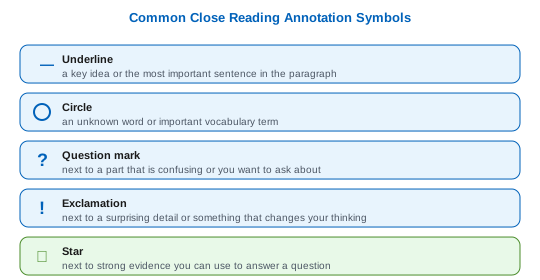 Close reading annotation key: underline for key ideas, circle for unknown words, question mark for confusing parts, exclamation for surprising details, star for important moments
For more on how teachers help students find and analyze important information, see Main Idea vs. Theme: What Your Child's Teacher Actually Means.
Example: A Short Passage Read Three Times
The passage (4th grade): "Maya hesitated at the edge of the pool. She had promised her coach she would try the high dive today, but her legs felt like they were made of stone. Below, the water looked darker than usual, almost black. She closed her eyes, counted to three, and stepped forward."
Read 1 — gist: Maya is nervous about jumping off the high dive, but she makes herself try it.
Read 2 — vocabulary and structure: The student circles "hesitated" and "dive" as key words, underlines "legs felt like stone" as a strong description, and notices that the paragraph moves from thinking to doing — from her brain to her body.
Read 3 — craft and meaning: The student notices that the author never uses the word "scared" but makes it clear Maya is scared through details like stone legs and dark water. The word "promised" tells us Maya is trying to keep her word even though she's frightened. A text-dependent question might ask: Find two pieces of evidence that show Maya is afraid without the author ever saying "afraid."
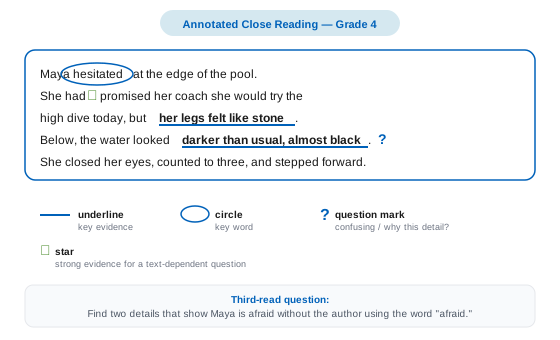 Annotated close reading example with Maya at the high dive: underlined key idea, circled vocabulary, starred evidence, and question mark on a confusing phrase
How Close Reading Connects to What You Already Know
You already close read things all the time. You just don't call it that.
When you get a confusing text message from a coworker, you read it once to figure out what it says, and then you reread it to figure out what they really meant. When you watch a movie twice and catch things you missed the first time — a line that turns out to be a clue, a look that means something different now — that's close reading a film. When you go back to a recipe because you realized you skipped a word like "gradually" or "room temperature," that's close reading a set of instructions.
Even the way you reread a contract, a school email, or a report card before reacting — that's close reading. You're slowing down on a short, important text to catch what a single pass missed.
The difference is that today's students are taught to recognize and name this kind of reading so they can apply it deliberately rather than only reaching for it when something feels important.
Watch: Close Reading Explained
How to Help at Home
Use the same language their teacher uses
When your child is working on a close reading assignment, match the vocabulary you hear from school. Say "Let's do a second read" instead of "Read it again." Ask "What did you notice this time that you didn't notice the first time?" instead of "Did you get it?" Hearing the same words at home that they hear in class reinforces the habit.
Don't push for the "right" answer on the first read
If your child finishes the first read and can't answer a deep question yet, that's normal — that's how close reading is supposed to work. Resist the urge to jump straight to the interpretation. Ask them what the passage is generally about first. Then do the second read together before moving on to the harder questions.
Read short passages together out loud
Close reading is built for short texts. Pick a paragraph from a book, a short poem, or even a page from a magazine and read it aloud together. On the second read, ask "Which word stood out to you?" On the third read, ask "What do you think the author is really trying to say?" Two reads of a paragraph is better than one read of a chapter.
Teach the "underline, circle, question mark" trio
If your child doesn't already have annotation symbols from their teacher, introduce three: underline for a key idea, circle for a word they don't know, and a question mark for any part that confuses them. These three alone cover most of what elementary teachers ask for. Let your child mark up a printed passage or use sticky notes on a library book.
Validate confusion instead of fixing it
When your child points at a sentence and says "I don't get this," don't immediately explain it. Say "Good — mark it with a question mark. That's exactly what you're supposed to do." Close reading assumes that noticing confusion is part of the process, not a failure. A question mark on the page means your child is thinking, not falling behind.
Let Methodwise walk through it
When your child has a specific close reading passage with text-dependent questions and neither of you is sure how to answer them, paste the passage and question into Methodwise. It will walk you through each read, help identify text evidence, and explain the author's choices in the same language and structure your child's teacher uses in class.
Common Mistakes to Watch For
Trying to do all three reads at once
The most common mistake is rushing. A child reads the passage one time, tries to answer the deep questions right away, and gets frustrated. Close reading only works if each read has a single job. If your child is stuck on a third-read question, the fix is usually to go back to read two, not to think harder.
Skipping evidence and relying on memory
When a question asks "What does the author mean by…?" or "How do you know?", students sometimes answer from memory without pointing to the actual line in the text. Teachers often expect students to support answers with evidence, so responses without text support may be marked incomplete. Always ask your child: Can you underline the line that tells you that?
Treating annotation like decoration
Some children discover annotation and start underlining everything in sight. If the whole paragraph is underlined, nothing is underlined. Annotation is supposed to be selective — only the one or two lines in each paragraph that carry the most meaning. A page with a handful of careful marks is doing more than a page that looks highlighted yellow.
Answering "yes" or "no" to open-ended questions
Text-dependent questions are almost never yes-or-no questions, even when they sound like they might be. If your child answers a question with one word, the teacher will mark it incomplete. The fix: every answer should start by restating the question and end with evidence from the text. "The author uses the word 'whispered' because… which shows that…"
Picking passages that are too long
If your child is trying to close read a whole chapter, the strategy falls apart. Close reading is for short pieces — usually a paragraph, a poem, or a page at most. When the passage is too long, students can't hold the details in their head long enough to notice the patterns. Shorter is always better.
Practice Questions
Try these with your child. Answers are below.
Grades 2–3 — First and second reads:
-
Read this passage to your child twice. "The old dog waited by the door with his leash in his mouth. Every afternoon at three o'clock, he did the same thing. His tail wagged slowly at first, then faster when he heard footsteps on the porch." After the first read, ask: "What is this passage about?" After the second read, ask: "What word tells you this dog does this a lot?"
-
Read this short passage twice. "Mia pressed her nose against the window. Outside, the snow fell in thick, quiet flakes. She had been waiting all week for this." What is the passage about? Which word best shows how Mia is feeling?
Grades 4–5 — Three reads with evidence:
-
Read this passage three times. "When the lights finally came back on, Jonah realized he had been holding his breath the whole time. He let it out in one long sigh. His little sister looked up from her book and said, 'Was that scary?' Jonah smiled and shrugged. 'Nah,' he said, even though his heart was still pounding.'"
- Read 1: What happened?
- Read 2: Which two details show how Jonah actually felt?
- Read 3: Why do you think Jonah said "Nah" to his sister?
-
In the same passage, find one piece of evidence that the author never uses the word "scared" but still shows that Jonah was.
Grades 6–8 — Analyzing craft:
- Read this passage. "The waves didn't crash against the rocks so much as lean on them, as if the ocean itself were tired after a long day of being the ocean." Why do you think the author chose the word "lean" instead of "crash"? What does comparing the ocean to something tired suggest about the mood of this scene? Use specific words from the passage in your answer.
Answers
-
First read: The passage is about a dog who waits by the door every afternoon for someone to come home. Second read: The phrase "every afternoon at three o'clock" and the words "the same thing" tell you this is a routine — something the dog does all the time.
-
Gist: Mia is watching it snow from inside her house and she's been waiting for the snow all week. Feeling word: "Waiting" (or "pressed her nose against the window") shows she's eager or excited — she's been looking forward to this.
-
Read 1: The lights went out, then came back on, and Jonah told his sister he wasn't scared — but he actually was. Read 2: "Holding his breath the whole time" and "his heart was still pounding" both show that Jonah was really scared. Read 3: Jonah probably said "Nah" because he wanted to seem brave in front of his little sister or protect her from feeling scared too.
-
Evidence: "Holding his breath" and "heart still pounding" are both physical clues. Neither sentence uses the word "scared," but both describe what being scared feels like in the body.
-
Possible answer: The author chose "lean" instead of "crash" because "lean" is a soft, tired action, while "crash" would sound powerful and angry. Comparing the ocean to someone "tired after a long day of being the ocean" makes the scene feel calm, slow, and almost sleepy, instead of wild or dramatic. The words "lean," "tired," and "long day" all work together to create a quiet, gentle mood.
Ready to try it with your child?
Open the chat, pick the subject and your child's grade, and get a step-by-step explanation you can use to help tonight.
Try 3 Questions Free — No Signup RequiredFrequently Asked Questions
What grade does close reading start?
Close reading begins as early as kindergarten, though it looks different at each grade level. In K–1, the teacher does the reading aloud and students listen and respond. By 2nd–3rd grade, students start annotating short passages themselves. By 4th–5th grade, they're doing multiple reads independently, and by middle school, they're analyzing an author's word choice, tone, and structure.
Why do teachers make kids read the same passage multiple times?
Because a single read only catches the surface. The first time through, your brain is working hard just to figure out what's happening. The second and third reads free up attention for deeper thinking — noticing word choices, unpacking confusing sentences, and figuring out what the author is really saying. It's the same reason you rewatch a movie and notice things you missed the first time.
What are annotation symbols in close reading?
Annotation symbols are small marks students make on a text to track their thinking. Common ones include underlining key ideas, circling important vocabulary, writing a question mark next to confusing parts, an exclamation mark for surprising information, and a star next to something that feels important. The exact symbols vary by classroom, but the goal is always the same — leaving a trail of your thinking so you can talk about the text later.
How is close reading different from regular reading?
Regular reading is what you do with a novel on the couch — you read once, get the story, and move on. Close reading is slower, more deliberate, and usually done with a short passage. Students are expected to go back to the text to find evidence, notice word choices, and explain what they think. It's less about finishing the book and more about truly understanding a small piece of it.
Can Methodwise help with close reading assignments?
Yes. If your child has a close reading worksheet with text-dependent questions, you can paste the passage and the questions into Methodwise and it will walk you through each read — helping your child find evidence, unpack vocabulary, and answer like their teacher expects. It uses the same close reading language your child is already hearing in class.
Try Methodwise Free
When your child brings home a close reading passage with text-dependent questions and you're not sure how to help them find the evidence their teacher wants, Methodwise walks you through it — read by read, using the same method their teacher is using in class.
- Start with 3 free questions — no account needed
- Free plan: 15 questions/month after signup
- Plus plan: unlimited questions + saved chat history + 7-day free trial
- Step-by-step explanations the way teachers teach
Related Articles
-
What Are Text Features? A Parent's Guide to Nonfiction Reading
-
Reading Comprehension Strategies: A Parent's Guide to How Teachers Teach Reading
-
Main Idea vs. Theme: What Your Child's Teacher Actually Means
-
Reading Levels Explained: Lexile, F&P, and DRA in Plain English
-
What Is Citing Evidence? A Parent's Guide to Text Evidence in Reading and Writing
-
Homework Help Tools: Built for Kids vs. Built for Parents — What's the Difference?
-
What Is Making Inferences? A Parent's Guide to Reading Between the Lines
-
Author's Purpose vs. Point of View: A Parent's Guide to PIE, Narrators, and Perspective
-
What Are Context Clues? A Parent's Guide to How Kids Figure Out New Words Without a Dictionary
-
What Is Text Structure? A Parent's Guide to How Nonfiction Is Organized
-
Opinion Writing vs. Argument Writing: A Parent's Guide to the K–8 Writing Progression
-
Summarizing vs. Retelling: A Parent's Guide to Why the Teacher Keeps Saying 'Too Many Details'
-
What Are Story Elements? A Parent's Guide to Characters, Setting, Problem, and Solution
-
What Is Phonemic Awareness? A Parent's Guide to Playing With Sounds Before Reading
Have questions about close reading? Email me at hello@methodwise.co
About the Author
Samantha Black is the founder of Methodwise and an educator with over 15 years in higher education and instructional design. She built Methodwise after experiencing the homework gap firsthand as a parent of two K–8 daughters. Learn more about why we built Methodwise →