
What Is Decomposing Numbers? A Parent's Guide to Breaking Apart Numbers
March 8, 2026
If your child came home saying they had to "decompose" numbers in math class, you're not alone in wondering what that means. It sounds more like a science lesson than a math one.
But decomposing numbers is one of the most important concepts in elementary math—and once you understand it, you'll start seeing it everywhere in your child's homework.
What Does "Decomposing Numbers" Mean?
To decompose a number means to break it apart into smaller pieces that are easier to work with.
The pieces can be added back together to get the original number. That's really all it is.
So 37 can be decomposed as:
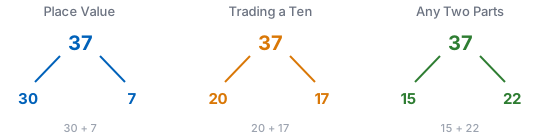 Three ways to decompose 37: by place value (30+7), trading a ten (20+17), or any two parts (15+22)
All three are correct. They're just different ways of breaking the same number apart—and teachers use all of them for different reasons.
Why Do Teachers Teach This?
Before kids can add and subtract large numbers confidently, they need to understand that numbers are flexible. A number isn't just a symbol—it's a quantity that can be split and recombined in lots of ways.
Decomposing numbers builds that flexibility. It's the foundation for:
- Mental math — breaking 47 + 8 into 47 + 3 + 5 to make it easier
- Column addition and subtraction — understanding why you "carry" or "borrow"
- Multiplication — splitting numbers to apply the distributive property
- Fractions — seeing parts of a whole
When a child understands decomposition deeply, math stops being a set of rules to memorize and becomes something they can reason through.
Stuck on tonight's homework?
Paste in the problem and get a step-by-step explanation in your child's grade level — using the same method their teacher uses.
Try 3 Questions Free — No Signup RequiredWhat Grade Is Decomposing Numbers Taught?
Decomposition appears at every grade level — just with increasing complexity:
Kindergarten & 1st Grade
Students decompose numbers up to 10 and then 20. They learn that 8 can be broken into 5 + 3, or 4 + 4, or 7 + 1. Teachers often use ten-frames and counters to make this visual.
2nd & 3rd Grade
Students decompose 2- and 3-digit numbers by place value (47 = 40 + 7). They also start trading tens (47 = 30 + 17) to prepare for subtraction with regrouping.
4th & 5th Grade
Decomposition is applied to multiplication (24 × 3 = 20 × 3 + 4 × 3) and to understanding fractions (¾ = ½ + ¼).
Middle School
The same logic appears in algebra as the distributive property: 3(x + 4) = 3x + 12.
If your child is in any of these grades and encountering this concept, it's developmentally appropriate and intentionally sequenced.
The Three Ways Students Decompose Numbers
1. By Place Value (Expanded Form)
This is the most common method and the one your child will see first. Each digit is broken out by its place value position.
| Number | Decomposed by Place Value |
|---|---|
| 47 | 40 + 7 |
| 253 | 200 + 50 + 3 |
| 1,482 | 1,000 + 400 + 80 + 2 |
This is also called expanded form. It helps children see that the "4" in 47 isn't just four—it represents four tens, or forty.
For a deeper dive on this method, see What Is Expanded Form? A Parent's Guide to Place Value.
2. By Trading Tens (Flexible Place Value)
Once kids are comfortable with standard place value decomposition, teachers introduce a more flexible version: trading a ten for ten ones (or vice versa).
This is the concept behind borrowing in subtraction.
| Number | Standard | Trading a Ten |
|---|---|---|
| 37 | 30 + 7 | 20 + 17 |
| 52 | 50 + 2 | 40 + 12 |
| 84 | 80 + 4 | 70 + 14 |
The number still equals the same amount—you've just reorganized the parts. When kids understand this, "borrowing" in subtraction stops being a mysterious trick and starts making sense: you're trading a ten for ten ones so you have enough to subtract.
A common place this shows up: When subtracting 43 − 17, your child might need to trade 43 into 30 + 13 before subtracting the 7. If they understand trading tens, this feels logical rather than arbitrary.
3. Into Any Two (or More) Parts
The most open-ended form of decomposition: breaking a number into any two addends that sum to the original. There's no single right answer.
Example: Decompose 10
| First Part | Second Part |
|---|---|
| 1 | 9 |
| 2 | 8 |
| 3 | 7 |
| 4 | 6 |
| 5 | 5 |
Teachers use this version to build number sense—the intuitive feel for how numbers relate to each other. It also lays the groundwork for understanding that addition is commutative (3 + 7 = 7 + 3) and for later work with fact families.
With larger numbers, kids choose decompositions that make a calculation easier:
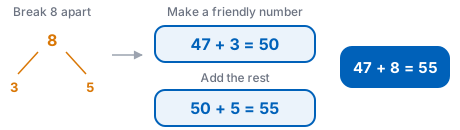 Mental math: decompose 8 into 3+5, then 47+3=50, 50+5=55
That's mental math in action. The child picked the decomposition that was most useful — not the "standard" one, but the strategic one.
Watch: Decomposing Numbers Explained
How Decomposing Connects to Things You Recognize
If you learned math the traditional way, you used decomposition too — you just weren't told that's what you were doing.
"Carrying" in addition — When you add 38 + 47 and write a little 1 above the tens column, you're decomposing 15 ones into 1 ten and 5 ones. The 1 gets "carried" to the tens column because that's where tens live.
"Borrowing" in subtraction — When you subtract 52 − 17 and cross out the 5 to make it 4 (with a 1 next to the 2), you're trading 1 ten for 10 ones: 50 + 2 becomes 40 + 12. That's flexible place value decomposition.
Multiplying by 10s in your head — If you know that 6 × 30 = 180, you're decomposing 30 as 3 × 10 and using that to simplify the calculation.
The difference is that today's students are taught to understand why these steps work, not just how to follow them.
How to Help at Home
You don't need to be a math teacher to reinforce this concept. Here are things that actually work:
Ask "what's another way?"
When your child solves a problem, ask if they can break the numbers apart a different way. There's no wrong answer as long as the parts add up. This builds flexibility without pressure.
Use objects for the trading tens method
Grab 10 pennies or blocks. Show that 1 group of ten is the same as 10 ones by physically trading them. The abstract concept clicks much faster when kids can hold the pieces.
Point it out in real life
"We need 24 crayons for the class. There are 20 in this box and 4 in this box — that's 24." Everyday groupings are decomposition in action.
Don't correct their method — ask if it works
If your child decomposes a number in a way you didn't expect, resist the urge to redirect them to "your" way. Ask: "Do those parts add back up to the original number?" If yes, they're right.
Let Methodwise walk through it
If your child is stuck on a specific homework problem, Methodwise explains the concept using the same approach their teacher uses—place value language, step-by-step breakdowns, and age-appropriate explanations.
Ready to try it with your child?
Open the chat, pick the subject and your child's grade, and get a step-by-step explanation you can use to help tonight.
Try 3 Questions Free — No Signup RequiredCommon Mistakes to Watch For
Using the digit instead of the value
Writing 47 as 4 + 7 instead of 40 + 7. The 4 represents four tens — forty — not four. Reinforce: "What is that digit worth in that spot?"
Thinking there's only one right answer
Some kids freeze because they can't figure out the "right" way to decompose a number. Remind them that 37 can be 30 + 7, or 20 + 17, or 25 + 12 — all correct. The question is which decomposition is most useful for the problem at hand.
Forgetting to check
Encourage your child to add the parts back together to verify their answer. If 253 becomes 200 + 60 + 3 = 263 when they check, something went wrong. The self-check habit is valuable far beyond decomposition.
Confusing decomposing with estimating
Decomposing produces exact values that sum to the original number. Estimating rounds to a nearby number. These are different operations, and kids sometimes conflate them in 3rd and 4th grade.
Practice Questions
Try these with your child. Answers are below.
Decompose using place value:
- 63 = ___ + ___
- 145 = ___ + ___ + ___
- 2,307 = ___ + ___ + ___
Decompose by trading a ten: 4. 45 = ___ + 15 5. 72 = ___ + 12
Decompose into two parts (any way you like): 6. Find three different ways to decompose 20. 7. Decompose 8 to make this easier: 52 + 8 = ?
Challenge (4th–5th grade): 8. Use decomposition to solve 23 × 4 without a calculator. (Hint: break 23 into 20 + 3.) 9. Decompose 2.5 into tenths. How many ways can you do it?
Answers
- 60 + 3
- 100 + 40 + 5
- 2,000 + 300 + 7
- 30 + 15
- 60 + 12
- Any three pairs that sum to 20 (e.g., 10+10, 12+8, 15+5)
- Break 8 into 2 + 6 → 52 + 2 = 54, then 54 + 6 = 60
- 23 × 4 = (20 × 4) + (3 × 4) = 80 + 12 = 92
- 2.5 = 2 + 0.5 = 1.5 + 1 = 1 + 1 + 0.5, etc.
Frequently Asked Questions
Is decomposing numbers the same as expanded form?
Place value decomposition (breaking 47 into 40 + 7) is the same as expanded form. But decomposing numbers is a broader concept — it includes trading tens and breaking numbers into any two parts. Expanded form is one specific type of decomposition.
Why do teachers ask kids to decompose numbers instead of just adding them?
Because decomposition builds flexibility. A child who can only add numbers using a standard algorithm is dependent on that procedure. A child who understands decomposition can adapt when a problem is awkward — rounding, splitting, trading — which is how mathematicians and engineers actually think.
My child's teacher uses "breaking apart" instead of "decomposing." Same thing?
Yes, exactly the same concept. Different teachers and curricula use different vocabulary: decomposing, breaking apart, splitting, partitioning. They all mean separating a number into parts.
How do I know which type of decomposition my child is supposed to use?
Look at the homework instructions or the example problems. Place value decomposition looks like 200 + 50 + 3. Trading tens problems often show a blank like 45 = ___ + 15. Open decomposition problems say "show two ways to make this number." If you're still not sure, Methodwise can identify the method from the problem itself.
Does this method work for all numbers?
Yes — whole numbers, decimals, and eventually fractions. The same core idea (a number is made of parts that can be rearranged) runs through all of them.
Try Methodwise Free
When your child is stuck on homework and you're not sure how to explain it the way their teacher would, Methodwise helps bridge that gap.
Try 3 Questions Free — No Signup Required →
- Start with 3 free questions — no account needed
- Free plan: 15 questions/month after signup
- Plus plan: unlimited questions + saved chat history + 7-day free trial
- Step-by-step explanations the way teachers teach
Related Articles
-
What Is the Area Model? A Parent's Guide to Box Multiplication
-
What Is a Number Line? A Parent's Guide to How Teachers Use It
-
What Are Number Bonds? A Parent's Guide to Making and Breaking Numbers
-
What Is Partial Sums Addition? A Parent's Guide to Why Your Child Doesn't 'Carry the One' Anymore
-
What Is a Tape Diagram? A Parent's Guide to Visualizing Word Problems
-
What Is a Ten Frame? A Parent's Guide to the Box That Builds Number Sense
-
What Is Partial Quotients Division? A Parent's Guide to the New Way Kids Learn Long Division
-
What Are Common Core Math Methods? A Parent's Guide to How Math Is Taught Today
-
What Are Arrays in Math? A Parent's Guide to Visualizing Multiplication
-
Homework Help Tools: Built for Kids vs. Built for Parents — What's the Difference?
-
What Are Fact Families? A Parent's Guide to How Addition and Subtraction Connect
-
What Is the Standard Algorithm? A Parent's Guide to Why Your Child Learns the 'Long Way' First
-
Fractions on a Number Line: A Parent's Guide to Why Pie Charts Aren't Enough
-
What Are Ratios and Proportional Reasoning? A Parent's Guide to Middle School Math
-
What Is Skip Counting? A Parent's Guide to How Counting by 2s, 5s, and 10s Becomes Times Tables
-
What Math Will My Child Learn This Year? A Parent's Guide to K-8 Math Methods by Grade
-
What Are Mental Math Strategies? A Parent's Guide to How Kids Add and Subtract in Their Heads
Have questions about decomposing numbers or other math methods? Email me at hello@methodwise.co
About the Author
Samantha Black is the founder of Methodwise and an educator with over 15 years in higher education and instructional design. She built Methodwise after experiencing the homework gap firsthand as a parent of two K–8 daughters. Learn more about why we built Methodwise →