
What is Expanded Form? A Parent's Guide to Place Value
March 1, 2026
If your child comes home with homework asking them to write numbers in "expanded form," you might not be sure where to start. What does that mean? And why do teachers use this method?
Let's break it down.
What is Expanded Form?
Expanded form is a way of writing numbers that shows the value of each digit based on its place value.
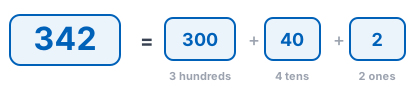 Expanded form: 342 = 300 + 40 + 2, with place value labels
For example:
- 47 in expanded form = 40 + 7
- 128 in expanded form = 100 + 20 + 8
Instead of seeing "47" as just a number, expanded form helps kids see it as 4 tens and 7 ones.
The standard way of writing a number (just "47") is called standard form. Expanded form unpacks what that number actually means.
Why Do Teachers Use Expanded Form?
Teachers use expanded form because it builds number sense — understanding what numbers actually mean, not just how to calculate them.
When kids understand that 47 is really "40 + 7," they:
- Grasp place value more deeply
- Find mental math easier (47 + 30 becomes "40 + 30 + 7")
- Build foundations for harder concepts like regrouping and algebra
This isn't about making math harder. It's about making sure kids understand what they're doing, not just memorize steps.
Think of it this way: a child who knows that 342 = 300 + 40 + 2 can figure out what happens when you add 200 to it. A child who only knows "342" as a symbol has to rely on a procedure they might not understand.
Stuck on tonight's homework?
Paste in the problem and get a step-by-step explanation in your child's grade level — using the same method their teacher uses.
Try 3 Questions Free — No Signup RequiredWhat Grade is Expanded Form Taught?
Expanded form is introduced early and built on throughout elementary school:
Kindergarten & 1st Grade
Students work with 2-digit numbers. They learn that 45 means 4 tens and 5 ones, and begin writing it as 40 + 5.
2nd & 3rd Grade
Students extend to 3-digit numbers (hundreds) and begin using more formal notation. This is when most parents first notice it on homework.
4th & 5th Grade
Students work with larger numbers (thousands, ten-thousands) and may also encounter expanded form with decimals.
Middle School
The same concept appears in algebra as the distributive property and polynomial notation.
If your 2nd or 3rd grader is bringing home expanded form homework, that's right on schedule.
Examples of Expanded Form
Let's look at a few examples at different levels:
| Number | Expanded Form |
|---|---|
| 56 | 50 + 6 |
| 234 | 200 + 30 + 4 |
| 1,503 | 1,000 + 500 + 3 |
| 4,060 | 4,000 + 60 |
Notice two things in the last two examples:
- 1,503 — there are no tens, so we skip the tens place. We only write the places that have a value.
- 4,060 — there are no ones, so we only write 4,000 + 60. No "+ 0" needed.
Expanded Form with Decimals
In 4th and 5th grade, your child may see expanded form applied to decimals:
- 3.47 = 3 + 0.4 + 0.07
- 12.5 = 10 + 2 + 0.5
The same logic applies — each digit's value is written out based on its place.
Watch: Expanded Form Explained
How to Help Your Child with Expanded Form
When your child is working on expanded form homework, here's how to help:
Start with place value
Ask: "What place is this digit in?" (ones, tens, hundreds, thousands)
For the number 47:
- The 4 is in the tens place (worth 40)
- The 7 is in the ones place (worth 7)
Show the value of each digit
Help them see: "The 4 in 47 is worth 40, not just 4."
This is the key insight that expanded form teaches. The digit 4 changes meaning depending on where it sits. In 47, the 4 means forty. In 400, the 4 means four hundred.
Work left to right
Have your child read the number left to right and write each digit's value before moving to the next. For 342: start with the 3 (it's in the hundreds place, so it's 300), then the 4 (tens place = 40), then the 2 (ones place = 2). So: 300 + 40 + 2.
Use visual aids if needed
If they're struggling, use physical objects:
- 4 groups of 10 blocks + 7 single blocks = 47
- Or draw it: four circles each containing "10," plus 7 individual dots
Connecting the abstract notation to something tangible makes the concept stick faster.
Check by adding back
Once your child writes the expanded form, have them add the parts together. If they get the original number, they got it right. This self-check builds confidence and reinforces the concept at the same time.
Ready to try it with your child?
Open the chat, pick the subject and your child's grade, and get a step-by-step explanation you can use to help tonight.
Try 3 Questions Free — No Signup RequiredCommon Mistakes to Watch For
Writing place value digits instead of values
A common error is writing 47 as "4 + 7" instead of "40 + 7." The digit 4 needs to become 40 — its actual value. Remind your child: "We write what the digit is worth, not just what it is."
Including zero values
Some kids write 1,503 as "1,000 + 500 + 0 + 3." Technically this isn't wrong, but teachers usually expect the zero places to be omitted. Check what your child's teacher prefers.
Forgetting that place value changes with position
The number 44 has two 4s, but they're worth different amounts: 40 + 4. If your child treats both as just "4," use the blocks or visual approach to show them the difference.
Practice Questions
Try these with your child:
- Write 56 in expanded form
- Write 234 in expanded form
- What number is this: 300 + 40 + 9?
- Write 1,205 in expanded form
- Write 5,070 in expanded form
- What number is this: 2,000 + 400 + 3?
Answers
- 50 + 6
- 200 + 30 + 4
- 349
- 1,000 + 200 + 5
- 5,000 + 70
- 2,403
How Expanded Form Connects to Later Math
Expanded form isn't just an early elementary concept. It appears in more sophisticated forms throughout your child's math education:
- Regrouping (carrying and borrowing) — When kids add 47 + 35, understanding that you can regroup 12 ones into 1 ten and 2 ones comes directly from expanded form thinking.
- Multi-digit multiplication — The partial products method (taught in 3rd–5th grade) is essentially expanded form applied to multiplication.
- Algebra — Expressions like 3x² + 4x + 2 follow the exact same logic as expanded form. The "x" is just a placeholder for a place value.
- Scientific notation — Writing large numbers like 4.5 × 10³ is an extension of expanded form thinking.
When teachers spend time on expanded form in 2nd grade, they're laying groundwork your child will use for the next decade of math.
For a deeper dive on a closely related method, see What Is Decomposing Numbers? A Parent's Guide to Breaking Apart Numbers.
Frequently Asked Questions
Is expanded form the same as expanded notation?
These terms are often used interchangeably. Some teachers use "expanded notation" to mean a slightly different format, such as (3 × 100) + (4 × 10) + (2 × 1) rather than 300 + 40 + 2. Both express the same idea. Ask your child's teacher which format they prefer.
Why does this seem so different from how I learned math?
You probably learned to just write and calculate numbers without explicitly breaking them apart. Expanded form makes the underlying logic visible — which research shows leads to deeper understanding and fewer errors with complex calculations later on.
My child's teacher wrote it differently than I did. Who's right?
There can be slight variations in how teachers format expanded form (with or without zero-value places, with or without parentheses). When in doubt, follow how the teacher introduced it in class. Methodwise can show you exactly how a specific method is being taught.
Does my child need to memorize place value to do expanded form?
They need to understand it, not just memorize it. The goal is for them to see why 342 becomes 300 + 40 + 2 — because the 3 is in the hundreds place, the 4 is in the tens place, and the 2 is in the ones place. If they can reason through it, they're in good shape.
Need More Help?
If expanded form (or any other teaching method) is confusing you, Methodwise can help.
Our AI tutor explains any math method in seconds — the way your child's teacher teaches it. You'll get:
- What the concept is
- What you need to know about it
- Quick knowledge check for foundational concepts
- How to walk through it together with your child
- Why it's taught this way
- And more!
Try 3 Questions Free — No Signup Required →
- Start with 3 free questions — no account needed
- Free plan: 15 questions/month after signup
- Plus plan: unlimited questions + saved chat history + 7-day free trial
- Step-by-step explanations the way teachers teach
Related Articles
-
What Is Decomposing Numbers? A Parent's Guide to Breaking Apart Numbers
-
What Is the Area Model? A Parent's Guide to Box Multiplication
-
What Is a Number Line? A Parent's Guide to How Teachers Use It
-
What Are Number Bonds? A Parent's Guide to Making and Breaking Numbers
-
What Is Partial Sums Addition? A Parent's Guide to Why Your Child Doesn't 'Carry the One' Anymore
-
What Is a Tape Diagram? A Parent's Guide to Visualizing Word Problems
-
What Is a Ten Frame? A Parent's Guide to the Box That Builds Number Sense
-
What Is Partial Quotients Division? A Parent's Guide to the New Way Kids Learn Long Division
-
What Are Common Core Math Methods? A Parent's Guide to How Math Is Taught Today
-
What Are Arrays in Math? A Parent's Guide to Visualizing Multiplication
-
Homework Help Tools: Built for Kids vs. Built for Parents — What's the Difference?
-
What Are Fact Families? A Parent's Guide to How Addition and Subtraction Connect
-
What Is the Standard Algorithm? A Parent's Guide to Why Your Child Learns the 'Long Way' First
-
Fractions on a Number Line: A Parent's Guide to Why Pie Charts Aren't Enough
-
What Are Ratios and Proportional Reasoning? A Parent's Guide to Middle School Math
-
What Is Skip Counting? A Parent's Guide to How Counting by 2s, 5s, and 10s Becomes Times Tables
-
What Math Will My Child Learn This Year? A Parent's Guide to K-8 Math Methods by Grade
-
What Are Mental Math Strategies? A Parent's Guide to How Kids Add and Subtract in Their Heads
Have questions about expanded form or other math methods? Email me at hello@methodwise.co
About the Author
Samantha Black is the founder of Methodwise and an educator with over 15 years in higher education and instructional design. She built Methodwise after experiencing the homework gap firsthand as a parent of two K–8 daughters. Learn more about why we built Methodwise →