
Main Idea vs. Theme: What Your Child's Teacher Actually Means
April 7, 2026
Your child comes home with an ELA worksheet that says "identify the theme" on one question and "find the main idea" on the next. You read the passage, and you're pretty sure the answer is the same for both. But when your child shows you the teacher's feedback, one answer was marked wrong — and you can't figure out why.
If that sounds familiar, you're in good company. Main idea and theme are two of the most commonly confused reading concepts in elementary and middle school — not just for students, but for the parents helping them. The terms sound like they should mean the same thing, but in today's ELA classroom, they mean something quite specific and quite different.
Here's what your child's teacher actually means when they ask for each one — and how you can help at home without second-guessing yourself.
What Is Main Idea?
The main idea is what a text is mostly about, stated in a way that includes specific details from that text. Think of it as a one- or two-sentence summary that captures the point of the passage — not just the topic, but what the author is saying about that topic.
If someone asks "What was that article about?" and you answer with a sentence that mentions specific people, events, or details from the piece, you've just stated the main idea.
What Is Theme?
Theme is a universal message or life lesson that the story explores — something true about human experience that extends beyond the specific characters and events. Unlike main idea, theme doesn't mention any names, places, or plot details. It's a statement about life that could apply to many different stories.
If someone asks "What did that story teach you about life?" and you answer with a broad truth like "True friends make sacrifices for each other," you've identified a theme.
Why Do Teachers Teach Both?
You might be wondering why teachers make such a sharp distinction between the two. When you were in school, you probably just answered "What is this story about?" and moved on.
Today's ELA standards ask students to think about text on two levels: what it says (main idea) and what it means (theme). Main idea builds comprehension — can the student understand and summarize what they read? Theme builds critical thinking — can the student step back and recognize the bigger message the author is conveying?
Teaching both skills isn't about making things harder. It's about helping students become readers who can do more than recall what happened — they can understand why it matters.
Stuck on tonight's homework?
Paste in the problem and get a step-by-step explanation in your child's grade level — using the same method their teacher uses.
Try 3 Questions Free — No Signup RequiredWhat Grade Is Main Idea vs. Theme Taught?
Kindergarten–2nd Grade — Building the Foundation
Students begin by retelling stories and identifying the central message, lesson, or moral. At this stage, they may answer questions like "What was this story mostly about?" or "What did the character learn?" Teachers usually focus on concrete language like lesson and message rather than the word theme.
3rd Grade — Main Idea Gets Formal
Third grade is where main idea becomes a more explicit skill, especially in informational text. Students learn to determine the main idea, identify key details, and explain how those details support it. In literature, they continue working with central message, lesson, and moral.
4th–5th Grade — Theme Arrives by Name
By fourth grade, students are expected to determine a theme of a story, drama, or poem from details in the text and summarize it. This is a bigger step because theme must be inferred, not just named as a one-word idea. Fifth grade continues that work with deeper text evidence and more complex thinking.
6th–8th Grade — Deeper Analysis
In middle school, students analyze how a theme develops across a text and how it relates to characters, setting, and plot. They may also identify multiple themes and support their thinking with evidence from the text.
If your child is working with main idea and theme at any of these stages, it's developmentally appropriate and part of a deliberate progression.
How Main Idea vs. Theme Works
The best way to see the difference is to look at the same text through both lenses. Here's how teachers walk students through it.
Example 1: A Fable (Grades 2–3)
The passage: A tortoise and a hare decide to race. The hare runs ahead quickly but gets overconfident and takes a nap. The tortoise keeps walking steadily and crosses the finish line first.
Finding the main idea: "What is this story mostly about?" The main idea is: A tortoise and a hare race each other, and the tortoise wins because he keeps going while the hare stops to rest.
Notice the main idea includes specific details — the tortoise, the hare, the race, what each one did.
Finding the theme: "What lesson does this story teach about life?" The theme is: Steady effort and persistence can beat natural talent when talent is wasted.
Notice the theme has no character names or plot details. It's a truth that could apply to anyone.
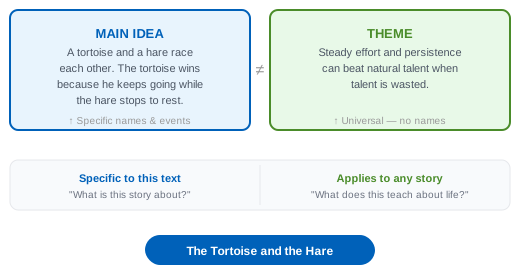 Main idea vs. theme for The Tortoise and the Hare: main idea includes specific story details, theme is a universal life lesson
Example 2: An Informational Text (Grades 3–5)
The passage: An article about Jane Goodall describes how she spent decades living among chimpanzees in Tanzania, making discoveries that changed how scientists understand animal behavior. Other researchers doubted her methods at first, but her patience and careful observation proved them wrong.
Finding the main idea: Jane Goodall's patient, long-term observation of chimpanzees in Tanzania led to groundbreaking discoveries about animal behavior, despite early skepticism from other scientists.
Finding the theme: Informational texts don't always have a "theme" the way stories do — but teachers may ask for the central message or author's message. Here, it might be: Persistence and unconventional thinking can lead to important discoveries.
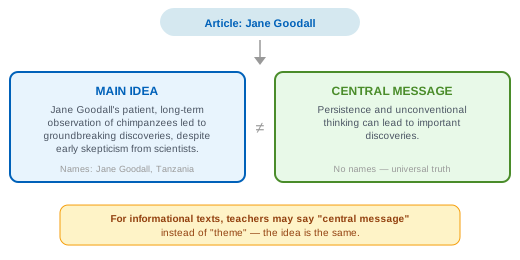 Main idea vs. theme for an informational text: main idea summarizes the specific article, central message captures the broader takeaway
For more on how teachers help students navigate nonfiction texts, see What Are Text Features? A Parent's Guide to Nonfiction Reading.
Example 3: A Novel Excerpt (Grades 5–8)
The passage: In a chapter from Charlotte's Web, Charlotte stays up all night spinning words into her web to save Wilbur from being slaughtered. She's exhausted but tells Wilbur she doesn't mind because he's her friend.
Finding the main idea of the chapter: Charlotte works through the night to spin a message in her web that will save Wilbur's life, even though it exhausts her.
Finding the theme: True friendship means making sacrifices for the people you care about, even when it costs you something.
By middle school, students are expected to trace how this theme develops across multiple chapters — not just identify it from a single passage.
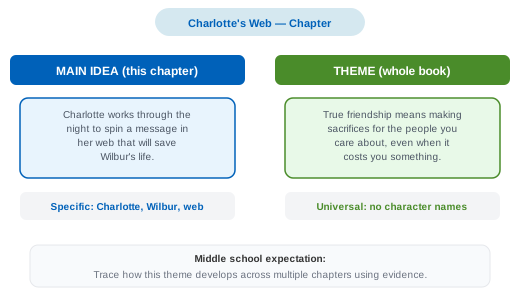 Main idea vs. theme for Charlotte's Web: main idea captures the chapter's events, theme expresses a universal truth about friendship
How Main Idea vs. Theme Connects to What You Already Know
You already use both of these thinking skills constantly — you just don't label them the way your child's teacher does.
When someone asks "What was that movie about?" and you say "It's about a retired astronaut who has to go back to space to save her daughter," that's main idea. When you walk out of the theater and say "It really made me think about how far parents will go for their kids," that's theme.
When you read a news article and summarize it for a coworker — "It's about how a local bakery survived the pandemic by switching to online orders" — that's main idea. When you reflect on what that story means and say "It shows that people who adapt quickly can make it through almost anything," that's theme.
When your child tells you about a fight with a friend and you help them figure out "what happened" (main idea) versus "what you learned from this" (theme), you're doing exactly what their teacher does in reading class.
The difference is that today's students are taught to recognize and name these two levels of understanding so they can apply them deliberately rather than only using them when things are obvious.
For more on how teachers build reading comprehension skills, see Reading Comprehension Strategies: A Parent's Guide to How Teachers Teach Reading.
Watch: Main Idea vs. Theme Explained
How to Help at Home
Use the same language their teacher uses
When your child is working on a reading assignment, match the vocabulary. Ask "What is this text mostly about?" for main idea and "What lesson or message does this teach about life?" for theme. These exact question frames are what teachers use in class, and hearing the same language at home reinforces the skill.
Start with main idea — it's more concrete
If your child is stuck, always start with main idea. It's easier to answer "What happened in this passage?" before jumping to "What does it mean?" Once they can summarize the text in their own words, they have a foundation for figuring out theme.
Teach the "no names" test for theme
Here's a quick check teachers use: if your child's theme statement includes character names, place names, or specific plot details, it's probably a main idea, not a theme. Theme should be general enough to apply to a different story entirely. Practice by asking: "Could this statement be true for a completely different book?"
Don't correct — redirect
If your child gives a topic word like "friendship" when asked for theme, don't say it's wrong. Say "You're on the right track — friendship is the topic. Now, what does this story say about friendship? Try making it a full sentence." This is exactly how teachers scaffold the skill in class.
Practice with movies and TV shows
ELA skills don't have to live on worksheets. After watching a show together, ask "What was that episode mostly about?" (main idea) and "What message was the show trying to get across?" (theme). Low-stakes practice like this builds the habit.
Let Methodwise walk through it
When your child has a specific reading passage and you're not sure whether they need the main idea or the theme, paste the question into Methodwise. It will walk you through the passage step by step, using the same approach and language their teacher uses.
Common Mistakes to Watch For
Giving a topic word instead of a theme statement
This is the most common mistake at every grade level. A student writes "friendship" or "courage" as the theme. But a topic is just one word — theme must be a complete sentence about life. "Friendship" is a topic. "True friends stand by you even when it's difficult" is a theme. Help your child turn their topic word into a full statement.
Including character names in the theme
If your child writes "Charlotte showed that friendship is important," that's actually closer to a main idea because it names a specific character. A theme version would be: "Real friendship means making sacrifices without expecting anything in return." Remind them: theme should work even if you've never read the book.
Confusing main idea with a summary
Main idea is not a play-by-play of everything that happened. If your child writes three sentences retelling the plot, they've written a summary, not the main idea. Main idea is the one key point the text is making — the thing everything else supports. A helpful prompt: "If you could only tell someone one sentence about this text, what would it be?"
Thinking theme is always stated in the text
In early grades, the lesson or moral is sometimes stated outright ("And the boy learned that honesty is always the best policy"). But by 4th grade and beyond, theme is almost always implied. Students have to infer it from the characters' actions, decisions, and what changes by the end of the story. If your child is hunting for a sentence that "says the theme," help them shift to looking at what the characters learned.
Assuming there's only one right theme
Students sometimes freeze because they're not sure they've found "the" theme. The truth is most texts have multiple valid themes. What matters is that the student can support their theme with evidence from the text. If your child identifies a theme and can point to moments in the story that back it up, they're doing the work correctly — even if it's not the same theme their classmate chose.
Practice Questions
Try these with your child. Answers are below.
Grades 2–3 — Identifying main idea and lesson:
-
Read this passage: "Mia wanted to win the art contest more than anything. She stayed up late painting every night. On the day of the contest, her painting didn't win first place — but her art teacher said it was the most improved work she'd ever seen." What is the main idea? What lesson does this story teach?
-
Read this passage: "Leo didn't want to share his new toy with his little brother. But when his brother started crying, Leo let him play with it. His brother smiled and said, 'You're the best big brother.'" What is the main idea? What is the theme?
Grades 4–5 — Distinguishing main idea from theme:
-
A story describes how a girl named Priya is nervous about starting at a new school. She sits alone at lunch for a week until she finally asks to join a group. The other kids welcome her. Which is the main idea and which is the theme? (A) "Taking a chance on new people can lead to friendship." (B) "Priya was nervous at her new school but made friends when she found the courage to introduce herself."
-
An article explains that honeybees communicate the location of flowers by performing a "waggle dance." Scientists studied this behavior for decades before understanding what it meant. What is the main idea of this article?
Grades 6–8 — Analyzing theme with evidence:
- In a novel, a character lies to protect a friend, and it works — but later, the character feels guilty and can't sleep. What theme might the author be developing? What evidence supports your answer?
Answers
-
Main idea: Mia worked hard on her painting for the art contest and, even though she didn't win, her teacher recognized her improvement. Lesson/theme: Hard work and effort matter even when you don't get the result you expected.
-
Main idea: Leo didn't want to share his toy but changed his mind when he saw his brother was upset, and his brother was grateful. Theme: Sharing with others — even when you don't want to — can make everyone happier.
-
(B) is the main idea — it names Priya and describes what happened. (A) is the theme — it's a universal statement about life with no character names.
-
Main idea: Honeybees use a waggle dance to tell other bees where flowers are, and scientists studied this behavior for decades to understand it. (Note: theme doesn't typically apply to informational texts, but the central message might be that animal communication is more complex than we realize.)
-
Possible theme: Lying — even with good intentions — comes with consequences. Evidence: The character's guilt and sleeplessness show that the lie had an emotional cost, even though it achieved its purpose.
Ready to try it with your child?
Open the chat, pick the subject and your child's grade, and get a step-by-step explanation you can use to help tonight.
Try 3 Questions Free — No Signup RequiredFrequently Asked Questions
Why do so many kids mix up main idea and theme?
Because both involve asking 'what is this about?' — but they're looking for different kinds of answers. Main idea is about THIS text specifically: what happened, who was involved, what the key information was. Theme is about life in general: what truth does the story illustrate that could apply anywhere? Kids get confused when teachers ask both types of questions using similar wording. The clearest fix: main idea has specific details (names, events, facts). Theme is a general statement that could be true in any story.
Is theme the same as the moral of a story?
They're closely related, but not exactly the same. A moral is a direct lesson the story tells you (like 'honesty is the best policy'). A theme is broader — it's the underlying truth the story explores about life. In elementary school, teachers often use the terms interchangeably, but by middle school, students learn that theme is usually implied rather than stated outright.
How do I help my child find the theme of a story?
Ask your child: 'What did the main character learn?' and 'Could that lesson apply to someone else's life too?' If the answer is yes, they're on their way to identifying the theme. Remind them that theme is never a single word — it's a complete sentence about life.
What grade do kids start learning about theme?
Students begin identifying the 'lesson' or 'moral' of a story as early as 2nd grade. By 4th grade, the Common Core standards formally introduce the word 'theme' and ask students to determine it from details in the text. Theme analysis deepens through middle school.
Can a story have more than one theme?
Yes. Most stories explore multiple themes. Charlotte's Web, for example, touches on friendship, sacrifice, the cycle of life, and growing up. Teachers may ask students to identify the central theme — the one most supported by evidence in the text — but there's rarely just one right answer.
Can Methodwise help my child with main idea and theme questions?
Yes. You can paste your child's reading passage or question into Methodwise and it will walk you through how to identify the main idea and theme step by step — using the same approach their teacher uses in class.
Try Methodwise Free
When your child brings home a reading passage and the worksheet asks for both the main idea and the theme, Methodwise walks you through it — step by step, using the same method their teacher is using.
- Start with 3 free questions — no account needed
- Free plan: 15 questions/month after signup
- Plus plan: unlimited questions + saved chat history + 7-day free trial
- Step-by-step explanations the way teachers teach
Related Articles
-
What Are Text Features? A Parent's Guide to Nonfiction Reading
-
Reading Comprehension Strategies: A Parent's Guide to How Teachers Teach Reading
-
What Is Close Reading? A Parent's Guide to Deeper Comprehension
-
Reading Levels Explained: Lexile, F&P, and DRA in Plain English
-
What Is Citing Evidence? A Parent's Guide to Text Evidence in Reading and Writing
-
Homework Help Tools: Built for Kids vs. Built for Parents — What's the Difference?
-
What Is Making Inferences? A Parent's Guide to Reading Between the Lines
-
Author's Purpose vs. Point of View: A Parent's Guide to PIE, Narrators, and Perspective
-
What Are Context Clues? A Parent's Guide to How Kids Figure Out New Words Without a Dictionary
-
What Is Text Structure? A Parent's Guide to How Nonfiction Is Organized
-
Opinion Writing vs. Argument Writing: A Parent's Guide to the K–8 Writing Progression
-
Summarizing vs. Retelling: A Parent's Guide to Why the Teacher Keeps Saying 'Too Many Details'
-
What Are Story Elements? A Parent's Guide to Characters, Setting, Problem, and Solution
-
What Is Phonemic Awareness? A Parent's Guide to Playing With Sounds Before Reading
Have questions about main idea and theme? Email me at hello@methodwise.co
About the Author
Samantha Black is the founder of Methodwise and an educator with over 15 years in higher education and instructional design. She built Methodwise after experiencing the homework gap firsthand as a parent of two K–8 daughters. Learn more about why we built Methodwise →