
What Is Making Inferences? A Parent's Guide to Reading Between the Lines
May 4, 2026
If your child has come home with a reading question that asks "How does the character feel?" or "Why did the author include this detail?" — and the answer isn't anywhere in the text — you've run into making inferences. And if your child has stared at the page and said "I don't know, it doesn't say," you've run into the exact friction point that frustrates more elementary and middle school readers than almost any other reading skill.
Making inferences (sometimes called reading between the lines) is the skill of figuring out what the author didn't tell you outright. It shows up in every grade, on every state reading test, and in nearly every reading assignment from second grade on. The good news: there's a clear formula teachers use, and once you learn it, you can walk your child through any inference question in a couple of minutes.
What Is Making Inferences?
Making an inference means using clues from the text plus what you already know about the world to figure out something the author didn't directly state. It's not a wild guess — it's a logical conclusion built from evidence.
Teachers often write it as a simple equation: text clues + what you know = an inference. If a story says "Marcus zipped his jacket all the way up and pulled his hood tight," the author never said "it was cold." But you know what people do when they're cold, so you can infer that it was cold outside. That's an inference.
Why Do Teachers Use Making Inferences?
When most of us were in school, reading questions were mostly about recall — what color was the dog, where did the story take place, what happened in chapter three. If the answer was right there in the text, you got it. If it wasn't, the question usually wasn't asked.
That's changed. Today's reading standards expect students to think beyond what the author said. The Common Core uses the phrase "inferences drawn from the text" starting in 1st grade and ramps up the expectation every year after that. The reasoning is straightforward: most real-world reading is full of implied meaning. A news article doesn't say "the senator is in trouble" — it shows you the polling numbers and trusts you to figure it out. A novel doesn't say "this character is lying" — it shows you the small contradiction and trusts you to catch it.
Teachers are training students to do this on purpose, with a method, instead of either missing the meaning entirely or grabbing at a guess that isn't supported. Naming the skill as making inferences — and giving students a clear way to do it — is what makes it teachable.
Stuck on tonight's homework?
Paste in the problem and get a step-by-step explanation in your child's grade level — using the same method their teacher uses.
Try 3 Questions Free — No Signup RequiredWhat Grade Are Inferences Taught?
Kindergarten–1st Grade — Inferring from Pictures and Read-Alouds
At this age, inference work is mostly oral and visual. A teacher reads a picture book aloud, points to an illustration, and asks "How do you think she feels? How do you know?" The child looks at the picture — the character's frown, the tear, the slumped shoulders — and uses what they know about feelings to answer. The standard (RL.K.1, RL.1.1) frames this as "asking and answering questions about key details," with inference woven in as soon as students can talk about what the picture shows.
2nd–3rd Grade — Inferring from Text Alone
By 2nd grade, students are expected to make inferences without relying on pictures. A typical question: "Why did Sam hide the cookie behind his back? The story doesn't say — what can you figure out?" Teachers introduce the text clues + what you know = inference equation and start asking students to point to the specific clue in the text. By 3rd grade (RL.3.1), students are expected to "refer explicitly to the text as the basis for the answers" — meaning the inference has to be tied to a real detail, not made up.
Grades 4–5 — Citing Evidence for Inferences
This is where inferences and citing evidence merge. A 4th or 5th grader is expected not just to make the inference but to quote or paraphrase the specific text detail that supports it (RL.4.1, RL.5.1). A typical question: "What kind of person is Maya? Use details from the text to support your answer." The expected answer includes the trait (Maya is brave), the evidence ("she stepped to the edge of the high dive even though her hands were shaking"), and a sentence connecting the two.
Grades 6–8 — Inferences About Theme, Purpose, and Tone
Middle school inferences get harder because the questions get more abstract. Students are asked to infer the theme of a story, the author's purpose, the tone of an article, or the implied argument in an opinion piece. They're often asked to pull two or more pieces of evidence and explain how the inference holds up across the whole text. By 8th grade (RL.8.1, RI.8.1), students are expected to "cite the textual evidence that most strongly supports an analysis of what the text says explicitly as well as inferences drawn from the text."
If your child is working with inferences at any of these stages, it's developmentally appropriate and part of a deliberate progression from "I noticed her face looks sad" to "I can defend my reading of the text with evidence."
How Making Inferences Works
Most teachers lean on the same simple framework — the inference equation — and then build worked examples on top of it. Here's what it looks like in practice.
The Inference Equation
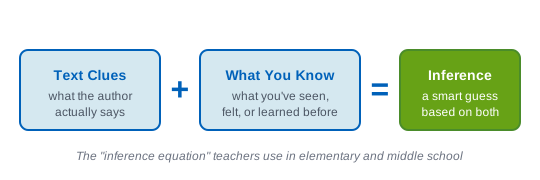 The inference equation: Text Clues plus What You Know equals Inference, shown as three labeled boxes connected by plus and equals signs
Every inference has two ingredients: a clue from the text and something you already know. Take either one away and the inference falls apart. If you have only the clue, you can't interpret it. If you have only background knowledge, you're not reading the text — you're making it up. The skill is in combining both, on purpose.
For more on how to back up an inference with the right kind of proof, see What Is Citing Evidence? A Parent's Guide to Text Evidence in Reading and Writing.
Stated vs. Inferred
The first hurdle for most kids is telling the difference between something the author said and something the reader figured out. Teachers often start here.
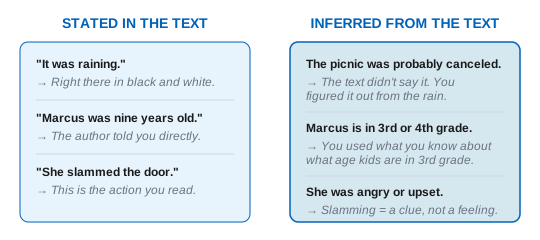 Side-by-side comparison: stated facts on the left like "It was raining" and inferred ideas on the right like "The picnic was probably canceled"
A useful rule of thumb: if you can underline the answer in the text, it's stated. If you have to think about what the author meant by it, it's inferred. Inference questions almost always use phrases like "How do you think...," "Why might...," "What can you tell about...," or "What does this suggest...." When you see those phrases, the answer is not going to be sitting there in plain sight.
A Worked Example
Here's a short passage and the kind of inference work a 3rd or 4th grader would be expected to do with it.
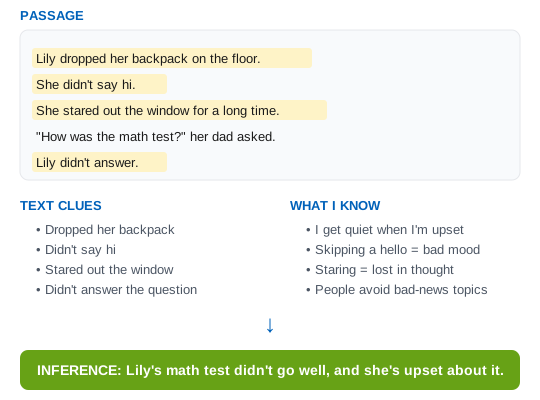 Worked example showing a short passage about Lily coming home from school, with text clues highlighted and combined with background knowledge to reach the inference that her math test didn't go well
Notice what the student did. She didn't just say "Lily is sad." She pointed to specific actions in the text — dropping the backpack, not saying hi, ignoring the question about the test — and combined them with what she already knows about how people act when something goes wrong. The author never wrote the words "the test went badly" or "Lily is upset." The reader figured it out from the clues.
That's the move teachers are training. The inference is Lily's math test didn't go well, and she's upset about it. The evidence is the four behaviors the author described. The connection is general knowledge about how people react when they're disappointed.
For more on telling the difference between what's specific to one story and what's a bigger pattern, see Main Idea vs. Theme: What Your Child's Teacher Actually Means.
Sentence Frames Teachers Use
To make the skill less intimidating, teachers usually give students a bank of sentence frames. These are the same phrases parents can use at home:
- I can infer that ___ because the text says ___.
- Based on the clues in the text, I think ___.
- The author doesn't say it directly, but I can tell ___ because ___.
- The text says ___, and I know ___, so ___.
These frames force the student to put both ingredients on the page — the clue and the connection. Over time, students stop needing the frames and just write the same kind of answer in their own words.
How Making Inferences Connects to What You Already Know
You make inferences constantly. You just don't call them that.
When you walk into the kitchen, see crumbs on the counter and a half-empty cereal box on its side, and conclude "someone made breakfast in a hurry" — that's an inference. The text (the crumbs, the box) didn't tell you anyone was in a hurry. You combined the visible clues with what you know about how careful people usually are when they have time.
When your kid comes home from school, slams the door, throws their bag down, and stomps to their room without saying a word — and you think "something happened today" — that's an inference. The kid didn't say "I had a hard day." You read the clues.
When you watch a movie and the camera lingers on a character's wedding ring before cutting to a scene with another woman, and you think "oh, this is going to be an affair plot" — that's an inference. Nobody said it. The director showed you a clue and trusted you to do the math.
The difference is that today's students are taught to recognize and name this strategy — to mark it with the inference equation and sentence frames — so they can apply it deliberately when answering a reading question, instead of only using it when they're trying to read a room.
Watch: Making Inferences Explained
How to Help at Home
Ask "What makes you think that?" instead of "What's the answer?"
When your child reads something — a chapter book, a comic, a TV episode summary — occasionally ask "How do you know?" or "What makes you think that?" You're not quizzing them. You're training them to point at the clue. Once they can name the clue, they're making an inference, even if they don't call it that.
Use the teacher's vocabulary
If your child's teacher uses "text clues + what you know," you use "text clues + what you know." If they use the word "infer" or "inference," you use it too. Match the language. It sounds small, but it makes homework feel consistent and reduces the "that's not how my teacher said it" friction.
Don't accept "it doesn't say in the book" as a final answer
This is the single most common stuck point. The whole point of an inference question is that the answer isn't stated. When your child says "it doesn't say," gently flip the question: "Right — so what does the author show us instead? What do the characters do or say?" Pointing at the clue is half the work.
Practice with movies and shows, not just books
You don't need a book to practice inference. Pause a TV show and ask "How is she feeling right now? How can you tell?" Watch the trailer for a movie and ask "What do you think this movie is about? What clues are you using?" The skill transfers directly to reading, and it's lower-stakes than homework.
Watch out for guesses that don't use a text clue
If your child says "I think the boy is mean because boys are usually mean to their sisters," that's not an inference — that's a stereotype dressed up as one. Walk them back to the text: "What in this passage actually shows the boy being mean? Can you point to a sentence?" The clue has to come from the text, not from outside it.
Let Methodwise walk through it
If your child is stuck on an inference question and doesn't know where to start, open the Methodwise chat, paste or describe the passage and the question, and ask for help making an inference. Methodwise will pull out the text clues, connect them to background knowledge, and model the response step by step — using the same language the teacher uses.
Common Mistakes to Watch For
Confusing an inference with an opinion
If the answer is "because I think so" or "because that's how I feel," it's an opinion, not an inference. Inferences are tied to a specific detail in the text. The fix is simple: "Show me the clue. Where in the passage did you get that idea?"
Pulling in information that isn't in the text
A child reads a story about a girl named Anna and decides Anna is shy "because girls named Anna are usually shy." That's outside knowledge with no text clue attached. Inferences combine what's in the text with what's true generally — not with what the reader assumes about the character before reading.
Missing the clue that's right there
Sometimes students miss inferences because they read past a critical detail. "Her hands were shaking" is a clue. "He didn't look up when she walked in" is a clue. Reread the passage out loud together and ask your child to underline anything a character did or said — those are usually where the inferences live.
Stopping at the clue without making the leap
A student writes "the text says her hands were shaking" and stops. That's a quote, not an inference. The inference is what the shaking means. Push for the second half: "Okay, her hands were shaking. So what can we figure out from that?"
Treating every detail as a clue
Not every sentence is a hint. Sometimes the author is just describing the room. If your child is trying to make an inference from a detail that doesn't actually point to anything ("she had brown hair, so I think she's quiet"), help them notice that the clue and the inference don't connect. The clue has to logically support the inference.
Practice Questions
Try these with your child. Read each short passage, answer the question, and notice the clue + what you know behind each answer. Answers are below.
Passage A:
Jordan rubbed his eyes and yawned for the third time. He looked at the math worksheet in front of him and pushed it away. "Maybe I'll just do it tomorrow," he said. He climbed into bed without taking off his socks.
Grades 2–3 — Simple inference:
- How is Jordan feeling? Find one clue from the passage that shows it.
Passage B:
Mia held her acceptance letter in both hands and read it for the fifth time. She walked into the kitchen, opened her mouth, and then closed it again. "What's wrong?" her mom asked. Mia just shook her head and smiled.
Grades 4–5 — Inference with cited evidence:
- What can you infer about how Mia is feeling? Use a detail from the text to support your answer, and explain why that detail leads to your inference.
Passage C:
The crowd outside the courthouse had been waiting since dawn. Reporters checked their watches. A black car pulled up to the curb, and the doors did not open right away. The mayor's press secretary, who had been smiling all morning, stopped smiling.
Grades 6–8 — Inference about tone or implied meaning:
- What can you infer about what's about to happen? Identify two details from the passage and explain how they support your inference. What is the tone of this passage?
Answers
-
Jordan is tired. The clue is that he "rubbed his eyes and yawned for the third time" — combined with what we know about how people act when they're sleepy. (You could also cite "climbed into bed without taking off his socks," which suggests he's too tired to bother with his usual routine.)
-
Mia is excited but overwhelmed — and probably nervous about sharing the news. The text says she "read it for the fifth time" and "opened her mouth, and then closed it again," which shows she's processing big news and not sure how to say it out loud. Combined with what we know about how people react to important letters (especially acceptance letters), we can infer that the news is good but that Mia is still gathering herself.
-
Two details: "the doors did not open right away" and "the press secretary…stopped smiling." Both suggest something has gone wrong — when officials hesitate and aides drop their public face, it usually means bad news is coming. We can infer that the announcement isn't going to be what the crowd was hoping for. The tone is tense and uneasy — the author is signaling that something is about to go sideways.
Ready to try it with your child?
Open the chat, pick the subject and your child's grade, and get a step-by-step explanation you can use to help tonight.
Try 3 Questions Free — No Signup RequiredFrequently Asked Questions
What's the difference between making an inference and making a prediction?
An inference is a smart guess about something happening now or already in the text — like how a character feels or why she did something. A prediction is a smart guess about what will happen next. Both rely on text clues plus what you already know, but inferences are about the present and past of the story, while predictions are about the future. Teachers introduce both around 1st or 2nd grade and use them side by side.
Is making inferences the same as 'drawing conclusions' or 'reading between the lines'?
They're closely related and teachers often use them interchangeably, especially in early elementary. Strictly speaking, making an inference is the catch-all term for using text clues plus background knowledge. Drawing conclusions usually means combining several inferences across a longer passage to land on a bigger judgment. Reading between the lines is the everyday version of the same idea. If your child's worksheet uses one of these phrases, treat them as the same skill — and use whichever wording their teacher uses to keep things consistent at home.
How is making inferences different in nonfiction vs. fiction?
The strategy is the same — text clues plus what you know — but the questions shift. In fiction, students usually infer about a character's feelings, motivation, or relationships. In nonfiction, they infer an author's point of view, the cause of an event, or the significance of a fact or statistic. By 4th or 5th grade, your child will see both types in the same week. The 'what you know' piece often changes from emotional knowledge in fiction to factual knowledge in nonfiction, but the equation doesn't change.
My child got the inference right but still lost points. What's going wrong?
Almost always the missing piece is the explanation. Many students stop after 'I think Lily is upset' and don't write the second half — why the text supports that. From 3rd grade up, teachers usually grade inference responses on three things: the inference, the cited clue, and the sentence connecting them. Ask your child, 'Did you say what the clue is, and did you explain why that clue led to your answer?' Adding one more sentence is often the entire fix.
What if my child's inference is different from the answer the teacher marked correct?
It depends on whether the inference is actually supported by the text. A good rule of thumb: if your child can point to a specific detail in the passage and explain how it leads to their inference, the answer should at least be defensible. That said, some questions are looking for the 'best supported' inference rather than a single right answer. If this keeps coming up, it's worth asking the teacher how they evaluate inference responses — most will tell you they're looking for evidence plus a logical connection, not a specific phrasing.
Can Methodwise help with inference questions?
Yes. If your child is stuck on a 'how does the character feel' or 'why did the author...' question, you can paste the passage and the question into Methodwise. It'll walk through the text clues, connect them to what your child already knows, and model the inference step by step — using the same vocabulary the teacher uses.
Try Methodwise Free
When your child brings home a reading assignment that asks "How does the character feel?" or "What can you infer?" and you're not sure how to walk them through it the way their teacher would, Methodwise does it for you — step by step, using the same inference equation and sentence frames their teacher is using.
- Start with 3 free questions — no account needed
- Free plan: 15 questions/month after signup
- Plus plan: unlimited questions + saved chat history + 7-day free trial
- Step-by-step explanations the way teachers teach
Related Articles
-
What Is Citing Evidence? A Parent's Guide to Text Evidence in Reading and Writing
-
What Is Close Reading? A Parent's Guide to Deeper Comprehension
-
Main Idea vs. Theme: What Your Child's Teacher Actually Means
-
Reading Comprehension Strategies: A Parent's Guide to How Teachers Teach Reading
-
What Are Text Features? A Parent's Guide to Nonfiction Reading
-
Reading Levels Explained: Lexile, F&P, and DRA in Plain English
-
Homework Help Tools: Built for Kids vs. Built for Parents — What's the Difference?
-
Author's Purpose vs. Point of View: A Parent's Guide to PIE, Narrators, and Perspective
-
What Are Context Clues? A Parent's Guide to How Kids Figure Out New Words Without a Dictionary
-
What Is Text Structure? A Parent's Guide to How Nonfiction Is Organized
-
Opinion Writing vs. Argument Writing: A Parent's Guide to the K–8 Writing Progression
-
Summarizing vs. Retelling: A Parent's Guide to Why the Teacher Keeps Saying 'Too Many Details'
-
What Are Story Elements? A Parent's Guide to Characters, Setting, Problem, and Solution
-
What Is Phonemic Awareness? A Parent's Guide to Playing With Sounds Before Reading
Have questions about making inferences? Email me at hello@methodwise.co
About the Author
Samantha Black is the founder of Methodwise and an educator with over 15 years in higher education and instructional design. She built Methodwise after experiencing the homework gap firsthand as a parent of two K–8 daughters. Learn more about why we built Methodwise →