What Are Number Bonds? A Parent's Guide to Making and Breaking Numbers
March 20, 2026
If your child's homework has circles connected by lines — with a big number on top and two smaller numbers below — you've seen a number bond. It might look unfamiliar if you learned math with flash cards and timed tests, but number bonds are one of the most widely used tools in elementary math today. They show up from kindergarten through 4th grade, and the thinking behind them carries into every math concept your child will encounter after that.
What Is a Number Bond?
A number bond is a simple diagram that shows how one number is made up of two parts. It has three circles connected by lines: the whole number on top (or in the center) and two parts below it.
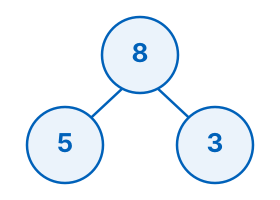 Number bond showing 8 = 5 + 3
That's it. 8 is the whole. 5 and 3 are the parts. Together, the parts make the whole: 5 + 3 = 8. And you can go the other direction too: 8 − 5 = 3.
The power of a number bond isn't the diagram itself — it's the idea that every number can be pulled apart and put back together. And that a single number bond gives you four related math facts at once.
Why Do Teachers Use Number Bonds?
Most of us memorized addition and subtraction facts one at a time: 5 + 3 = 8 was one fact, 8 − 3 = 5 was a different one, and we drilled them separately. Number bonds take a different approach — they teach kids to see the relationship between addition and subtraction from the very beginning.
From one number bond (8 = 5 + 3), a student can derive four facts:
- 5 + 3 = 8
- 3 + 5 = 8
- 8 − 5 = 3
- 8 − 3 = 5
Instead of memorizing four separate facts, the child understands one relationship and can generate all four. That's more efficient, and it builds the kind of flexible thinking that matters far more than speed.
Number bonds also lay the groundwork for:
- Mental math — seeing that 47 + 8 is easier when you think of 8 as 3 + 5 (47 + 3 = 50, then 50 + 5 = 55)
- Fact families — the formal term for the four related facts in a number bond
- Missing addend problems — "What plus 5 equals 8?" becomes intuitive when you can see the empty circle in a number bond
- Algebra — solving for x in x + 5 = 8 is the same structure as a number bond with a missing part
Teachers use number bonds because they give kids a visual model for thinking about numbers — not just calculating with them.
Stuck on tonight's homework?
Paste in the problem and get a step-by-step explanation in your child's grade level — using the same method their teacher uses.
Try 3 Questions Free — No Signup RequiredWhat Grade Are Number Bonds Taught?
Number bonds appear from kindergarten through 4th grade, with the complexity increasing at each stage:
Kindergarten — Bonds Within 5 and 10
This is where number bonds begin. Students learn all the ways to make numbers up to 5, then up to 10. "How many ways can you make 5?" becomes a regular classroom question: 1 + 4, 2 + 3, 5 + 0, and so on.
Teachers use physical objects — counters, cubes, fingers — alongside the number bond diagram so kids can see and touch the parts before they draw them. The standard your child's teacher is working toward: fluently add and subtract within 5, and know the pairs that make 10.
1st Grade — Bonds Within 10 and 20
Students move to number bonds within 20 and start using them as a strategy for addition and subtraction. The "make a ten" strategy depends entirely on number bonds: to solve 8 + 5, a student breaks 5 into 2 + 3, makes a ten (8 + 2 = 10), then adds the leftover 3 to get 13.
First graders also use number bonds to understand fact families formally — writing all four related equations from one bond.
2nd & 3rd Grade — Larger Numbers and Multiplication
Number bonds expand beyond basic facts. Students decompose two-digit numbers (45 = 40 + 5) and use that thinking for addition and subtraction with regrouping. By 3rd grade, the same part-whole structure appears in multiplication and division: if 24 = 6 × 4, then 24 ÷ 6 = 4 and 24 ÷ 4 = 6.
4th Grade — Fractions
The number bond model extends to fractions: 1 = 3⁄4 + 1⁄4, or 5⁄8 = 3⁄8 + 2⁄8. Students use number bonds to decompose fractions and to add and subtract fractions with like denominators.
If your child is working with number bonds at any of these stages, it's developmentally appropriate and part of a deliberate progression.
How Number Bonds Work
Basic Number Bonds (Kindergarten–1st Grade)
Example: All the bonds for 7
| Whole | Part + Part |
|---|---|
| 7 | 0 + 7 |
| 7 | 1 + 6 |
| 7 | 2 + 5 |
| 7 | 3 + 4 |
| 7 | 4 + 3 |
| 7 | 5 + 2 |
| 7 | 6 + 1 |
| 7 | 7 + 0 |
In class, your child might be asked to find all the bonds for a number. This isn't busywork — it builds the complete mental map of how 7 breaks apart, which is the foundation for every calculation involving 7 later on.
The "Make a Ten" Strategy (1st–2nd Grade)
This is the single most important application of number bonds in early math.
Example: 8 + 5
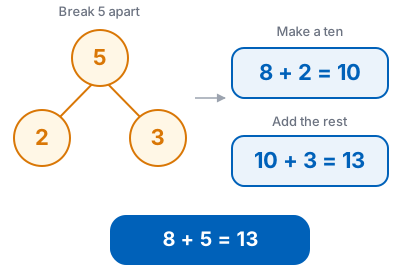 Make a ten strategy: break 5 into 2 + 3, then 8 + 2 = 10, then 10 + 3 = 13
The student used a number bond (5 = 2 + 3) to turn an awkward problem into an easy one. This is the same strategy adults use for mental math — we just do it automatically because we've internalized the bonds through years of practice.
For more on this strategy, see What Is Decomposing Numbers? A Parent's Guide to Breaking Apart Numbers.
Missing Part Problems (1st–2nd Grade)
Number bonds make "missing addend" problems visual and intuitive.
Example: ___ + 4 = 9
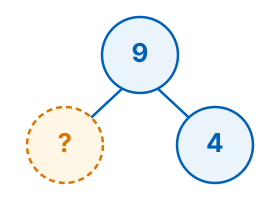 Number bond with missing part: 9 = ? + 4
The child looks at the bond and thinks: "9 is the whole, 4 is one part — what's the other part?" The answer (5) comes from understanding the relationship, not from guessing or counting on fingers.
This is the exact same structure as solving x + 4 = 9 in algebra. Kids who are comfortable with number bonds are practicing algebraic thinking years before they see a variable.
Number Bonds With Larger Numbers (2nd–3rd Grade)
Example: Decompose 64 to make subtraction easier
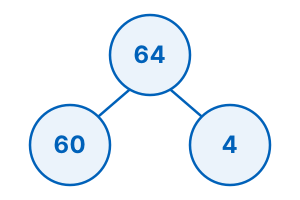 Number bond showing 64 = 60 + 4
Now the student can use this to solve 64 − 8:
- Take 4 from 64 to get 60 (using the bond)
- Then subtract 4 more: 60 − 4 = 56
- 64 − 8 = 56
The number bond helped the student break a harder problem into two simple steps.
This is decomposition in action. See What Is Expanded Form? A Parent's Guide to Place Value for how this extends to place value.
Number Bonds With Fractions (4th Grade)
Example: Decompose 5⁄6
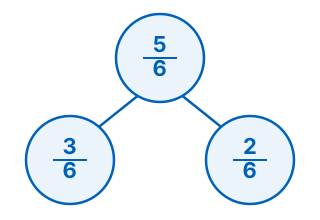 Number bond showing 5/6 = 3/6 + 2/6
This helps students add and subtract fractions, and it reinforces the idea that fractions behave the same way as whole numbers — they can be pulled apart and recombined.
How Number Bonds Connect to What You Already Know
You've used number bond thinking your entire life — you just didn't draw the circles.
Making change. If something costs $6 and you pay with a $10 bill, you instantly know you get $4 back. That's a number bond: 10 = 6 + 4. You didn't count up from 6 or subtract on paper — you just knew the relationship.
Splitting a check. A $45 dinner split between two people is 45 = 22.50 + 22.50. You're decomposing a whole into parts.
Doubling a recipe. If a recipe needs 3⁄4 cup of sugar and you're doubling it, you might think: 3⁄4 + 3⁄4 = 6⁄4 = 11⁄2. That's fraction number bonds in action.
Tipping. To calculate 20% of $65, you might break 65 into 60 + 5, find 20% of each (12 + 1 = 13), and recombine. That's decomposition — the same skill number bonds build.
The difference is that today's students are taught to recognize and name this strategy, so they can apply it deliberately rather than stumbling into it by accident.
Watch: Number Bonds Explained
How to Help at Home
Start with objects, not worksheets
Grab 8 Legos, grapes, or coins. Ask your child to split them into two groups. Write the bond: 8 = 5 + 3. Then ask them to split the same 8 a different way. The physical act of moving objects makes the concept stick faster than filling in blanks on paper.
Practice the bonds for 10 until they're automatic
The pairs that make 10 — 1+9, 2+8, 3+7, 4+6, 5+5 — are the single most important set of math facts your child will learn in early elementary. They're the foundation for the "make a ten" strategy, which shows up constantly from 1st through 3rd grade. Quiz these casually: "I say 7, you say what makes 10?"
When they're stuck, draw the bond
If your child is staring at a problem like ___ + 6 = 11, draw the three circles. Put 11 in the top circle, 6 in one of the bottom circles. Ask: "What goes in the empty one?" The visual structure often unlocks the answer when staring at the equation alone doesn't.
Ask "what's the fact family?"
When your child solves 3 + 9 = 12, ask: "What other facts do you know from that bond?" They should be able to generate 9 + 3 = 12, 12 − 3 = 9, and 12 − 9 = 3. This is one of the most efficient ways to practice — four facts for the price of one.
Don't rush to the "fast" way
If your child draws a number bond to solve a problem you could do in your head, that's fine. They're building the understanding that will eventually become the speed. Pushing them to "just memorize it" skips the conceptual foundation that makes all later math easier.
Let Methodwise walk through it
If your child is stuck on a specific number bond problem, Methodwise explains it using the same part-whole language their teacher uses — with a knowledge check to make sure the foundation is solid before moving forward.
Common Mistakes to Watch For
Confusing the whole and the parts
Students sometimes put one of the parts in the top circle instead of the whole. Reinforce: "The biggest number — the total — always goes on top. The two smaller numbers that make it go on the bottom."
Thinking there's only one right answer
When asked to decompose 10, some kids freeze because they think there's one "correct" bond. Remind them: 10 = 1+9, 2+8, 3+7, 4+6, 5+5 — all correct. The question is which bond is most useful for the problem they're working on.
Not connecting bonds to subtraction
Kids sometimes treat addition bonds and subtraction as separate topics. If your child knows 7 + 3 = 10 but can't quickly answer 10 − 7, practice the fact family: draw the bond and generate all four facts together.
Skipping the "make a ten" step
When solving 7 + 5, some students count on their fingers instead of using the strategy: break 5 into 3 + 2, make a ten (7 + 3 = 10), add the rest (10 + 2 = 12). If they're still counting one-by-one past 1st grade, gently redirect them to the bond strategy.
Writing the bond but not using it
Older students sometimes draw a number bond because the teacher requires it, but then solve the problem a different way. Encourage them to actually use the bond to choose their strategy — that's the thinking tool, not just the diagram.
Practice Questions
Try these with your child. Answers are below.
Number bonds within 10 (Kindergarten–1st grade):
- Draw all the number bonds for 6.
- Fill in the missing part: 10 = 4 + ___
Make a ten (1st–2nd grade):
- Use a number bond to solve 9 + 4.
- Use a number bond to solve 7 + 6.
Missing part (1st–2nd grade):
- ___ + 5 = 12
- 15 − ___ = 9
Challenge — Fractions (4th grade):
- Decompose 7⁄8 into two fractions using a number bond.
- Use a number bond to solve 5⁄6 − 2⁄6.
Answers
- 0+6, 1+5, 2+4, 3+3, 4+2, 5+1, 6+0
- 10 = 4 + 6
- Break 4 into 1+3 → 9+1 = 10 → 10+3 = 13
- Break 6 into 3+3 → 7+3 = 10 → 10+3 = 13
- 7 + 5 = 12
- 15 − 6 = 9
- 7⁄8 = 4⁄8 + 3⁄8 (or any two fractions with denominator 8 that sum to 7⁄8)
- 5⁄6 = 2⁄6 + 3⁄6 → 5⁄6 − 2⁄6 = 3⁄6 (or 1⁄2)
Ready to try it with your child?
Open the chat, pick the subject and your child's grade, and get a step-by-step explanation you can use to help tonight.
Try 3 Questions Free — No Signup RequiredFrequently Asked Questions
Are number bonds the same as fact families?
They're closely related but not identical. A number bond is the visual diagram — the circles and lines showing a whole and two parts. A fact family is the set of four related equations you can write from that bond (2 + 6 = 8, 6 + 2 = 8, 8 − 2 = 6, 8 − 6 = 2). The number bond is the model; the fact family is the set of equations it generates.
My child's teacher calls them part-part-whole diagrams. Is that the same thing?
Yes, exactly the same concept. Number bonds, part-part-whole diagrams, and part-whole models are all names for the same tool. Different curricula and teachers use different vocabulary, but the idea is identical: one whole made of two parts.
My child can already add. Why do they need to draw circles?
Because the goal isn't just getting the answer — it's understanding the relationship between the numbers. A child who knows that 8 + 5 = 13 has memorized a fact. A child who can explain that they broke 5 into 2 + 3, made a ten, and added 3 more has a strategy that works for any numbers, not just the ones they've memorized. The circles build that reasoning.
Should my child memorize all the bonds, or figure them out each time?
Both, eventually. In the early stages, figuring them out builds understanding. Over time, the bonds for 10 especially should become automatic — your child should know instantly that 10 = 7 + 3 without drawing it. But the drawing stage is important and shouldn't be rushed. Fluency built on understanding lasts; memorization without understanding fades.
How are number bonds different from decomposing numbers?
Number bonds are one way to show decomposition visually. Decomposing numbers is the broader concept — breaking any number into parts. A number bond is the specific diagram (circles and lines) that represents a decomposition. Your child will decompose numbers in many ways; the number bond diagram is the tool they use to organize their thinking in the early grades.
Do number bonds only work with addition and subtraction?
In the early grades, yes — but the part-whole thinking extends to multiplication and division (24 = 6 × 4), fractions (1 = 3/4 + 1/4), and eventually algebra (x + 5 = 12). The diagram fades away, but the structural understanding stays.
Try Methodwise Free
When your child brings home a number bond worksheet and you're not sure how to explain it the way their teacher would, Methodwise walks you through it — step by step, using the same method their teacher is using.
- Start with 3 free questions — no account needed
- Free plan: 15 questions/month after signup
- Plus plan: unlimited questions + saved chat history + 7-day free trial
- Step-by-step explanations the way teachers teach
Related Articles
-
What Is Decomposing Numbers? A Parent's Guide to Breaking Apart Numbers
-
What Is the Area Model? A Parent's Guide to Box Multiplication
-
What Is a Number Line? A Parent's Guide to How Teachers Use It
-
What Is Partial Sums Addition? A Parent's Guide to Why Your Child Doesn't 'Carry the One' Anymore
-
What Is a Tape Diagram? A Parent's Guide to Visualizing Word Problems
-
What Is a Ten Frame? A Parent's Guide to the Box That Builds Number Sense
-
What Is Partial Quotients Division? A Parent's Guide to the New Way Kids Learn Long Division
-
What Are Common Core Math Methods? A Parent's Guide to How Math Is Taught Today
-
What Are Arrays in Math? A Parent's Guide to Visualizing Multiplication
-
Homework Help Tools: Built for Kids vs. Built for Parents — What's the Difference?
-
What Are Fact Families? A Parent's Guide to How Addition and Subtraction Connect
-
What Is the Standard Algorithm? A Parent's Guide to Why Your Child Learns the 'Long Way' First
-
Fractions on a Number Line: A Parent's Guide to Why Pie Charts Aren't Enough
-
What Are Ratios and Proportional Reasoning? A Parent's Guide to Middle School Math
-
What Is Skip Counting? A Parent's Guide to How Counting by 2s, 5s, and 10s Becomes Times Tables
-
What Math Will My Child Learn This Year? A Parent's Guide to K-8 Math Methods by Grade
-
What Are Mental Math Strategies? A Parent's Guide to How Kids Add and Subtract in Their Heads
Have questions about number bonds or other math methods? Email me at hello@methodwise.co
About the Author
Samantha Black is the founder of Methodwise and an educator with over 15 years in higher education and instructional design. She built Methodwise after experiencing the homework gap firsthand as a parent of two K–8 daughters. Learn more about why we built Methodwise →