
What Is a Number Line? A Parent's Guide to How Teachers Use It
March 15, 2026
If your child's math homework involves jumping along a line with arrows, counting by twos, or placing fractions between whole numbers, you've seen a number line in action.
Number lines show up in math from kindergarten all the way through 8th grade — and the way teachers use them changes significantly at each level. What looks like a simple counting tool in 1st grade becomes a critical model for understanding negative numbers and irrational numbers by middle school.
What Is a Number Line?
A number line is a straight line with numbers placed at equal intervals along it. Numbers increase from left to right, and the spacing between them is consistent — so the distance from 0 to 1 is the same as the distance from 1 to 2, from 5 to 6, and so on.
That equal spacing is what makes number lines so powerful. They make the relationships between numbers visible — not just the numbers themselves.
Why Do Teachers Use Number Lines?
Most of us learned math through procedures: memorize the steps, follow the algorithm, get the answer. Number lines take a different approach — they make mathematical thinking visible.
When a student adds 47 + 8 by jumping from 47 to 50 (a jump of 3), then from 50 to 55 (a jump of 5), they're not just getting an answer. They're learning to work flexibly with numbers — breaking a problem into manageable steps and choosing the most efficient path.
This is the same number sense that allows students to do mental math, estimate quickly, and eventually handle algebra. Teachers use number lines because they build that flexibility from the very beginning — long before students encounter variables or equations.
A number line also makes abstract concepts concrete. Negative numbers are hard to explain in words, but on a number line, -3 is simply three steps to the left of zero. The concept clicks visually in a way that a definition alone doesn't achieve.
Stuck on tonight's homework?
Paste in the problem and get a step-by-step explanation in your child's grade level — using the same method their teacher uses.
Try 3 Questions Free — No Signup RequiredWhat Grade Is the Number Line Taught?
Number lines are one of the few math tools that appear at every grade level from kindergarten through 8th grade — with increasing complexity at each stage:
Grades K–1 — Number Paths and Early Sequences
In the earliest grades, teachers often start with number paths rather than abstract number lines — a row of numbered boxes or stepping stones that children can physically touch and count. This builds the foundational understanding that numbers have an order and that moving forward means adding while moving backward means subtracting. By the end of 1st grade, students transition to standard number lines for counting sequences and basic addition and subtraction.
Grades 2–3 — Addition, Subtraction, and Skip Counting
This is when number lines become a primary strategy for solving addition and subtraction problems within 100. Students learn to make strategic jumps — rather than counting one by one, they jump to the nearest ten and then count on. Skip counting by 2s, 5s, and 10s on a number line also builds the foundation for multiplication. In 3rd grade, fractions are introduced on the number line for the first time, helping students see that ½ lives exactly halfway between 0 and 1.
Grades 4–5 — Fractions, Mixed Numbers, and Decimals
Number lines become essential for comparing and ordering fractions, mixed numbers, and decimals. Placing ¾ and 0.8 on the same number line and determining which is larger is a far more powerful exercise than comparing the digits alone — it builds genuine understanding of magnitude. Students also use number lines to add and subtract fractions with unlike denominators by visualizing the jumps.
Grades 6–8 — Negative Numbers and Irrational Numbers
This is where the number line earns its status as one of the most important tools in all of math. In 6th grade, the number line extends to the left of zero to include negative integers — and suddenly concepts like "–3 is greater than –7" make visual sense. By 8th grade, students encounter irrational numbers like √2 and π and learn to approximate their position on the number line, building the bridge to high school mathematics.
If your child is working with number lines at any of these stages, it's exactly the right tool for where they are in the progression.
How the Number Line Works
Addition and Subtraction (Grades 2–3)
Example: 47 + 8
Instead of stacking numbers in columns, students use the number line to make strategic jumps:
- Start at 47
- Jump +3 to reach 50 (a friendly number)
- Jump +5 to reach 55
47 + 8 = 55
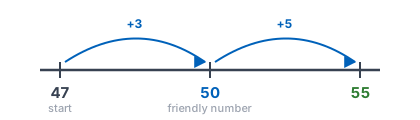 Number line showing 47 + 8: jump +3 to 50, then +5 to 55
The student broke 8 into 3 + 5 to make the addition easier. That's decomposing numbers in action — and the number line makes the strategy visible.
For more on breaking numbers apart, see What Is Decomposing Numbers? A Parent's Guide.
Fractions on a Number Line (Grades 3–5)
Example: Place ¾ on a number line between 0 and 1
- Divide the space between 0 and 1 into 4 equal parts
- Each part represents ¼
- Count 3 parts from 0 — that's ¾
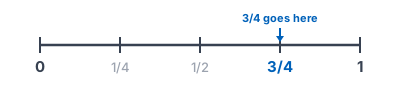 Number line from 0 to 1 with 3/4 marked
This teaches students that ¾ is a specific location — not just a symbol — and that it's closer to 1 than to 0. That visual understanding is what makes fraction comparison intuitive rather than mechanical.
Negative Numbers (Grade 6+)
Example: –3 + 5
- Start at –3 on the number line
- Jump 5 spaces to the right
- Land on 2
–3 + 5 = 2
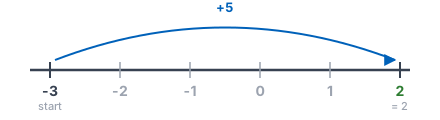 Number line showing -3 + 5 = 2: start at -3, jump +5 to land on 2
The number line makes the direction of the operation visible. Moving right means adding. Moving left means subtracting. This prevents the most common error students make with integers — getting the sign wrong because they're relying on memorized rules rather than understanding.
Your child's 6th grade homework might look exactly like this. Helping them draw the number line and make the jumps is often all it takes to unstick the problem.
How Number Lines Connect to What You Already Know
Number lines aren't new — you've used them your whole life without calling them that.
A ruler is a number line. Every measurement you've made using a ruler is a number line exercise — finding a location at a specific distance from zero.
A thermometer is a vertical number line. When you read a temperature of –5°, you're reading a number line that extends below zero. The same logic your child is learning in 6th grade math applies directly to reading a thermometer.
A timeline is a number line. History class timelines, project schedules, and calendars all use the same underlying structure — equal intervals, ordered from left to right (or past to future).
The difference is that today's students are taught to use the number line as an active calculation tool — not just a reference. That's the shift most parents notice.
Watch: Number Lines for Addition and Subtraction
How to Help at Home
Ask them to draw it first
Before touching the calculation, ask your child to draw a number line and mark the starting number. The physical act of drawing often breaks the paralysis of staring at a problem. Don't skip this step even if it seems slow.
Focus on the jumps, not the answer
The goal of a number line problem isn't just to get the answer — it's to show the reasoning. Ask: "What jump makes sense here?" Encourage your child to jump to a friendly number (a multiple of 10) first, then count on from there.
For fractions: count the intervals, not the marks
The most common fraction number line mistake is counting the tick marks instead of the spaces between them. If a number line between 0 and 1 has 3 tick marks in the middle, it's divided into 4 parts — not 3. Reinforce: "How many equal pieces is the whole divided into?"
For negative numbers: use the real world
Temperatures, floors in a building, or yards gained and lost in football all model negative numbers naturally. If your child is struggling with –3 + 5, ask: "If it's –3 degrees and the temperature rises 5 degrees, what's the new temperature?" The context makes the direction of the jump intuitive.
Let Methodwise walk through it
If your child is stuck on a specific number line problem, Methodwise explains the strategy using the same approach their teacher uses — with a knowledge check to make sure the foundation is solid before moving forward.
Common Mistakes to Watch For
Counting tick marks instead of intervals
This is the most common number line error at every grade level. Students count the marks rather than the spaces, which throws off every answer. Reinforce: "The number of equal parts is what matters — not the number of lines."
Starting at 1 instead of 0
Young students sometimes begin counting at 1 rather than 0, which shifts every answer by one. Make sure your child starts at the correct position before making any jumps.
Jumping in the wrong direction with negative numbers
When adding a positive number to a negative number, students sometimes jump left instead of right. The rule: adding always means moving right, subtracting always means moving left — regardless of whether the starting number is positive or negative.
Making unequal intervals
Students sometimes draw tick marks at uneven spacing, which makes the number line inaccurate. Encourage your child to use a ruler or to estimate carefully — equal spacing is what makes the tool work.
Not decomposing the jump
Older students sometimes try to make one giant jump instead of breaking it into smaller, friendlier steps. Remind them: you can always make two smaller jumps instead of one big one. That's what makes the number line a flexible thinking tool rather than just a counting tool.
Practice Questions
Try these with your child. Answers are below.
Addition and subtraction (Grades 2–3):
- Use a number line to solve 36 + 7
- Use a number line to solve 54 − 8
Fractions (Grades 3–5):
- Draw a number line from 0 to 1. Place ⅔ on it.
- Which is greater — ¾ or ⅘? Use a number line to show your reasoning.
Challenge — Negative numbers (Grades 6–8):
- Use a number line to solve –4 + 9
- Use a number line to solve –6 − (–2)
Answers
- 36 + 7: Jump +4 to reach 40, then +3 to reach 43
- 54 − 8: Jump –4 to reach 50, then –4 to reach 46
- Divide 0 to 1 into 3 equal parts. ⅔ is at the second mark from 0.
- ¾ = 0.75, ⅘ = 0.80 — on a number line, ⅘ is greater (it sits further right)
- –4 + 9: Start at –4, jump 9 right → land on 5
- –6 − (–2): Subtracting a negative means adding its positive — start at –6, jump 2 right → land on –4
Ready to try it with your child?
Open the chat, pick the subject and your child's grade, and get a step-by-step explanation you can use to help tonight.
Try 3 Questions Free — No Signup RequiredFrequently Asked Questions
What grade is the number line taught?
Number lines appear at every grade level from kindergarten through 8th grade. In K–1, students use number paths for counting sequences. In grades 2–3, number lines are a primary strategy for addition and subtraction. In grades 3–5, they're used for fractions and decimals. In grades 6–8, the number line extends to negative numbers and irrational numbers.
What is an open number line?
An open number line (also called an empty number line) shows only the starting point and the jumps, without all the tick marks filled in. It emphasizes the strategy — the size and direction of the jump — rather than just the endpoint. If your child's homework shows arrows and arcs above a line, that's an open number line.
Is a number line the same as a number path?
Not exactly — a number path is the version used in kindergarten and early 1st grade, where numbers are written inside boxes or on stepping stones that children can count physically. A number line is the abstract version with tick marks and equal spacing. Teachers transition from number paths to number lines as students develop a more abstract understanding of number order.
My child's teacher uses jumps and arrows — is that the same thing?
Yes. Open number lines (also called empty number lines) show only the starting point and the jumps, without all the tick marks filled in. They're used to emphasize the strategy — the size and direction of the jump — rather than just the endpoint. If your child's homework shows arrows and arcs above a line, that's an open number line.
Will my child stop using number lines once they learn the standard algorithm?
Not entirely. Number lines remain a useful tool for estimation, checking work, and visualizing concepts like fractions and negative numbers even after students learn formal algorithms. In middle school, the number line becomes the foundation for the coordinate plane — so the concept never fully disappears.
My child gets the right answer without the number line — do they still need to draw it?
If the teacher requires it, yes — showing the strategy is part of the assignment. But beyond compliance, drawing the number line builds the flexible thinking that makes mental math and estimation faster in later grades. Getting the right answer is one skill. Understanding why it's right is another.
How does the number line connect to the coordinate plane?
The coordinate plane is two number lines at right angles — a horizontal x-axis and a vertical y-axis. Every point in algebra and geometry is located using the same logic as a number line: how far right or left, how far up or down. The number line is the first chapter of a concept that runs through high school math and beyond.
Try Methodwise Free
When your child brings home a number line problem and you're not sure where to start, Methodwise walks you through it — step by step, using the same method their teacher is using.
- Start with 3 free questions — no account needed
- Free plan: 15 questions/month after signup
- Plus plan: unlimited questions + saved chat history + 7-day free trial
- Step-by-step explanations the way teachers teach
Related Articles
-
What Is Decomposing Numbers? A Parent's Guide to Breaking Apart Numbers
-
What Is the Area Model? A Parent's Guide to Box Multiplication
-
What Are Number Bonds? A Parent's Guide to Making and Breaking Numbers
-
What Is Partial Sums Addition? A Parent's Guide to Why Your Child Doesn't 'Carry the One' Anymore
-
What Is a Tape Diagram? A Parent's Guide to Visualizing Word Problems
-
What Is a Ten Frame? A Parent's Guide to the Box That Builds Number Sense
-
What Is Partial Quotients Division? A Parent's Guide to the New Way Kids Learn Long Division
-
What Are Common Core Math Methods? A Parent's Guide to How Math Is Taught Today
-
What Are Arrays in Math? A Parent's Guide to Visualizing Multiplication
-
Homework Help Tools: Built for Kids vs. Built for Parents — What's the Difference?
-
What Are Fact Families? A Parent's Guide to How Addition and Subtraction Connect
-
What Is the Standard Algorithm? A Parent's Guide to Why Your Child Learns the 'Long Way' First
-
Fractions on a Number Line: A Parent's Guide to Why Pie Charts Aren't Enough
-
What Are Ratios and Proportional Reasoning? A Parent's Guide to Middle School Math
-
What Is Skip Counting? A Parent's Guide to How Counting by 2s, 5s, and 10s Becomes Times Tables
-
What Math Will My Child Learn This Year? A Parent's Guide to K-8 Math Methods by Grade
-
What Are Mental Math Strategies? A Parent's Guide to How Kids Add and Subtract in Their Heads
Have questions about number lines or other math methods? Email me at hello@methodwise.co
About the Author
Samantha Black is the founder of Methodwise and an educator with over 15 years in higher education and instructional design. She built Methodwise after experiencing the homework gap firsthand as a parent of two K–8 daughters. Learn more about why we built Methodwise →