
What Is Partial Quotients Division? A Parent’s Guide to a Friendly Long Division Strategy.
April 23, 2026
If your child's math homework has a division problem with a column of numbers like "10, 20, 5, 3" next to it and a strange bracket shape instead of the long division symbol you remember, you're looking at partial quotients division. And if your first thought is "wait, where's the bring-it-down step?" — you're not alone. This method looks completely different from the long division most of us learned, but it's built on something your child actually needs: a real understanding of what division means.
What Is Partial Quotients Division?
Partial quotients is a division strategy where students break a big division problem into smaller, easier chunks. Instead of working one digit at a time from left to right, students ask: "How many groups of the divisor can I pull out of this number?" They pull out a friendly-number chunk (like 10 groups or 20 groups), subtract that chunk from the dividend, and repeat until they've accounted for the whole number.
At the end, they add up all the chunks — all the "partial quotients" — to get the final answer. The name tells you exactly what's happening: each step finds a partial piece of the full quotient.
Why Do Teachers Use Partial Quotients?
When you and I learned long division, we followed a sequence: divide, multiply, subtract, bring down, repeat. It worked — but most of us never really understood what was happening. Why do we "bring down the next digit"? What are we actually dividing? The traditional algorithm is efficient, but it's also almost invisible. The reasoning disappears into the procedure.
Partial quotients make the reasoning visible. When a student writes "20 × 4 = 80" and subtracts 80 from 348, they can see that they're pulling out 20 groups of 4. Every chunk is a real, meaningful piece of division. Students aren't memorizing where to write digits — they're actually dividing.
The method also protects students from one of the biggest frustrations of traditional long division: picking the "right" digit for the quotient. In partial quotients, if you pull out 20 groups when you could have pulled out 80, that's fine. You just take another chunk. There's no wrong first guess, only a longer or shorter path to the same answer.
Stuck on tonight's homework?
Paste in the problem and get a step-by-step explanation in your child's grade level — using the same method their teacher uses.
Try 3 Questions Free — No Signup RequiredWhat Grade Is Partial Quotients Taught?
3rd Grade — Building the Foundation
Third graders don't use partial quotients yet, but they're laying the groundwork. They learn division as equal groups or as repeated subtraction (12 ÷ 3 means "how many 3s are in 12?"), and they memorize multiplication facts. That fluency with multiplication — especially with 10s, 20s, and 100s — is exactly what partial quotients will lean on.
4th Grade — Introduction with One-Digit Divisors
This is where partial quotients typically appears. Students divide three- and four-digit numbers by a one-digit divisor. A problem like 348 ÷ 4 is solved by pulling out chunks — first 80 groups of 4 (which is 320), then 7 more groups of 4 (which is 28), adding those partial quotients to get 87. The chunks make the problem feel manageable instead of overwhelming.
5th Grade — Extending to Two-Digit Divisors
By 5th grade, students apply the same strategy to larger divisors. A problem like 672 ÷ 24 becomes a series of chunks: 20 groups of 24 is 480, then 8 more groups of 24 is 192, totaling 28 groups. The numbers are bigger, but the logic is identical.
6th Grade and Beyond — Transition to the Standard Algorithm
By 6th grade, Common Core standards expect students to use the standard long division algorithm fluently. But students who learned partial quotients first carry an important understanding with them: they know why each step works. When they eventually learn the traditional method, the bring-down step finally makes sense.
If your child is working with partial quotients at any of these stages, it's developmentally appropriate and part of a deliberate progression.
How Partial Quotients Works
Two-Digit Example: 72 ÷ 6
Here's how a 4th grader might solve this using partial quotients:
Step 1: Ask "how many groups of 6 can I pull out of 72?" A friendly first guess is 10 groups.
Step 2: 10 × 6 = 60. Subtract 60 from 72, leaving 12.
Step 3: Now ask the same question about 12. How many groups of 6 fit? 2 groups, because 2 × 6 = 12.
Step 4: Subtract 12 from 12, leaving 0. You're done.
Step 5: Add up the partial quotients: 10 + 2 = 12.
So 72 ÷ 6 = 12. Notice that students never had to guess the "perfect" first digit. They just picked a friendly chunk and kept going.
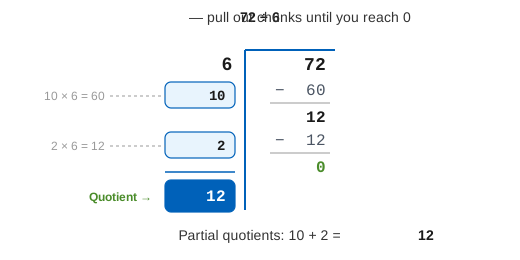 Partial quotients for 72 divided by 6: subtract 10 groups (60), then 2 groups (12), quotient is 12
For more on how students use place value to break apart numbers, see What Is Expanded Form? A Parent's Guide to Place Value.
Three-Digit Example: 348 ÷ 4
A 4th grader would apply the same strategy to a bigger number:
Step 1: How many groups of 4 are in 348? Start big — try 80 groups. 80 × 4 = 320. Subtract: 348 − 320 = 28.
Step 2: How many groups of 4 are in 28? That's 7, because 7 × 4 = 28. Subtract: 28 − 28 = 0.
Step 3: Add the partial quotients: 80 + 7 = 87.
So 348 ÷ 4 = 87. A student who wasn't ready to pull out 80 groups could have started with 50 (50 × 4 = 200, leaving 148), then 30 more (30 × 4 = 120, leaving 28), then 7 more. The answer is still 50 + 30 + 7 = 87. Different paths, same destination.
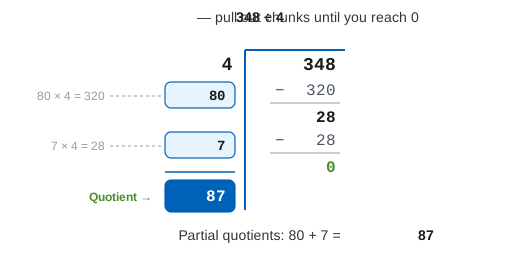 Partial quotients for 348 divided by 4: subtract 80 groups (320), then 7 groups (28), quotient is 87
For more on how breaking numbers into friendly chunks helps with multi-digit math, see What Is Decomposing Numbers? A Parent's Guide to Breaking Apart Numbers.
Two-Digit Divisor Example: 672 ÷ 24
A 5th grader extends the strategy to two-digit divisors:
Step 1: How many groups of 24 are in 672? Try 20 groups. 20 × 24 = 480. Subtract: 672 − 480 = 192.
Step 2: How many groups of 24 are in 192? Try 8 groups. 8 × 24 = 192. Subtract: 192 − 192 = 0.
Step 3: Add the partial quotients: 20 + 8 = 28.
So 672 ÷ 24 = 28. Notice how useful multiplying by 10 and 20 becomes at this stage. Students who are fluent with "24 × 10 = 240" and "24 × 20 = 480" can pull out big chunks fast. The strategy rewards strong multiplication facts.
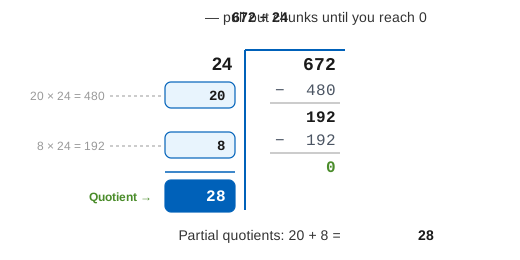 Partial quotients for 672 divided by 24: subtract 20 groups (480), then 8 groups (192), quotient is 28
For more on how multiplication and division connect, see What Is the Area Model? A Parent's Guide to Box Multiplication.
How Partial Quotients Connects to What You Already Know
You already use partial quotients thinking — you just don't call it that.
When you're splitting a restaurant bill and try to figure out how many $20 bills you need to cover $174, you probably think "eight twenties is $160, so we need nine — that covers it with $6 left over." You just did partial quotients. You pulled out a friendly chunk (8), checked how close you were, and adjusted.
When you're figuring out how many hours of driving it will take to cover 450 miles at 60 mph, you might think "60 times 5 is 300, then I need another 150, which is another 2.5 hours, so 7.5 hours total." You're breaking a division problem into chunks and adding the partial answers.
When you're loading folding chairs into a minivan — "I can fit 8 in the back, 4 per row times 3 rows on the seats, so 8 + 12 = 20 chairs" — you're dividing a big number into chunks that match what you know. That's partial quotients thinking in a parking lot.
The difference is that today's students are taught to recognize and name this strategy, so they can apply it deliberately rather than only using it when the numbers happen to line up neatly.
Watch: Partial Quotients Division Explained
How to Help at Home
Use the words "partial quotients," not "the new long division"
Your child's teacher calls this method partial quotients, and using the same vocabulary at home reduces confusion. If your child says "I took out 20 groups of 4," you're hearing the strategy described correctly — mirror that language back instead of translating it into "carrying" or "bringing down."
Let them pick their own chunks
The single biggest parent mistake is telling a child "you should have used 80 instead of 20." If your child pulls out 20 groups when a bigger chunk was possible, that's fine — they'll just take another chunk. There's no "wrong" first guess in partial quotients. Resisting the urge to optimize their work is the whole point of the method.
Brush up on multiplying by 10s and 100s
Partial quotients lives or dies on multiplication fluency — especially 24 × 10, 4 × 80, 6 × 100, and so on. If your child hesitates on these, spend 5 minutes practicing them before tackling division. Once those multiples are automatic, partial quotients become much faster.
Don't rush to the standard algorithm
You may feel tempted to teach your child "the way you learned" so they can get answers faster. Hold off. The standard algorithm is coming in 5th or 6th grade, and a student who masters partial quotients first will understand every step of it. Skipping the partial quotients phase is like skipping the why to get to the how.
Encourage estimation first
Before your child starts chunking, ask "about how big will the answer be?" For 348 ÷ 4, a rough estimate is "about 80, because 4 × 80 = 320." That estimate tells your child a reasonable first chunk to try. Estimation habits turn partial quotients from trial-and-error into strategic thinking.
Let Methodwise walk through it
If you're staring at a problem and can't remember the steps, open Methodwise and type or snap a photo of the problem. It will walk you and your child through partial quotients step by step — using the same method their teacher is using.
Common Mistakes to Watch For
Forgetting to add up the partial quotients
Students get so focused on the chunks and the subtraction that they forget the final step: adding all the partial quotients together to find the actual answer. A student writes 20, 8, and a big 0 remainder — then circles 0 as the answer. Remind your child that the quotient is the sum of all the chunks they pulled out.
Multiplying the chunk wrong
When a student decides to pull out 30 groups of 7, they need to compute 30 × 7 = 210. If they mis-multiply (say, writing 30 × 7 = 240), the subtraction and every step after it will be off. Partial quotients depends on accurate multiplication, so if answers are way off, check the multiplication first.
Subtracting incorrectly
Each chunk requires a subtraction, and multi-digit subtraction is its own source of errors. A child might write 348 − 320 = 38 instead of 28. Encourage lining up place values carefully, and double-check subtractions by adding the answer back (28 + 320 should equal 348).
Pulling out more than the dividend can give
Sometimes students write "50 groups of 6" when only 40 groups fit — and the subtraction goes negative. If your child ends up with a negative number, it means their chunk was too big. Back up, pick a smaller chunk, and try again. This isn't a failure; it's information.
Stopping too early
A student pulls out 10 groups, then 5 groups, and stops — even though there's still a big chunk left to divide. The process only ends when the remaining number is smaller than the divisor (or zero). If there's still room to pull out more groups, keep going.
Practice Questions
Try these with your child. Answers are below.
One-digit divisor (4th grade):
- Use partial quotients to solve 84 ÷ 6.
- Use partial quotients to solve 192 ÷ 8.
- Use partial quotients to solve 456 ÷ 4.
Two-digit divisor (5th grade):
- Use partial quotients to solve 432 ÷ 12.
- Use partial quotients to solve 816 ÷ 24.
- Use partial quotients to solve 675 ÷ 15.
Answers
- 10 × 6 = 60 (leaves 24), 4 × 6 = 24 (leaves 0). Quotient: 10 + 4 = 14
- 20 × 8 = 160 (leaves 32), 4 × 8 = 32 (leaves 0). Quotient: 20 + 4 = 24
- 100 × 4 = 400 (leaves 56), 10 × 4 = 40 (leaves 16), 4 × 4 = 16 (leaves 0). Quotient: 100 + 10 + 4 = 114
- 30 × 12 = 360 (leaves 72), 6 × 12 = 72 (leaves 0). Quotient: 30 + 6 = 36
- 30 × 24 = 720 (leaves 96), 4 × 24 = 96 (leaves 0). Quotient: 30 + 4 = 34
- 40 × 15 = 600 (leaves 75), 5 × 15 = 75 (leaves 0). Quotient: 40 + 5 = 45
Ready to try it with your child?
Open the chat, pick the subject and your child's grade, and get a step-by-step explanation you can use to help tonight.
Try 3 Questions Free — No Signup RequiredFrequently Asked Questions
What if there's a remainder when my child uses partial quotients?
Remainders work the same way they do in traditional long division — when the leftover after subtracting the last chunk is smaller than the divisor, that's the remainder. For 73 ÷ 8, a student might pull out 9 groups of 8 (72) and be left with 1. The answer is 9 R1. Some teachers introduce remainders right away in 4th grade; others wait until students are comfortable with even-quotient problems first. Check your child's homework directions to see which format their teacher wants — written as R1, as a fraction (1/8), or as a decimal.
Why don't kids learn long division the old way anymore?
They still do — eventually. But teachers now start with partial quotients because it makes the meaning of each step visible. In traditional long division, a 4th grader follows steps without understanding why they work. Partial quotients show exactly what's being divided and why, which makes the standard algorithm much easier to learn later.
What grade do kids learn partial quotients?
Partial quotients is typically introduced in 4th grade when students start dividing multi-digit numbers by one-digit divisors. It extends into 5th grade for two-digit divisors. By 6th grade, most students transition to the standard long division algorithm.
Is partial quotients the same as the big-7 or box method?
They're related. Partial quotients is the underlying strategy — subtract chunks of the divisor until you reach zero. The big-7 or ladder method is just one way to record partial quotients on paper (using a right-angle shape instead of the standard division bracket). They use the same underlying idea of subtracting multiples of the divisor, but teachers may record it in different formats.
Can I just teach my child the traditional long division?
You can, but your child may get confused if their teacher is using partial quotients in class. A better approach is to learn the method the teacher is using so you can support it at home. Methodwise can walk through any division problem using the partial quotients method — or the standard algorithm — depending on what your child is learning.
Try Methodwise Free
When your child brings home partial quotients homework and you're not sure how to explain it the way their teacher would, Methodwise walks you through it — step by step, using the same method their teacher is using.
- Start with 3 free questions — no account needed
- Free plan: 15 questions/month after signup
- Plus plan: unlimited questions + saved chat history + 7-day free trial
- Step-by-step explanations the way teachers teach
Related Articles
-
What Is Decomposing Numbers? A Parent's Guide to Breaking Apart Numbers
-
What Is the Area Model? A Parent's Guide to Box Multiplication
-
What Is a Number Line? A Parent's Guide to How Teachers Use It
-
What Are Number Bonds? A Parent's Guide to Making and Breaking Numbers
-
What Is Partial Sums Addition? A Parent's Guide to Why Your Child Doesn't 'Carry the One' Anymore
-
What Is a Tape Diagram? A Parent's Guide to Visualizing Word Problems
-
What Is a Ten Frame? A Parent's Guide to the Box That Builds Number Sense
-
What Are Common Core Math Methods? A Parent's Guide to How Math Is Taught Today
-
What Are Arrays in Math? A Parent's Guide to Visualizing Multiplication
-
Homework Help Tools: Built for Kids vs. Built for Parents — What's the Difference?
-
What Are Fact Families? A Parent's Guide to How Addition and Subtraction Connect
-
What Is the Standard Algorithm? A Parent's Guide to Why Your Child Learns the 'Long Way' First
-
Fractions on a Number Line: A Parent's Guide to Why Pie Charts Aren't Enough
-
What Are Ratios and Proportional Reasoning? A Parent's Guide to Middle School Math
-
What Is Skip Counting? A Parent's Guide to How Counting by 2s, 5s, and 10s Becomes Times Tables
-
What Math Will My Child Learn This Year? A Parent's Guide to K-8 Math Methods by Grade
-
What Are Mental Math Strategies? A Parent's Guide to How Kids Add and Subtract in Their Heads
Have questions about partial quotients? Email me at hello@methodwise.co
About the Author
Samantha Black is the founder of Methodwise and an educator with over 15 years in higher education and instructional design. She built Methodwise after experiencing the homework gap firsthand as a parent of two K–8 daughters. Learn more about why we built Methodwise →