
What Is Partial Sums Addition? A Parent's Guide to Why Your Child Doesn't 'Carry the One' Anymore
April 3, 2026
If your child's math homework has addition problems with three or four separate sums written out before the final answer, you're looking at partial sums addition. And if your first reaction is "why don't they just stack and carry like I did?" — you're in very good company. This method looks completely different from what most of us learned, but it's built on something your child actually needs more of: a real understanding of what each digit in a number is worth.
What Is Partial Sums Addition?
Partial sums is an addition strategy where students break a problem apart by place value, add each place value separately, and then combine those sums to get the final answer. Instead of working from right to left and "carrying" digits, students work from left to right — adding the hundreds first, then the tens, then the ones — and write each result on its own line before totaling everything up.
The name says it all: you're finding partial sums (the sum of just the hundreds, just the tens, just the ones) and then putting them together.
Why Do Teachers Use Partial Sums?
When you and I learned to "carry the one," we were following a procedure. It worked — but most of us had no idea why it worked. What does it actually mean to "carry" a 1 from the ones column to the tens column? It means you're regrouping 10 ones into 1 ten. That's a big idea, and the traditional algorithm hides it behind a tiny digit written above the next column.
Partial sums makes that place value thinking visible. When a student adds 40 + 70 and writes 110, they're seeing that 4 tens plus 7 tens equals 11 tens — which is 110. There's nothing hidden. Every step shows what's actually happening with the numbers, which is why it's a foundational strategy in Everyday Mathematics and other Common Core–aligned curricula.
The goal isn't to replace the standard algorithm forever. It's to make sure that when students eventually learn to carry and regroup, they understand the math beneath the procedure.
Stuck on tonight's homework?
Paste in the problem and get a step-by-step explanation in your child's grade level — using the same method their teacher uses.
Try 3 Questions Free — No Signup RequiredWhat Grade Is Partial Sums Taught?
1st Grade — Building the Foundation
First graders don't use partial sums yet, but they're doing the groundwork. They learn to break two-digit numbers into tens and ones (26 is 20 + 6), and they practice adding multiples of ten (30 + 40 = 70). This place value fluency is exactly what partial sums will build on.
2nd Grade — Introduction with Two-Digit Numbers
This is where partial sums typically appears. Students add two-digit numbers like 47 + 35 by separating tens and ones: 40 + 30 = 70, then 7 + 5 = 12, then 70 + 12 = 82. The numbers are manageable, and the process reinforces what they learned about expanded form in first grade.
3rd Grade — Extending to Three-Digit Numbers
Students apply the same strategy to larger numbers. A problem like 348 + 275 becomes three partial sums: 300 + 200 = 500, 40 + 70 = 110, 8 + 5 = 13, then 500 + 110 + 13 = 623. The steps are identical — there are just more of them.
4th Grade and Beyond — Transition to the Standard Algorithm
By 4th grade, Common Core standards expect students to use the standard algorithm for multi-digit addition. But students who learned partial sums first carry a deep understanding of regrouping with them. When they "carry the 1," they know what that 1 actually represents.
If your child is working with partial sums at any of these stages, it's developmentally appropriate and part of a deliberate progression.
How Partial Sums Works
Two-Digit Example: 47 + 35
Here's how a 2nd grader would solve this using partial sums:
Step 1: Add the tens. 40 + 30 = 70
Step 2: Add the ones. 7 + 5 = 12
Step 3: Combine the partial sums. 70 + 12 = 82
That's it. No carrying, no tiny digits above columns. Each step is a straightforward addition problem that a 2nd grader can do mentally.
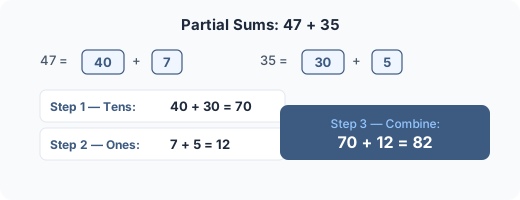 Partial sums for 47 + 35: tens give 70, ones give 12, total is 82
For more on how students break numbers into tens and ones, see What Is Expanded Form? A Parent's Guide to Place Value.
Three-Digit Example: 348 + 275
A 3rd grader would extend the same process to three place values:
Step 1: Add the hundreds. 300 + 200 = 500
Step 2: Add the tens. 40 + 70 = 110
Step 3: Add the ones. 8 + 5 = 13
Step 4: Combine the partial sums. 500 + 110 + 13 = 623
Notice that in Step 2, the tens add up to more than 100. That's perfectly fine — there's no need to regroup mid-problem. Students just write 110 and keep going. The regrouping happens naturally when you combine at the end.
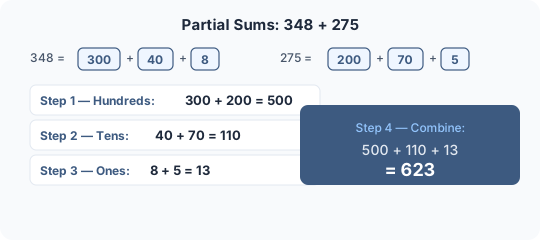 Partial sums for 348 + 275: hundreds give 500, tens give 110, ones give 13, total is 623
For more on how breaking apart numbers supports addition, see What Is Decomposing Numbers? A Parent's Guide to Breaking Apart Numbers.
Vertical Format: How It Looks on Paper
Your child's homework might show partial sums written vertically, which looks like this:
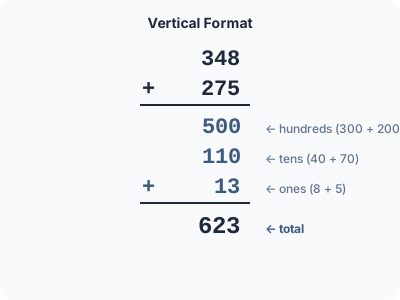 Vertical partial sums layout for 348 + 275 showing each place value sum stacked
This vertical layout is the most common format in textbooks. Students write the original problem at the top, list each partial sum below the line, and then add those partial sums for the final answer.
How Partial Sums Connects to What You Already Know
You already use partial sums thinking — you just don't call it that.
Calculating a tip at a restaurant. If the bill is $47 and you want to leave 20%, you think "20% of 40 is 8, and 20% of 7 is about 1.40, so that's around $9.40." You just did partial sums — breaking the problem into friendly place value chunks.
Adding up prices while shopping. You probably round to the nearest dollar and keep a running total. That's the same left-to-right, big-pieces-first thinking that partial sums teaches.
Estimating driving time. "It's about 2 hours to get there plus another 30 minutes for the detour, so 2 hours 30 minutes." You're combining partial amounts rather than converting everything to minutes and doing one big calculation.
The difference is that today's students are taught to recognize and name this strategy, so they can apply it deliberately rather than only using it when the numbers happen to be easy.
Watch: Partial Sums Explained
How to Help at Home
Use the words "partial sums," not "the new way"
Your child's teacher calls this method partial sums, and using the same vocabulary at home reduces confusion. If your child says "we add each place value part," you're hearing the strategy described correctly — mirror that language back.
Let them start from the left
This is the biggest adjustment for parents. In partial sums, students add the largest place value first (hundreds, then tens, then ones). If you instinctively start from the ones column, pause and follow your child's lead. Left-to-right is correct for this method.
Don't jump to the final answer
When your child writes three separate sums before combining them, that's not "extra work" — that is the work. Each partial sum is a chance to practice place value. Resist the urge to shortcut to the answer, even if you can see it immediately.
Watch for expanded form as the first step
Before adding, students often rewrite each number in expanded form (348 = 300 + 40 + 8). If your child skips this step and makes mistakes, gently suggest they write it out. The expansion is the setup that makes everything else work.
Practice with real-world numbers
Grocery receipts, sports scores, and board game point totals are all fair game. Ask your child to add two scores using partial sums and talk through the place values together. Real numbers feel less like "homework" and more like a useful skill.
Let Methodwise walk through it
If you're staring at a problem and can't remember the steps, Methodwise will walk you and your child through partial sums step by step — using the same method their teacher is using.
Common Mistakes to Watch For
Forgetting a place value
The most common error: students add the hundreds and the ones but skip the tens (or vice versa). This usually happens when the problem is written horizontally. Encourage your child to write each number in expanded form first so every place value is visible and accounted for.
Misaligning place values in vertical format
When writing partial sums vertically, students sometimes write 13 (the ones sum) starting in the tens column instead of the ones column. Lined or grid paper helps enormously — each digit gets its own box, and columns stay straight.
Adding place values from different numbers incorrectly
Some students accidentally add the hundreds of the first number to the tens of the second number (300 + 70 instead of 300 + 200). This happens when expanded form is skipped. Writing both numbers in expanded form side by side makes the pairs clear: 300 + 200, 40 + 70, 8 + 5.
Stopping after the partial sums
A student writes 500, 110, and 13 — and then circles 13 as the answer, or writes all three numbers but forgets to combine them. Remind your child that partial sums is a two-phase process: first find the parts, then combine the parts.
Confusing partial sums with the standard algorithm
If your child starts writing a tiny "1" above the tens column while doing partial sums, they're mixing up two methods. That's normal — they're learning both. Gently clarify which method the assignment is asking for, and help them stick with one approach per problem.
Practice Questions
Try these with your child. Answers are below.
Two-digit partial sums (2nd grade):
- Use partial sums to add 56 + 37.
- Use partial sums to add 84 + 49.
- Use partial sums to add 63 + 28.
Three-digit partial sums (3rd grade):
- Use partial sums to add 245 + 378.
- Use partial sums to add 529 + 364.
- Use partial sums to add 187 + 456.
Answers
- 50 + 30 = 80, 6 + 7 = 13, 80 + 13 = 93
- 80 + 40 = 120, 4 + 9 = 13, 120 + 13 = 133
- 60 + 20 = 80, 3 + 8 = 11, 80 + 11 = 91
- 200 + 300 = 500, 40 + 70 = 110, 5 + 8 = 13, 500 + 110 + 13 = 623
- 500 + 300 = 800, 20 + 60 = 80, 9 + 4 = 13, 800 + 80 + 13 = 893
- 100 + 400 = 500, 80 + 50 = 130, 7 + 6 = 13, 500 + 130 + 13 = 643
Ready to try it with your child?
Open the chat, pick the subject and your child's grade, and get a step-by-step explanation you can use to help tonight.
Try 3 Questions Free — No Signup RequiredFrequently Asked Questions
Is partial sums the same as the standard algorithm my child will learn later?
No — they're different strategies, though they solve the same problems. The standard algorithm (stacking numbers and carrying) is compact and efficient but hides what's happening mathematically. Partial sums makes place value visible by keeping each column separate before combining. Teachers use partial sums first so students understand why the standard algorithm works. Once that understanding is solid, the standard algorithm makes sense — it's just a faster version of the same thinking.
Why don't kids carry the one anymore?
Students still learn the standard algorithm eventually, but teachers now start with strategies like partial sums that build understanding of why carrying works. When students later learn to 'carry the one,' they understand that they're actually regrouping 10 ones into 1 ten — not just following a rule.
What grade do kids learn partial sums?
Partial sums is typically introduced in 2nd grade with two-digit numbers and extended to three-digit numbers in 3rd grade. By 4th grade, students transition to the standard algorithm, but they carry the place value understanding with them.
Is partial sums harder than the traditional method?
It's not harder — it's different. Partial sums actually involves simpler individual calculations because students never have to regroup mid-problem. Many parents find it easier once they see how it works. The tricky part is that it's unfamiliar, not that it's difficult.
Can I just teach my child the old way?
You can, but it may create confusion if your child is using a different method at school. A better approach is to learn the method the teacher is using and support that at home. Methodwise can show you the exact steps for any problem using the method your child's teacher would use.
Try Methodwise Free
When your child brings home partial sums homework and you're not sure how to explain it the way their teacher would, Methodwise walks you through it — step by step, using the same method their teacher is using.
- Start with 3 free questions — no account needed
- Free plan: 15 questions/month after signup
- Plus plan: unlimited questions + saved chat history + 7-day free trial
- Step-by-step explanations the way teachers teach
Related Articles
-
What Is Decomposing Numbers? A Parent's Guide to Breaking Apart Numbers
-
What Is the Area Model? A Parent's Guide to Box Multiplication
-
What Is a Number Line? A Parent's Guide to How Teachers Use It
-
What Are Number Bonds? A Parent's Guide to Making and Breaking Numbers
-
What Is a Tape Diagram? A Parent's Guide to Visualizing Word Problems
-
What Is a Ten Frame? A Parent's Guide to the Box That Builds Number Sense
-
What Is Partial Quotients Division? A Parent's Guide to the New Way Kids Learn Long Division
-
What Are Common Core Math Methods? A Parent's Guide to How Math Is Taught Today
-
What Are Arrays in Math? A Parent's Guide to Visualizing Multiplication
-
Homework Help Tools: Built for Kids vs. Built for Parents — What's the Difference?
-
What Are Fact Families? A Parent's Guide to How Addition and Subtraction Connect
-
What Is the Standard Algorithm? A Parent's Guide to Why Your Child Learns the 'Long Way' First
-
Fractions on a Number Line: A Parent's Guide to Why Pie Charts Aren't Enough
-
What Are Ratios and Proportional Reasoning? A Parent's Guide to Middle School Math
-
What Is Skip Counting? A Parent's Guide to How Counting by 2s, 5s, and 10s Becomes Times Tables
-
What Math Will My Child Learn This Year? A Parent's Guide to K-8 Math Methods by Grade
-
What Are Mental Math Strategies? A Parent's Guide to How Kids Add and Subtract in Their Heads
Have questions about partial sums? Email me at hello@methodwise.co
About the Author
Samantha Black is the founder of Methodwise and an educator with over 15 years in higher education and instructional design. She built Methodwise after experiencing the homework gap firsthand as a parent of two K–8 daughters. Learn more about why we built Methodwise →