
Reading Comprehension Strategies: A Parent's Guide to How Teachers Teach Reading
March 24, 2026
Reading comprehension strategies are the specific thinking habits — predicting, questioning, and summarizing — that teachers explicitly name and practice in K–8 ELA classrooms. If your child's homework asks them to "make a prediction," "ask a question about the text," or "summarize the key idea," these are the strategies their teacher is building.
These aren't just reading activities. They're specific comprehension strategies that teachers name, model, and practice every day in K–8 ELA. They have a structure. They have a purpose. And when you use the same language at home, you're reinforcing what your child already learned in class — instead of introducing a different approach that can create confusion.
What Are Reading Comprehension Strategies?
Reading comprehension strategies are specific mental habits that help readers construct meaning from text. They're not worksheets or assessments — they're actions good readers take before, during, and after reading.
Most of us developed these habits without ever naming them. Today's teachers name them explicitly — and teach them directly — because research shows that students who learn to apply these strategies consciously become stronger, more independent readers.
The three strategies your child is most likely practicing in class right now:
- Making Predictions
- Asking Questions
- Summarizing
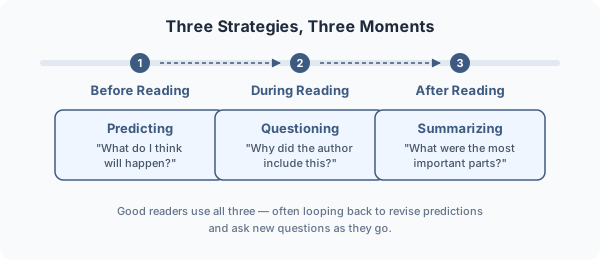 Three reading strategies mapped to before, during, and after reading
Why Do Teachers Use These Strategies?
Many of us were taught to read by just… reading. We answered questions at the end of a chapter and got a grade. Reading comprehension strategies take a different approach — they make the thinking process visible.
When a student stops mid-chapter to ask "What is this character trying to do?" they're not getting distracted. They're doing exactly what their teacher taught them to do — monitoring their understanding in real time.
This is the same thinking that helps students read closely in science and social studies, analyze sources in history, and write well-supported arguments. Teachers build these habits in reading class because they transfer to every subject.
Stuck on tonight's homework?
Paste in the problem and get a step-by-step explanation in your child's grade level — using the same method their teacher uses.
Try 3 Questions Free — No Signup RequiredThe Three Strategies and How to Use Them at Home
Making Predictions
Before reading, ask: "What do you think this story is going to be about?" After a few pages: "Was your prediction right? What changed?"
This activates prior knowledge and keeps kids engaged with the text. Predictions don't need to be correct — they need to be reasonable. The point is the thinking, not the outcome.
When a prediction turns out to be wrong, that's actually a rich conversation: "What did the author do that you didn't expect?"
What teachers are building: Students who make predictions before reading pay closer attention to the text as they go — they're checking their thinking, not just absorbing words.
Asking Questions
Good readers ask questions while they read — not just after. Try: "What are you wondering right now?" or "Why do you think the character did that?"
These questions build the habit of active reading. If your child is sitting quietly and their eyes are moving across the page, that's not necessarily comprehension — it's decoding. Comprehension is what happens when they engage with what they're reading. Questions create that engagement.
What teachers are building: Students who habitually ask questions while reading become students who don't give up when a text is hard. They have a strategy — figure out what they're confused about and pursue it.
Summarizing
After reading, ask: "What were the most important things that happened?" Encourage your child to use their own words — not to retell every detail, but to identify what mattered most. That's the skill teachers are building.
A retelling covers everything in order. A summary requires judgment — deciding what's essential and what can be left out. That's a sophisticated thinking skill, and it's harder than it looks.
What teachers are building: Summarizing is how students consolidate their understanding. If your child can't put the main idea in their own words, they probably haven't fully grasped the text yet — and that's useful information before the test.
What Grade Are These Strategies Taught?
These three strategies appear across all K–8 grades, but how they're taught — and what they look like in practice — shifts significantly:
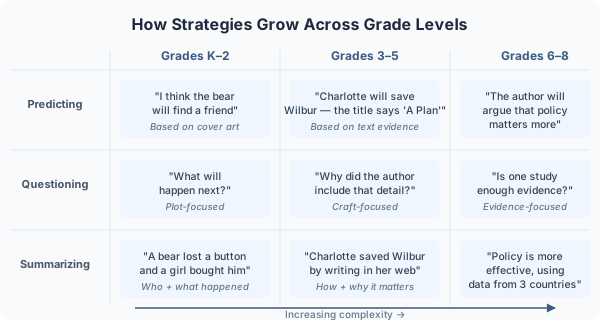 How predicting, questioning, and summarizing grow from K–2 through middle school
Grades K–2 — Building the Foundation
In early grades, teachers model strategies aloud during read-alouds. You might hear a teacher say "I'm going to make a prediction" and then think out loud about the cover of a book. Students start practicing with simple picture books where visual cues make the strategies concrete.
What it looks like at home: Your child is reading a picture book like Corduroy. Before reading, they might say: "I think the bear is going to find a friend because he looks lonely on the cover." After reading: "I was right, but I didn't predict the girl would take him home." That's a prediction, a check, and a revision — all from a 5-year-old.
For summarizing at this level, your child might say: "It was about a bear who lost a button and a girl who bought him." That's enough. Two sentences. They identified the character, the problem, and the resolution. That's a summary.
Grades 3–5 — Applying Independently
By 3rd grade, students are expected to apply these strategies on their own during independent reading. Summarizing gets more demanding as texts get longer. Asking questions shifts from "what happens next" to "why did the author include this detail."
What it looks like at home: Your child is reading a chapter book like Charlotte's Web. A strong prediction at this level is more specific: "I think Charlotte is going to save Wilbur because the chapter title says 'A Plan' and she seems smarter than the other animals." Questioning sounds like: "Why does the author keep mentioning the seasons changing?" Summarizing a chapter might be: "Charlotte came up with a plan to save Wilbur by writing words in her web so people would think he was special."
Notice the difference from K–2: the prediction uses textual evidence (the chapter title), the question is about author's craft (not just plot), and the summary captures the how and why, not just the what.
Grades 6–8 — Working with Complex Texts
In middle school, these same strategies apply to nonfiction, primary sources, and literary analysis. A student summarizing a historical article uses the same skill as one summarizing a short story — but the judgment required is more sophisticated.
What it looks like at home: Your child is reading an article about climate change for science class. Predicting sounds like: "Based on the title and subheadings, I think the author is going to argue that individual action isn't enough." Questioning sounds like: "The author only cites data from one study — is that enough to support this claim?" Summarizing sounds like: "The article argues that government policy is more effective than individual behavior change, using data from three countries."
At this level, predictions are about arguments and perspective, questions are about reliability and evidence, and summaries require distinguishing the author's main claim from supporting details. Same three strategies — dramatically different application.
How Reading Strategies Connect to What You Already Know
You use all three of these strategies constantly — you just don't call them that.
Making predictions. When you see a movie trailer, you immediately predict what the movie is about, who the villain is, and whether you'll like it. When the actual movie surprises you, you enjoy it more because you had an expectation to compare it against. That's exactly what your child's teacher is building — the expectation makes the reading more engaging, not less.
Asking questions. When you're watching a show and you say "Wait — why did she do that?" or "I bet that guy is lying" — you're actively questioning. You don't wait until the credits roll to think about what you just watched. You process in real time. That's the habit teachers want kids to bring to reading: don't wait until the end of the chapter to think.
Summarizing. When a friend asks "What's that book about?" you don't recite every chapter. You say: "It's about a woman who discovers her family has been hiding a secret for thirty years." You instinctively pick out what matters and leave out what doesn't. That's summarizing — and it's exactly what your child's teacher is asking them to practice.
The difference is that today's students are taught to recognize and name these strategies, so they can apply them deliberately when a text gets hard — rather than only using them naturally when something is easy or entertaining.
Watch: Reading Comprehension Strategies Explained
How to Help at Home
Use the same words your child's teacher uses
If their teacher says "make a prediction," say that at home too — not "guess what happens next." The language matters because it signals to your child that what they're doing at home is connected to what they're learning at school.
Ask before, during, and after
Most homework reading happens after. But the strategies work across the whole experience. Before: "What do you predict?" During: "What are you wondering?" After: "What were the most important parts?" Three questions. Big payoff.
Resist the urge to summarize for them
When your child struggles to identify the main idea, it's tempting to just tell them. Don't. Ask: "What do you think the author most wanted you to understand?" That question puts the thinking back where it belongs — with them.
Let wrong predictions sit for a moment
When a prediction turns out to be wrong, pause before correcting. Ask: "What in the story was different from what you expected?" That reflection — comparing prediction to reality — is exactly the kind of thinking their teacher is trying to build.
Accept their interpretation before redirecting
If your child's summary highlights different details than what you'd pick, don't jump straight to correcting. Ask: "Why did that part feel important to you?" They may have a valid reading you didn't consider — or the conversation will naturally help them see what they missed. Either way, the thinking does more work than the correction.
Let Methodwise walk through it
If you're not sure what the teacher means by a particular strategy, Methodwise can explain the approach and give you the specific language to use.
Ready to try it with your child?
Open the chat, pick the subject and your child's grade, and get a step-by-step explanation you can use to help tonight.
Try 3 Questions Free — No Signup RequiredCommon Mistakes to Watch For
Retelling instead of summarizing
The most common reading homework mistake at every grade level. Students list everything that happened in order rather than identifying what mattered most. Reinforce: "If your friend hadn't read this, what are the two or three things they'd most need to know?"
Making predictions that can't be tested
Young students sometimes make predictions that are so vague they can't be confirmed or revised: "I think something will happen." Push for specificity: "What do you think will happen to the main character?" A good prediction is specific enough to check.
Asking questions after instead of during
The habit teachers are building is real-time questioning — noticing confusion or curiosity while reading, not just responding to comprehension questions at the end. If your child finishes a chapter and then thinks up questions, that's a start — but the goal is to catch questions mid-page.
Assuming wrong predictions are failures
A wrong prediction is not a mistake — it's evidence that your child engaged with the text and updated their thinking. That's the skill. If your child is reluctant to make predictions because they're afraid of being wrong, it's worth explicitly naming: predictions don't have to be right to be useful.
Practice Questions
Try these conversation starters with your child. There are no single right answers — these are meant to open up thinking.
Making Predictions (Grades K–2):
- Look at the cover of this book. What do you think it will be about? What clues do you see?
- We've read three pages. Was your prediction right? What changed?
Asking Questions (Grades 3–5): 3. Stop here. What are you wondering right now? 4. Why do you think the author chose to include that detail?
Summarizing (Grades 5–8): 5. What were the two or three most important things that happened in that chapter? 6. If you had to explain this passage to someone who hadn't read it, what would you tell them?
Frequently Asked Questions
Are these strategies only for fiction?
No — and this is an important point. Making predictions, asking questions, and summarizing all transfer to nonfiction, textbooks, and informational texts. In fact, these strategies become more critical in middle school when students are reading primary sources, science articles, and historical documents. The language adjusts slightly ("what will the author argue" rather than "what will happen next") but the strategy is the same.
My child already gets good grades in reading. Do these strategies still matter?
Yes — because reading difficulty jumps significantly in middle school. Students who've been intuitive readers can hit a wall when texts become dense, argumentative, or content-heavy. Named strategies give them a fallback when natural comprehension isn't enough.
What's the difference between a summary and a retelling?
A retelling covers events in order — "first this happened, then this happened." A summary identifies what was most important and why. Teachers in grades 3 and up are specifically asking for summaries, because that requires judgment, not just memory. If your child is listing everything that happened, gently redirect: "What was the most important part?"
How do I know which strategy my child's teacher is focusing on right now?
Check the homework instructions for the vocabulary the teacher uses — if it says "make a prediction" or "summarize the passage," those are the cues. You can also ask your child directly: "What reading strategy did you work on in class today?" Most students in 2nd grade and up can name it. If you want a more detailed explanation of any specific strategy, Methodwise can explain exactly how your child's teacher approaches it.
Will my child stop using these strategies once they're a 'good' reader?
Not exactly. What happens is that the strategies become automatic — fluent readers make predictions, ask questions, and summarize without consciously naming what they're doing. But the strategies don't disappear. They get internalized. That's the goal.
Try Methodwise Free
When you know the strategy your child's teacher is using, homework help stops being a guessing game. Methodwise gives you instant explanations of any teaching method, aligned with how teachers teach — so you can reinforce the right approach at home.
- Start with 3 free questions — no account needed
- Free plan: 15 questions/month after signup
- Plus plan: unlimited questions + saved chat history + 7-day free trial
- Step-by-step explanations the way teachers teach
Related Articles
-
What Are Text Features? A Parent's Guide to Nonfiction Reading
-
Main Idea vs. Theme: What Your Child's Teacher Actually Means
-
What Is Close Reading? A Parent's Guide to Deeper Comprehension
-
Reading Levels Explained: Lexile, F&P, and DRA in Plain English
-
What Is Citing Evidence? A Parent's Guide to Text Evidence in Reading and Writing
-
Homework Help Tools: Built for Kids vs. Built for Parents — What's the Difference?
-
What Is Making Inferences? A Parent's Guide to Reading Between the Lines
-
Author's Purpose vs. Point of View: A Parent's Guide to PIE, Narrators, and Perspective
-
What Are Context Clues? A Parent's Guide to How Kids Figure Out New Words Without a Dictionary
-
What Is Text Structure? A Parent's Guide to How Nonfiction Is Organized
-
Opinion Writing vs. Argument Writing: A Parent's Guide to the K–8 Writing Progression
-
Summarizing vs. Retelling: A Parent's Guide to Why the Teacher Keeps Saying 'Too Many Details'
-
What Are Story Elements? A Parent's Guide to Characters, Setting, Problem, and Solution
-
What Is Phonemic Awareness? A Parent's Guide to Playing With Sounds Before Reading
Have questions about reading strategies or other teaching methods? Email me at hello@methodwise.co
About the Author
Samantha Black is the founder of Methodwise and an educator with over 15 years in higher education and instructional design. She built Methodwise after experiencing the homework gap firsthand as a parent of two K–8 daughters. Learn more about why we built Methodwise →