
What Is Skip Counting? A Parent's Guide to How Counting by 2s, 5s, and 10s Becomes Times Tables
June 8, 2026
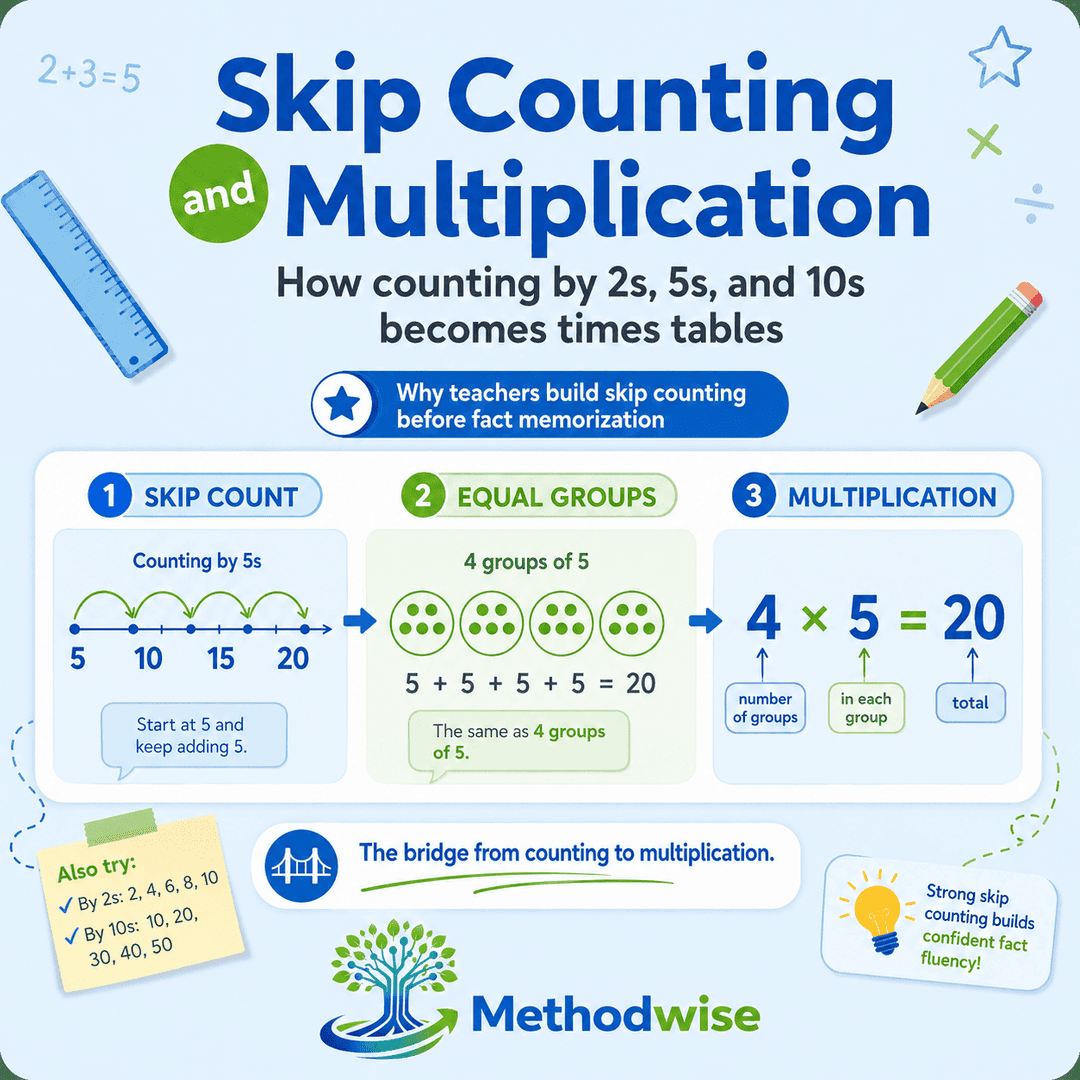
If your child has been chanting "5, 10, 15, 20..." on the walk home, or you've found a worksheet asking them to fill in the blanks in "2, 4, ___, 8, ___, 12," you're looking at skip counting. Skip counting builds the mental model of equal groups, so when the times tables are introduced, students are naming relationships they already understand and not just memorizing disconnected facts.
What Is Skip Counting?
Skip counting is counting forward by a number larger than 1. Instead of saying "1, 2, 3, 4, 5, 6, 7, 8, 9, 10," a child skip counting by 2 says "2, 4, 6, 8, 10." Same numbers reached, bigger jumps.
The number you count by is called the skip size (or factor). The numbers you say (2, 4, 6, 8…) are the multiples. Skip counting by 2s gives you the multiples of 2 (2, 4, 6, 8, 10, 12…). Skip counting by 5s gives you the multiples of 5 (5, 10, 15, 20, 25…). Each step is the same size, and that consistent jump is what turns counting into multiplication.
Stuck on tonight's homework?
Paste in the problem and get a step-by-step explanation in your child's grade level — using the same method their teacher uses.
Try 3 Questions Free — No Signup RequiredWhy Do Teachers Use Skip Counting?
When most of us learned multiplication, we chanted times tables. Two times one is two, two times two is four, two times three is six. The list got memorized. What we often couldn't do was show what "2 × 3 = 6" actually represented.
Skip counting closes that gap. When a child says "2, 4, 6," they are literally counting three groups of two. The total is the same, the answer is the same, but the meaning is visible. Each skip is a group; the running count tells you how many you've added so far. By the time these students reach 3rd grade and meet "2 × 3 = 6" written out, they aren't memorizing a new fact. They're naming something they've done dozens of times.
Skip counting also lays the groundwork for division, fractions, and arrays, all of which depend on the idea of equal groups. The few minutes a 1st grader spends counting nickels are paying for math skills the same child will use in 4th grade and beyond.
What Grade Is Skip Counting Taught?
Kindergarten: Counting by 10s to 100
Kindergarteners begin with counting by tens, which is an early form of skip counting. Common Core standard K.CC.A.1 asks them to count to 100 by ones and by tens. Most classrooms practice this with a hundreds chart or a daily routine where kids count out loud: "10, 20, 30, 40…" It feels like a song. It is also the first time a child sees that numbers can be grouped and counted in chunks.
1st Grade: Counting by 2s and 5s Join In
By 1st grade, students add counting by 2s and 5s to their counting by 10s. They count pennies (1s), nickels (5s), and dimes (10s), or they fill in missing numbers on a hundreds chart. The connection to money is intentional: 5, 10, 15, 20 is the same sequence whether your child is skip counting on a worksheet or counting nickels at the kitchen table.
2nd Grade: Skip Counting Meets Equal Groups
Common Core standard 2.OA.4 asks 2nd graders to find the total number of objects in rectangular arrays by repeated addition. This is where skip counting and arrays start working together. A child looking at 4 rows of 5 dots will skip count "5, 10, 15, 20" to find the total, then write 5 + 5 + 5 + 5 = 20. Skip counting becomes the strategy that makes equal-group problems solvable, even before multiplication has a name.
3rd Grade: Skip Counting Becomes Multiplication
Third grade is the year skip counting becomes multiplication officially (3.OA.1, 3.OA.3). Now "5, 10, 15, 20" is written as 4 × 5 = 20. The same four skips a child has been doing since 1st grade is now a multiplication fact. Many 3rd graders rely on skip counting as their first multiplication strategy, especially for the 2s, 5s, and 10s, before those facts become automatic by the end of the year (3.OA.7).
4th Grade and Beyond: Skip Counting as Mental Math
Skip counting doesn't retire after 3rd grade. It becomes a mental math tool for bigger problems. A 4th grader figuring out 30 × 6 might skip count by 30s: "30, 60, 90, 120, 150, 180." Skip counting also shows up in fractions (counting by fourths: 1/4, 2/4, 3/4, 4/4) and again in middle school when students study patterns, sequences, and proportional reasoning.
If your child is working with skip counting at any of these stages, it's developmentally appropriate and part of a deliberate progression.
How Skip Counting Works
Skip Counting by 2s on a Number Line
A number line is the cleanest way to see what skip counting is doing. Take a number line from 0 to 12. To skip count by 2, a student puts a finger on 0 and jumps forward 2 each time.
Step 1: Start at 0.
Step 2: Jump to 2. Say "2."
Step 3: Jump to 4. Say "4."
Step 4: Continue: 6, 8, 10, 12.
After six jumps, the student is at 12. That is the same as saying 6 × 2 = 12, or 2 + 2 + 2 + 2 + 2 + 2 = 12. The number line makes the connection between the chant and the multiplication fact visible.
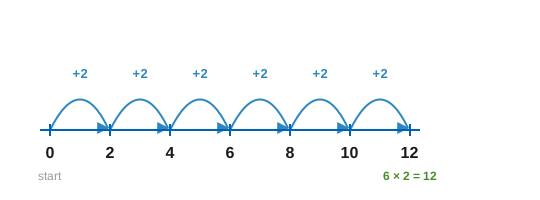 Number line from 0 to 12 showing six arched jumps of +2, ending at 12 with the label 6 × 2 = 12
For more on this tool, see What Is a Number Line? A Parent's Guide to How Teachers Use It.
Skip Counting by 5s and the 5× Table
Skip counting by 5s produces one of the easiest sequences to spot: every multiple ends in 0 or 5. That predictable pattern is why the 5s are usually the first multiplication facts kids know by heart.
Step 1: Start at 5. Say "5."
Some teachers start from 0 (0, 5, 10…), while others start from the first multiple (5, 10, 15…). Both are valid.
Step 2: Add 5. Say "10."
Step 3: Continue: 15, 20, 25.
Now line that sequence up next to the 5× table. The first jump (5) is 1 × 5. The second jump (10) is 2 × 5. The fifth jump (25) is 5 × 5. Each skip in the chant matches a fact in the table.
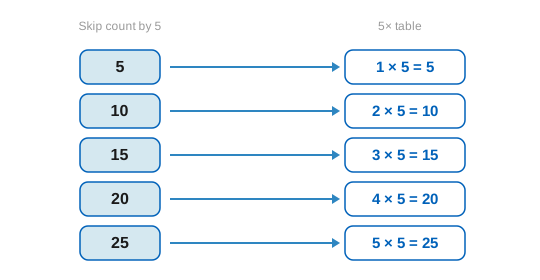 Skip counting by 5s on the left (5, 10, 15, 20, 25) with arrows pointing to the matching 5× facts on the right (1×5=5, 2×5=10, 3×5=15, 4×5=20, 5×5=25)
For more on how the rectangle picture of multiplication grows out of skip counting, see What Is the Area Model? A Parent's Guide to Box Multiplication.
From Skip Count to Multiplication Fact
Here is the move that closes the loop between skip counting and multiplication. Take a problem like 5 × 3. A child can solve it three ways, and all three give the same answer.
Skip count: 3, 6, 9, 12, 15. Five jumps of 3 lands on 15.
Repeated addition: 3 + 3 + 3 + 3 + 3 = 15.
Multiplication: 5 × 3 = 15.
The three representations sit on top of one another. Skip counting is the picture, repeated addition is the writing, multiplication is the shorthand. When teachers ask a 2nd or 3rd grader to skip count to solve a problem, they're walking the student through the same idea in three forms so the meaning is locked in before the fact gets memorized.
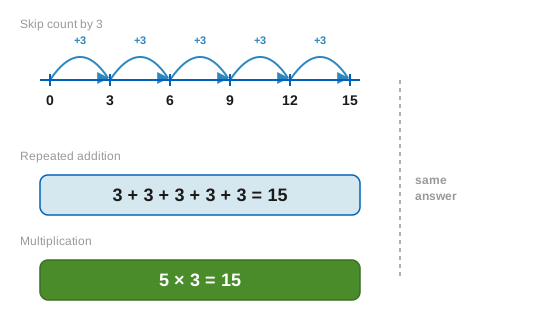 Three representations of 5 × 3: a number line with five jumps of +3 from 0 to 15, the equation 3 + 3 + 3 + 3 + 3 = 15, and the multiplication fact 5 × 3 = 15, all labeled "same answer"
For more on how breaking numbers apart connects to multiplication, see What Is Decomposing Numbers? A Parent's Guide to Breaking Apart Numbers.
How Skip Counting Connects to What You Already Know
You skip count constantly without naming it.
When you pair socks coming out of the dryer, you count by twos. When you sort nickels at the bottom of a drawer ("5, 10, 15…"), you count by fives. When you flip through a stack of twenty-dollar bills, you count by twenties. When you check the clock and say "the meeting starts at the half hour, so I have ten, twenty, thirty minutes," you count by tens.
The difference is that today's students are taught to recognize and name this strategy, so they can apply it deliberately for multiplication rather than only when the situation makes the grouping obvious.
Watch: Skip Counting Explained
How to Help at Home
Skip count out loud during everyday routines
Skip counting is one of the few math skills that genuinely gets stronger from repetition out loud. Count cookies by 2 onto a plate. Count quarters by 25 while sorting change. Count steps by 2 going up the stairs. Five minutes a day is enough; the daily rhythm matters more than the length of any single session.
Start with objects, not worksheets
Skip counting works best with real objects your child can touch. Cheerios in piles of 5, Lego bricks in stacks of 2, pennies in groups of 10. The physical grouping is what makes the math click. Fill-in-the-blank worksheets are useful practice once the meaning is solid, but they're not where the understanding starts.
Connect each skip count to a multiplication fact
When your child skip counts to solve a problem, name the multiplication fact at the end. "2, 4, 6, 8, 10. That's five groups of two, or 5 × 2 = 10." This habit closes the loop between skip counting (the strategy) and multiplication (the fact). Without that final translation, kids can skip count fluently and still feel stuck when a problem is written as 5 × 2.
Don't rush past the 2s, 5s, and 10s
These are the easiest skip counts, which is why teachers spend so much time on them. They form the foundation that makes the harder facts (3s, 4s, 6s, 7s, 8s, 9s) approachable. A child who can skip count by 2, 5, and 10 fluently has the rhythm they need for everything else. Spend extra time here even if it feels slow.
Match the teacher's vocabulary
Different curricula use slightly different words. Some teachers say "skip counting," others say "counting by 2s" or "multiples of 2." Some use "groups of" for multiplication, others use "sets of" or "times." Use whichever phrase appears on your child's worksheets or in their homework folder. Matching the school's language at home reduces the cognitive load on your child and keeps the conversation seamless.
Let Methodwise walk through it
When your child hits a problem at home and you're not sure how their teacher would talk through it, ask Methodwise. It will solve the problem step by step using skip counting, equal groups, arrays, or whichever strategy matches the curriculum, and it explains each step in the same language teachers use today.
Common Mistakes to Watch For
Saying the sequence without seeing the groups
A child can chant "2, 4, 6, 8" as a song without realizing each number stands for an additional group of 2. If you hear the chant come out without context, pause and ask them to show you with objects. "Can you make piles of two to match? Two cookies, then two more cookies…" The chant is helpful once the meaning rides along with it.
Starting at 1 instead of the multiple itself
For skip counting by 5s, kids should start at 5: "5, 10, 15, 20." Some students start at 1: "1, 5, 10, 15," which throws off the pattern and breaks the link to multiplication. Remind them that the first jump is the first number they say.
Skipping the connection from skip count to multiplication
A child can skip count by 3 fluently ("3, 6, 9, 12, 15") and still freeze when shown "5 × 3 = ___." The skip count and the multiplication fact are the same thing, but they look different on paper. Practice saying both at the same time so the connection becomes automatic.
Treating each multiple as a separate skill
Skip counting by 2s, 5s, and 10s share the same underlying logic: equal jumps from zero. If your child has mastered the 2s but struggles with the 5s, the skill isn't different; the size of the jump is. Help them see the pattern is the same, so they aren't relearning the strategy with every new number.
Practice Questions
Try these with your child. Answers are below.
Grades 1–2: Filling in the sequence
- Fill in the missing numbers: 2, 4, ___, 8, ___, 12, 14.
- Skip count by 5s starting at 5 and stopping at 30. Write the numbers.
- Skip count by 10s starting at 10 and stopping at 100.
Grades 2–3: Skip counting to multiply
- Use skip counting to solve 4 × 5. Write the skips and then the answer.
- Use skip counting to solve 6 × 2. Write the skips and then the answer.
- Lola has 3 jars with 10 marbles in each. Use skip counting to find the total number of marbles.
Grades 3–4: Harder facts and division
- Use skip counting by 3s to find 7 × 3.
- How many 5s does it take to skip count to 35? Write the skips and the answer.
- Skip count by 25s starting at 25 and stopping at 200.
Answers
- 2, 4, 6, 8, 10, 12, 14
- 5, 10, 15, 20, 25, 30
- 10, 20, 30, 40, 50, 60, 70, 80, 90, 100
- 5, 10, 15, 20. Four skips, so 4 × 5 = 20
- 2, 4, 6, 8, 10, 12. Six skips, so 6 × 2 = 12
- 10, 20, 30. 30 marbles
- 3, 6, 9, 12, 15, 18, 21. Seven skips, so 7 × 3 = 21
- 5, 10, 15, 20, 25, 30, 35. 7 fives (the same as 35 ÷ 5 = 7)
- 25, 50, 75, 100, 125, 150, 175, 200
Ready to try it with your child?
Open the chat, pick the subject and your child's grade, and get a step-by-step explanation you can use to help tonight.
Try 3 Questions Free — No Signup RequiredFrequently Asked Questions
Is skip counting the same thing as multiplication?
Not quite. Skip counting is a strategy; multiplication is the formal operation. Skip counting by 3s and saying '3, 6, 9, 12' gives you the same answers as the 3× table, but a child using skip counting is building each product by adding equal jumps, not recalling a fact from memory. The goal by the end of 3rd grade is for skip counting to fade into the background as students recall multiplication facts directly, with skip counting available as a backup when a fact slips.
When should my child have multiplication facts memorized?
Common Core asks students to know all single-digit multiplication facts from memory by the end of 3rd grade (standard 3.OA.7). Most curricula introduce facts in this order: 0s, 1s, 2s, 5s, and 10s first, then 3s and 4s, then the harder ones (6s, 7s, 8s, 9s) toward the end of the year. Skip counting is the bridge strategy that builds comfort with the products before the memorization push begins.
Does skip counting help with division too?
Yes. Counting how many jumps it takes to reach a number is a 3rd grader's first division strategy. To solve 35 ÷ 5, a child can skip count by 5s and count the jumps: 5, 10, 15, 20, 25, 30, 35. That's seven jumps, so 35 ÷ 5 = 7. The same skip count that builds the 5× table also unlocks division by 5.
Why is skip counting by 3s and 4s harder than 2s, 5s, and 10s?
The 2s, 5s, and 10s have patterns that show up everywhere in our number system: multiples of 2 are all even numbers, 5s end in 0 or 5, 10s end in 0. The 3s and 4s don't have a tidy ones-place pattern, so kids have to actually add each jump rather than recognize the next number on sight. Extra practice with the 3s and 4s in 2nd and 3rd grade is normal and expected.
My child counts the multiples on their fingers. Is that a problem?
Not in the early stages. Tracking skip counts on fingers is a developmentally appropriate strategy in 2nd and 3rd grade. It may become a concern if it persists into 4th grade or later and is the child's only strategy, as the goal shifts to automatic fact recall. If you see finger counting past 3rd grade, that's a sign your child may need more practice connecting the skip count directly to the multiplication fact.
What's the difference between skip counting and counting by groups?
They're two names for the same idea. 'Skip counting by 4' and 'counting by groups of 4' both mean adding 4 each time and saying the running total. Some curricula prefer 'counting by groups' in kindergarten and 1st grade because it emphasizes the physical grouping; others use 'skip counting' from the start. If your child's worksheets use one phrase, use that one at home so the language matches.
Try Methodwise Free
When your child brings home skip counting or early multiplication homework and you're not sure how to explain it the way their teacher would, Methodwise walks you through it, step by step, using the same method their teacher is using.
- Start with 3 free questions, no account needed
- Free plan: 15 questions/month after signup
- Plus plan: unlimited questions + saved chat history + 7-day free trial
- Step-by-step explanations the way teachers teach
Related Articles
-
What Is a Number Line? A Parent's Guide to How Teachers Use It
-
What Is Decomposing Numbers? A Parent's Guide to Breaking Apart Numbers
-
What Is the Area Model? A Parent's Guide to Box Multiplication
-
What Are Arrays in Math? A Parent's Guide to Visualizing Multiplication
-
What Is a Ten Frame? A Parent's Guide to the Box That Builds Number Sense
-
What Are Number Bonds? A Parent's Guide to Making and Breaking Numbers
-
What Are Fact Families? A Parent's Guide to How Addition and Subtraction Connect
-
What Is Partial Sums Addition? A Parent's Guide to Why Your Child Doesn't 'Carry the One' Anymore
-
What Is Partial Quotients Division? A Parent's Guide to the New Way Kids Learn Long Division
-
Fractions on a Number Line: A Parent's Guide to Why Pie Charts Aren't Enough
-
What Is a Tape Diagram? A Parent's Guide to Visualizing Word Problems
-
What Is the Standard Algorithm? A Parent's Guide to Why Your Child Learns the 'Long Way' First
-
What Are Ratios and Proportional Reasoning? A Parent's Guide to Middle School Math
-
What Are Common Core Math Methods? A Parent's Guide to How Math Is Taught Today
-
Homework Help Tools: Built for Kids vs. Built for Parents — What's the Difference?
-
What Math Will My Child Learn This Year? A Parent's Guide to K-8 Math Methods by Grade
-
What Are Mental Math Strategies? A Parent's Guide to How Kids Add and Subtract in Their Heads
Have questions about skip counting? Email me at hello@methodwise.co
About the Author
Samantha Black is the founder of Methodwise and an educator with over 15 years in higher education and instructional design. She built Methodwise after experiencing the homework gap firsthand as a parent of two K–8 daughters. Learn more about why we built Methodwise →