
What Is the Standard Algorithm? A Parent's Guide to Why Your Child Learns the 'Long Way' First
May 14, 2026
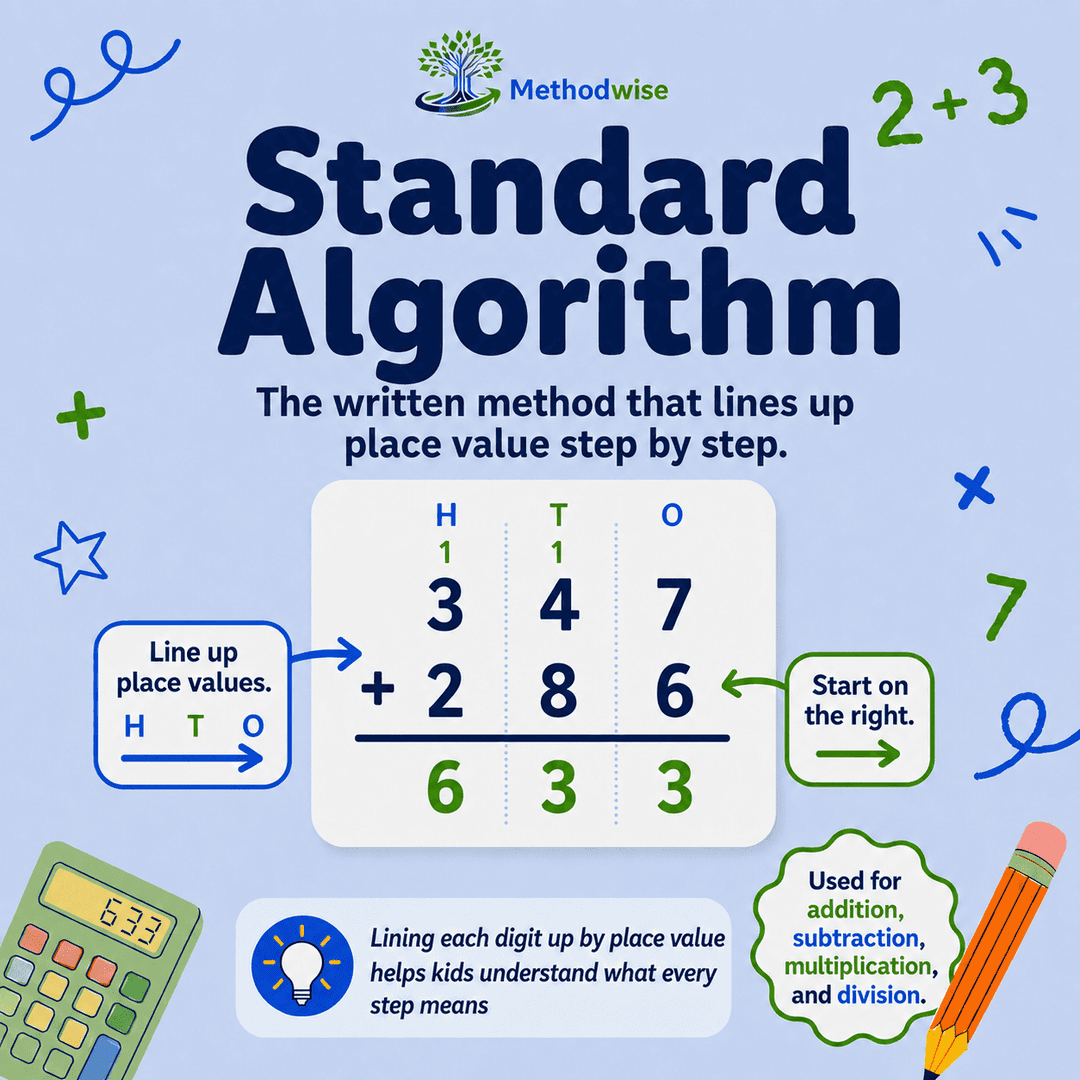
If your child's homework has finally started showing problems with carries written above columns, neat stacks of numbers, and answers reached in just a few short steps — congratulations, you're seeing the standard algorithm. And if your reaction is "finally — why didn't they just teach this from the start?" — you're asking the question almost every parent in America asks at some point. The short answer: today's students do learn the standard algorithm, but only after they've built something most of us never had: a real understanding of why it works.
What Is the Standard Algorithm?
The standard algorithm is the traditional column-based procedure most adults learned in school — stack the numbers, carry when you go over ten in addition, regroup when you can't subtract, regroup when you multiply, and bring down the next digit when you divide. It's the most compact, efficient way to do arithmetic with pencil and paper, and it's the same set of procedures many adults learned in school.
There are four standard algorithms in elementary school: addition, subtraction, multiplication, and long division. Common Core-aligned curricula and state assessments expect fluency with each, but spread across grades — addition and subtraction by the end of 4th grade, multiplication by 5th, and long division by 6th.
Why Do Teachers Use the "Long Way" First?
This is the question that frustrates parents more than any other in elementary math. Why all the partial sums, the box drawings, the column of partial quotients running down the side? Why not just teach the procedure and move on?
The answer is that the standard algorithm is fast, but it's also hidden. When a 4th grader writes a tiny "1" above the tens column, what does that 1 actually mean? Most adults — if we're being honest — don't fully remember. We learned the rule, applied the rule, got the right answer, and moved on. That worked, until it didn't. (Anyone who's helped with middle school math and discovered they don't actually understand why borrowing across zeros works has felt this firsthand.)
Common Core teachers flipped the order. Instead of teaching the procedure first and hoping understanding follows, they teach understanding first — through methods that make place value visible — and then compress that understanding into the standard algorithm. By the time your child writes the carried 1, they already know it represents 10 ones being regrouped into 1 ten. The procedure becomes a shortcut for thinking they've already done, not a substitute for thinking they haven't.
The result: the standard algorithm is the destination, not the starting point. Everything before it is the road that gets your child there with comprehension intact.
Stuck on tonight's homework?
Paste in the problem and get a step-by-step explanation in your child's grade level — using the same method their teacher uses.
Try 3 Questions Free — No Signup RequiredWhat Grade Is the Standard Algorithm Taught?
Kindergarten–1st Grade — Foundations
Students aren't doing standard algorithms yet. They're learning what numbers actually mean: counting, decomposing 10 into parts, adding and subtracting within 20, and recognizing that two-digit numbers are "tens and ones." This is the ground floor.
2nd–3rd Grade — Conceptual Strategies
These are the years parents find most confusing. Students use strategies that make place value visible — partial sums for addition, expanded form, number bonds, and the area model when multiplication starts. The point is not speed; the point is making sure students understand what's happening to the numbers.
4th Grade — Standard Algorithm for Addition and Subtraction
Common Core 4.NBT.B.4 says it plainly: students must "fluently add and subtract multi-digit whole numbers using the standard algorithm." This is when "carrying the one" and traditional borrowing finally appear as the expected method. Students who built place value through partial sums in 2nd and 3rd grade now compress that thinking into the standard form.
5th Grade — Standard Algorithm for Multiplication
Common Core 5.NBT.B.5 introduces the standard multiplication algorithm — the stacked, regrouped form most adults remember. Students transition from the area model (the "box" method) to the column method, but the area model stays available as a way to check work or break down harder problems.
6th Grade — Long Division
The traditional long division algorithm — divide, multiply, subtract, bring down — typically arrives in 6th grade (Common Core 6.NS.B.2). Most students reach it after working with partial quotients in 4th and 5th grade. They already know how to chunk a divisor out of a dividend; long division is the compressed version of that same process.
If your child is working in any of these stages, they're exactly where they should be. The standard algorithm isn't being delayed — it's being built.
How the Standard Algorithm Works
Standard Addition: 348 + 275
Most parents recognize this one instantly. Stack the numbers, add the ones column first, carry to the tens, add the tens, carry to the hundreds, add the hundreds.
Step 1: Add the ones. 8 + 5 = 13. Write 3, carry 1.
Step 2: Add the tens. 4 + 7 + 1 (carried) = 12. Write 2, carry 1.
Step 3: Add the hundreds. 3 + 2 + 1 (carried) = 6. Write 6.
Answer: 623.
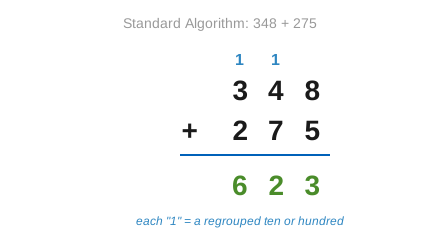 Standard algorithm for 348 + 275: stacked addition with carries above each column, sum 623
What's happening underneath: that little carried 1 isn't a 1 — it's a 10 (or, in the next column, a 100). Students who learned partial sums first already know this. They've already added 300 + 200, 40 + 70, and 8 + 5 separately. The standard algorithm is just a tighter way to write down that same work.
For more on the conceptual method that builds toward this, see What Is Partial Sums Addition? A Parent's Guide.
Standard Multiplication: 34 × 27
This is the one most parents both remember and dread.
Step 1: Multiply 34 by the ones digit (7). 7 × 4 = 28, write 8 carry 2. 7 × 3 + 2 = 23. First partial product: 238.
Step 2: Multiply 34 by the tens digit (2), but remember it's actually 20. Place a 0 in the ones column as a placeholder, then multiply: 2 × 4 = 8. 2 × 3 = 6. Second partial product: 680.
Step 3: Add the partial products. 238 + 680 = 918.
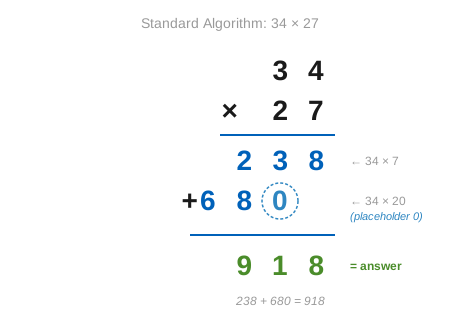 Standard algorithm for 34 times 27: two partial products, 238 and 680, added to give 918
The trickiest part for students is the placeholder zero. Why does the second row need a 0 in the ones place? Because we're not multiplying by 2 — we're multiplying by 20. Students who learned the area model already understand this: the four-cell box for 34 × 27 has a (30 × 20) cell worth 600 and a (4 × 20) cell worth 80, which together equal 680. The standard algorithm is just the area model written more compactly.
For more on the visual method that builds toward this, see What Is the Area Model? A Parent's Guide to Box Multiplication.
Long Division: 672 ÷ 24
The classic "divide, multiply, subtract, bring down" procedure most parents remember from 5th or 6th grade.
Step 1: How many times does 24 go into 67? 24 × 2 = 48, 24 × 3 = 72 (too big). So 2. Write 2 above the 7 in 672.
Step 2: Multiply: 2 × 24 = 48. Subtract: 67 − 48 = 19.
Step 3: Bring down the 2 from 672 to make 192.
Step 4: How many times does 24 go into 192? 24 × 8 = 192 exactly. Write 8 above the 2.
Step 5: Multiply: 8 × 24 = 192. Subtract: 192 − 192 = 0.
Answer: 28 with no remainder.
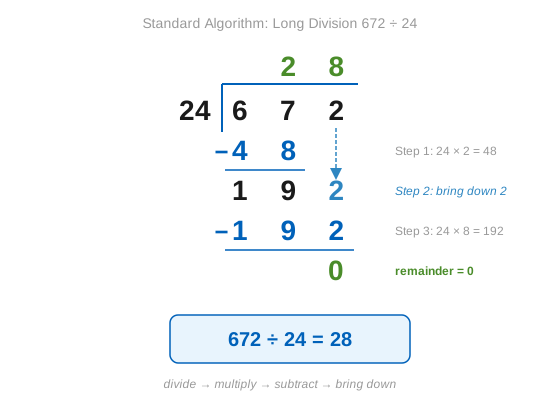 Long division of 672 by 24: quotient 28, showing each step of divide-multiply-subtract-bring down
Students who learned partial quotients first don't experience long division as a mysterious dance of digits. They've already pulled groups of 24 out of 672 — maybe 20 groups first (for 480), then 8 more groups (for 192) — and added the chunks together to get 28. Long division is the same process, written so compactly that you only see one column at a time.
For more on the conceptual method that builds toward this, see What Is Partial Quotients Division? A Parent's Guide.
How the Standard Algorithm Connects to What You Already Know
This section is short, because the connection is the simplest one in the entire blog: this is what you already know. The standard algorithm is the math you grew up with. The carries, the borrows, the long division bracket — all of it survives, fully intact, in your child's curriculum. It just arrives a little later in their schooling than it did in yours.
What's different is what surrounds it. When you were a kid, the standard algorithm was the whole show. Today, it's the final scene of a much longer play. The good news: your child still gets the ending. The better news: by the time they get there, they actually understand the plot.
Watch: The Standard Algorithm Explained
How to Help at Home
Use the words "the standard algorithm"
Teachers use this exact phrase, and using it at home keeps your child from feeling like they're caught between two different worlds. "Let's solve this with the standard algorithm" is exactly how their teacher would say it. Avoid calling it "the right way" or "the normal way" — those phrases imply that what they learned earlier was wrong.
Don't push the standard algorithm before it's introduced
If your child is in 2nd grade using partial sums, teaching them to "carry the one" can do real harm — they may use it on a test where the teacher expected the strategy method, and end up losing points for a correct answer. Wait for the teacher's signal. Once the standard algorithm is on the table (usually 4th grade for addition, 5th for multiplication, 6th for division), then you can absolutely reinforce it.
Translate "carry" as "regroup"
When you help with a problem, name what's actually happening. "We had 13 ones, so we trade 10 of them for 1 ten" sounds slow, but it's exactly the language teachers use today. After a few problems, your child will start to internalize that the carried 1 represents a regrouped ten. That understanding is what protects them from making procedural errors later.
Watch the placeholder zero in multiplication
If your 5th grader is learning standard multiplication, the single most common mistake is forgetting the placeholder 0 in the second partial product line. When you check their work, glance at the second row first. If it's missing a 0, the answer will be off by a factor of 10 in that section.
Cross-check with the conceptual method when answers don't match
If a homework answer comes out wrong, ask your child to redo the problem using whatever conceptual method they learned first — partial sums, area model, or partial quotients. The two methods should give the same answer. If they don't, the gap reveals exactly where the procedural mistake happened. This is one of the best uses of the conceptual methods even after the standard algorithm is the main tool.
Let Methodwise walk through it
If a problem is stumping you and you're not sure whether to use the standard algorithm or the strategy method your child learned first, open Methodwise and snap a picture of the homework. It will pick the right method for your child's grade and walk you through it step by step.
Common Mistakes to Watch For
Misaligning the columns
When students stack 348 + 275, the digits have to line up by place value: hundreds under hundreds, tens under tens, ones under ones. With longer numbers (especially when one number has fewer digits than the other), students sometimes shift by a column and get a wildly wrong answer. Lined or grid paper helps a lot.
Forgetting to add the carried digit
A student adds 8 + 5 = 13, writes the 3, carries the 1, then adds 4 + 7 = 11 — and forgets the carried 1 entirely. Pencil marks above the next column help, but the deeper fix is making sure your child mentally says "plus the 1 I carried" out loud the first few times.
Borrowing across zeros
Subtracting 502 − 167 trips up a lot of students because the tens place is zero. They have to borrow from the hundreds first, turning the zero into 10, then borrow from that 10 to give the ones place enough. This is the single most error-prone subtraction problem in elementary school. If your child is consistently missing problems with zeros in the middle, that's almost always the culprit.
Skipping the placeholder zero in multiplication
Discussed above — the missing 0 in the second row of standard multiplication is the single most common 5th-grade mistake. Worth repeating: always glance at the second partial product first.
"Bring down" without checking the next step
In long division, after bringing down a digit, students sometimes forget to ask "how many times does the divisor go into this new number?" and instead bring down again. The pattern is always divide → multiply → subtract → bring down. Skipping a step in the cycle is the most common long division error.
Practice Questions
Try these with your child. Answers are below.
Standard addition (4th grade):
- 348 + 275
- 1,469 + 738
- 2,506 + 1,894
Standard subtraction (4th grade):
- 632 − 245
- 502 − 167
- 1,003 − 478
Standard multiplication (5th grade):
- 34 × 27
- 56 × 43
- 128 × 15
Long division (6th grade):
- 672 ÷ 24
- 945 ÷ 15
- 1,512 ÷ 18
Answers
- 623 (carries: 1, 1)
- 2,207 (carries: 1, 1, 1)
- 4,400 (carries: 1, 1, 1)
- 387 (borrow from tens, then hundreds)
- 335 (borrow across the 0 in the tens place)
- 525 (borrow across the 0s)
- 918 (partial products 238 + 680)
- 2,408 (partial products 168 + 2,240)
- 1,920 (partial products 640 + 1,280)
- 28
- 63
- 84
Ready to try it with your child?
Open the chat, pick the subject and your child's grade, and get a step-by-step explanation you can use to help tonight.
Try 3 Questions Free — No Signup RequiredFrequently Asked Questions
My child got the right answer using the standard algorithm, but the teacher marked it wrong. Why?
This happens most often in 2nd through 4th grade, when assignments are specifically testing whether students can demonstrate a strategy method like partial sums or the area model. The teacher isn't grading the final answer alone — they're checking that your child can show the conceptual reasoning. If the directions said something like 'use partial sums,' a correct answer reached with the standard algorithm typically won't get full credit. Email the teacher to confirm what method the assignment expected; if no specific method was required and a correct answer was still marked wrong, that's worth a conversation.
Is the standard algorithm tested on state tests?
Yes. Many Common Core-aligned curricula and state assessments expect fluency with the standard algorithm starting in 4th grade for addition and subtraction, 5th grade for multiplication, and 6th grade for long division. Earlier grades often accept either strategy methods or the algorithm. By upper elementary, the standard algorithm is the expected method on timed sections, so it's worth practicing it the way it appears on the test.
What's the difference between the standard algorithm and methods like partial products or lattice multiplication?
Partial products is the area model written vertically — same place-value reasoning, just stacked instead of in a box. Lattice multiplication is a different visual method that uses a grid with diagonal lines, taught in some curricula (including parts of Singapore Math). The standard algorithm is the most compact written form and the one US state tests expect. Strategy methods like partial products and the area model are taught first to build understanding; the standard algorithm is the efficient endpoint.
Should I be concerned if my 5th grader still reaches for partial sums or the area model?
Almost always no. Many students keep using strategy methods even after they've learned the standard algorithm, especially when numbers feel hard or when they want to double-check their work. As long as your child can use the standard algorithm fluently when an assignment asks for it, the strategy methods are a feature, not a bug. Students who fluently switch between methods catch their own errors more often than students stuck on a single approach.
My child transferred from a school that taught the standard algorithm earlier. How do we help them catch up on the conceptual side?
They have a head start on the procedure but may be missing the place-value foundation their new classmates have spent two or three years building. When they solve a problem, ask them to also show the partial sums, area model, or partial quotients version alongside the standard algorithm answer. This back-fills the reasoning their new class assumes they have, and prevents procedural mistakes from going uncaught later. Methodwise can show both methods side by side for any problem, which makes the bridging much faster.
Try Methodwise Free
When your child brings home standard algorithm homework and you're not sure whether to teach the way you learned or the way their teacher is teaching, Methodwise walks you through it — step by step, using the same method their teacher is using.
- Start with 3 free questions — no account needed
- Free plan: 15 questions/month after signup
- Plus plan: unlimited questions + saved chat history + 7-day free trial
- Step-by-step explanations the way teachers teach
Related Articles
-
What Is Partial Sums Addition? A Parent's Guide to Why Your Child Doesn't 'Carry the One' Anymore
-
What Is the Area Model? A Parent's Guide to Box Multiplication
-
What Is Partial Quotients Division? A Parent's Guide to the New Way Kids Learn Long Division
-
What Is Decomposing Numbers? A Parent's Guide to Breaking Apart Numbers
-
What Are Number Bonds? A Parent's Guide to Making and Breaking Numbers
-
What Is a Number Line? A Parent's Guide to How Teachers Use It
-
What Are Arrays in Math? A Parent's Guide to Visualizing Multiplication
-
What Is a Tape Diagram? A Parent's Guide to Visualizing Word Problems
-
What Is a Ten Frame? A Parent's Guide to the Box That Builds Number Sense
-
What Are Fact Families? A Parent's Guide to How Addition and Subtraction Connect
-
What Are Common Core Math Methods? A Parent's Guide to How Math Is Taught Today
-
Homework Help Tools: Built for Kids vs. Built for Parents — What's the Difference?
-
Fractions on a Number Line: A Parent's Guide to Why Pie Charts Aren't Enough
-
What Are Ratios and Proportional Reasoning? A Parent's Guide to Middle School Math
-
What Is Skip Counting? A Parent's Guide to How Counting by 2s, 5s, and 10s Becomes Times Tables
-
What Math Will My Child Learn This Year? A Parent's Guide to K-8 Math Methods by Grade
-
What Are Mental Math Strategies? A Parent's Guide to How Kids Add and Subtract in Their Heads
Have questions about the standard algorithm? Email me at hello@methodwise.co
About the Author
Samantha Black is the founder of Methodwise and an educator with over 15 years in higher education and instructional design. She built Methodwise after experiencing the homework gap firsthand as a parent of two K–8 daughters. Learn more about why we built Methodwise →