
What Is a Tape Diagram? A Parent's Guide to Visualizing Word Problems
March 26, 2026
If your child has come home with a math worksheet covered in long rectangles split into sections — some labeled with numbers, some with question marks — you've seen a tape diagram in action. And if your first thought was "why aren't they just writing an equation?", you're in very good company.
Tape diagrams (sometimes called bar models or strip diagrams) are one of the most widely used visual tools in math classrooms today. They show up as early as first grade and stick around through middle school. The idea behind them is simple, even if they look unfamiliar: draw the problem before you solve it. Once you see how they work, you'll realize they're doing exactly what you do in your head when you figure out a tip or split a bill — they just put it on paper.
What Is a Tape Diagram?
A tape diagram is a rectangular bar (or strip) that represents a quantity in a math problem. Students draw one or more bars, divide them into sections, label the known values, and mark the unknown with a question mark. That's it. The bar makes the relationship between numbers visible — which part is bigger, what's missing, how pieces add up to the whole.
Think of it like a measuring tape laid flat on the table. The whole tape is the total. The sections are the parts. If you know the parts, you can find the total. If you know the total and one part, you can figure out the missing piece.
Why Do Teachers Use Tape Diagrams?
If you learned math by memorizing steps — "borrow from the tens column," "invert and multiply" — you might wonder why anyone would bother drawing a picture first.
Here's the reasoning: when students learn a procedure without understanding why it works, they can follow the steps but get stuck the moment a problem looks even slightly different. Tape diagrams build the understanding underneath the procedure. By drawing the problem, a student has to think about what the numbers actually represent before they start calculating.
This approach comes from Singapore Math, which introduced "model drawing" in the 1980s as part of a concrete → pictorial → abstract teaching framework. Students start with physical objects (blocks, counters), move to drawings (tape diagrams, number lines), and then graduate to equations and symbols. The drawing stage is the bridge — it's more portable than a pile of blocks but more intuitive than a naked equation.
The payoff shows up later. Students who learn to diagram word problems in third grade have a much easier time setting up algebraic equations in seventh grade, because a tape diagram with a question mark is essentially the same thing as an equation with a variable. The rectangle labeled "?" becomes "x" — and the thinking stays the same.
Stuck on tonight's homework?
Paste in the problem and get a step-by-step explanation in your child's grade level — using the same method their teacher uses.
Try 3 Questions Free — No Signup RequiredWhat Grade Is This Taught?
Tape diagrams span nearly the entire elementary and middle school math experience, growing more sophisticated at each stage.
Kindergarten & 1st Grade — Building Blocks
Students are introduced to tape diagrams for basic addition and subtraction within 20. The bars are simple — usually just two sections showing parts that make a whole. A problem like "5 + 3 = ?" becomes a bar with a section of 5 and a section of 3, and the student figures out how long the whole bar is.
At this level, tape diagrams are closely tied to physical manipulatives. A student might line up 5 red cubes and 3 blue cubes, then draw a rectangle around each group. The drawing mirrors what they just built with their hands.
2nd & 3rd Grade — Growing Complexity
The problems get bigger (two- and three-digit numbers) and the unknown moves around. Instead of always solving for the total, students now encounter problems where the starting amount is missing or the change is missing: "I had some stickers. I gave away 12. Now I have 25. How many did I start with?" The tape diagram makes the structure of this problem visible in a way that reading the words alone doesn't.
Third graders also start using tape diagrams for multiplication and division — drawing bars divided into equal groups. A bar split into 4 equal sections of 6 shows that 4 × 6 = 24.
4th & 5th Grade — Multi-Step and Fractions
Tape diagrams now handle multi-step problems, fractions, and multiplicative comparisons ("Sam has 3 times as many cards as Mia"). Fifth graders use them to solve fraction problems — dividing a bar into equal parts to find, say, 3/4 of 20 by splitting the bar into 4 sections of 5 and shading 3 of them.
This is also where tape diagrams start to overlap with the area model for multiplication, giving students multiple visual strategies to choose from.
Grades 6–8 — Ratios and the Bridge to Algebra
In middle school, tape diagrams power ratio and proportion work. Students draw double tape diagrams — two bars stacked and aligned — to compare quantities. If the ratio of dogs to cats at a shelter is 3:2, a student draws a 3-unit bar for dogs above a 2-unit bar for cats, figures out the value of one unit, and scales from there.
By eighth grade, many students transition from tape diagrams to algebraic equations, but the diagrams remain a go-to tool when a problem feels confusing and they need to "see" what's happening before writing an equation.
If your child is working with tape diagrams at any of these stages, it's developmentally appropriate and part of a deliberate progression from visual reasoning to abstract algebra.
How Tape Diagrams Work
Let's walk through some actual problems at different grade levels, the way your child's teacher would approach them.
Addition (Grade 1)
Problem: Emma has 8 red crayons and 5 blue crayons. How many crayons does she have in all?
Steps:
- Draw a bar and split it into two sections.
- Label the first section "8" (red crayons) and the second section "5" (blue crayons).
- Write a "?" above the whole bar to show that the total is what we're looking for.
- Add the parts: 8 + 5 = 13.
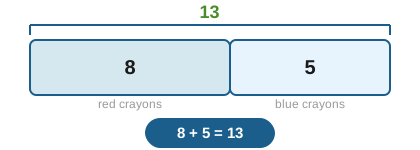 Tape diagram for 8 + 5 = 13: bar split into two sections labeled 8 and 5, with total 13 above
The diagram makes it concrete: the two parts sit side by side, and the whole bar is the answer. There's no ambiguity about what "in all" means when you can see it.
For more on how students break apart numbers to add, see What Is Decomposing Numbers? A Parent's Guide to Breaking Apart Numbers.
Missing Number Subtraction (Grade 2)
Problem: Jake had some baseball cards. He gave 15 to his friend. Now he has 23. How many did he start with?
Steps:
- Draw a bar for the total (the unknown starting amount). Label it "?".
- Split the bar into two sections: one labeled "15" (the cards he gave away) and one labeled "23" (the cards he has left).
- Since both parts are known, add them: 15 + 23 = 38.
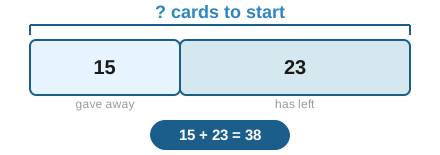 Tape diagram for unknown start: bar labeled ? on top, split into 15 and 23 below
This is where tape diagrams really shine. The problem sounds like subtraction ("he gave away"), but the diagram reveals it's actually an addition problem in disguise. Students who try to subtract get confused. Students who draw the diagram see exactly what to do.
Multiplication with Equal Groups (Grade 3)
Problem: There are 4 bags with 6 oranges in each bag. How many oranges are there?
Steps:
- Draw a bar divided into 4 equal sections.
- Label each section "6."
- Write "?" above the whole bar.
- Multiply: 4 × 6 = 24.
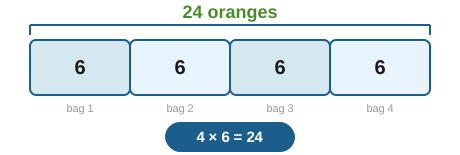 Tape diagram for 4 × 6 = 24: bar split into 4 equal sections each labeled 6, total 24
The tape diagram shows multiplication as repeated equal groups — which is exactly how third graders are learning to think about it. Each section is the same size because each bag has the same number of oranges.
For more on visual multiplication strategies, see What Is the Area Model? A Parent's Guide to Box Multiplication.
Division as Equal Sharing (Grade 4)
Problem: 24 cookies are shared equally among 4 friends. How many does each friend get?
Steps:
- Draw a bar and label the whole thing "24."
- Divide it into 4 equal sections (one per friend).
- Label each section "?" since that's what we're solving for.
- Divide: 24 ÷ 4 = 6.
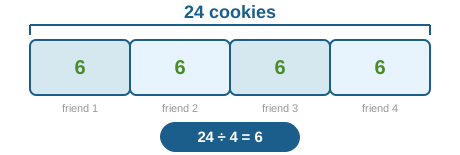 Tape diagram for 24 ÷ 4 = 6: bar labeled 24 on top, split into 4 equal sections each showing 6
Notice how similar this looks to the multiplication example — but the unknown moved. In multiplication, we knew the parts and found the whole. In division, we know the whole and the number of parts, and we find the size of each part. The diagram makes that relationship visible.
Ratios with Double Tape Diagrams (Grade 6)
Problem: The ratio of red marbles to blue marbles in a jar is 3:2. If there are 15 red marbles, how many blue marbles are there?
Steps:
- Draw two bars, one above the other. The top bar (red) gets 3 equal sections. The bottom bar (blue) gets 2 equal sections. Make each section the same width.
- We know 3 units = 15 red marbles, so 1 unit = 5.
- Blue has 2 units: 2 × 5 = 10 blue marbles.
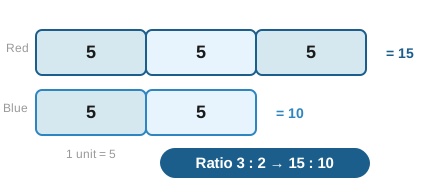 Double tape diagram for 3:2 ratio: top bar with 3 sections of 5, bottom bar with 2 sections of 5
The double tape diagram is one of the most powerful tools in middle school math. It takes ratios — which can feel very abstract — and turns them into something you can count and compare visually.
For more on how students learn to place and compare values visually, see What Is a Number Line? A Parent's Guide to How Teachers Use It.
How Tape Diagrams Connect to What You Already Know
You use tape diagrams in your head every day — you just don't draw them.
Splitting a restaurant bill. When four people go out and the bill is $120, you mentally picture the total divided into four equal parts. That's a tape diagram for 120 ÷ 4. You don't need to draw it because the situation is familiar, but the reasoning is identical.
Budgeting your paycheck. If you earn $3,000 a month and $1,200 goes to rent, you're mentally picturing a bar: one big chunk is rent, and the remaining section is everything else. When you ask "how much is left?", you're solving for the missing part of the tape.
Comparing prices while shopping. "Brand A costs $4 for 3 bars. Brand B costs $5 for 4 bars. Which is the better deal?" You're mentally stacking two bars and comparing unit sizes — exactly what a double tape diagram does for ratios.
Estimating time. "I have 2 hours before dinner. If I spend 45 minutes on email and 30 minutes on a call, how much free time do I have?" You're partitioning a strip of time into sections and finding the leftover. Tape diagram.
The difference is that today's students are taught to recognize and name this strategy, so they can apply it deliberately rather than only using it when the situation is simple enough to do in their head.
Watch: Tape Diagrams Explained
How to Help at Home
Use the word "tape diagram"
If your child's teacher calls it a tape diagram, use that term at home — even if you've seen it called a bar model or strip diagram. Matching the teacher's vocabulary reduces confusion. If you're not sure which term the class uses, check any handouts or ask at the next parent-teacher conference.
Ask "what do we know?" before anything else
When your child is stuck on a word problem, resist the urge to jump to the math. Instead, ask: "What numbers do we know? What are we trying to find?" This is exactly what drawing a tape diagram trains them to do — identify the known and unknown quantities before choosing an operation. Even if they don't draw a diagram every time, the habit of asking these questions is the real skill.
Let them draw it their way
Your child's tape diagram might not look like the textbook version. The sections might be uneven, the labels might be in weird spots, the handwriting might be a mess. That's okay. If the diagram correctly represents the relationships in the problem, it's working. Resist the urge to redraw it "neatly" — the thinking matters more than the aesthetics.
Don't skip the diagram when they "already know the answer"
Some kids will say "I already know it's 24, I don't need to draw it." For simple problems, they might be right. But the diagram isn't just for getting the answer — it's for building a habit of reasoning that pays off when problems get harder. Encourage them to draw it anyway: "Show me how you know it's 24." The diagram is the proof.
Connect it to real life
Next time you're splitting snacks, dividing up chores, or figuring out how many days until a trip, say "that's a tape diagram problem!" You don't have to literally draw a bar on a napkin (though you can). Just naming the connection helps your child see that math class isn't a separate world.
Let Methodwise walk through it
If your child is stuck on a specific tape diagram problem, Methodwise explains it using the same approach their teacher uses — drawing out the bar, labeling the parts, and walking through the reasoning step by step, with a knowledge check to make sure the foundation is solid before moving forward.
Common Mistakes to Watch For
Drawing bars that don't match the numbers
A student solving "15 + 23" might draw two sections that look the same size. The diagram should roughly reflect that 23 is bigger than 15. When the sections are proportional, the diagram actually helps with estimation and reasonableness. When they're not, it's just decoration. If you notice this, gently ask: "Which section should be bigger?"
Putting the unknown in the wrong place
In a problem like "I had some stickers, gave away 12, and have 25 left," the unknown is the starting total — but students sometimes label the "gave away" part as the unknown instead. This leads to the wrong operation. Have your child point to each part of the diagram and say what it represents in the story before solving.
Forgetting to label
An unlabeled tape diagram is like a map without street names. Students sometimes draw beautiful bars with perfectly proportional sections and then can't remember what any of it means. Encourage labeling everything — each section, the total, the unknown — as they draw, not after.
Using unequal sections for equal groups
In multiplication and division problems, every section should be the same size because the groups are equal. A student solving "4 bags of 6 oranges" who draws four wildly different-sized sections is missing the point of equal groups. If you see this, ask: "Are all the bags the same? Should the sections be the same?"
Jumping to an equation without the diagram
As students get more confident, they'll want to skip the diagram and go straight to the math. Sometimes that's fine. But when they get a problem wrong and can't figure out why, the first question should be: "Can you draw a tape diagram for this?" Nine times out of ten, the diagram reveals where their thinking went off track.
Practice Questions
Try these with your child. Answers are below.
Addition and subtraction (Grades 1–2):
- Mia has 9 stickers. Noah has 7 stickers. How many stickers do they have together?
- There were 16 birds on a fence. Some flew away. Now there are 9. How many flew away?
Multiplication and division (Grades 3–4):
- There are 5 boxes with 8 markers in each box. How many markers are there in all?
- 36 students are split into 4 equal teams. How many students are on each team?
- Lily read 3 times as many pages as Sam. Sam read 12 pages. How many pages did Lily read?
Fractions and ratios (Grades 5–6):
- What is 3/5 of 40?
- The ratio of fiction to nonfiction books on a shelf is 4:3. If there are 28 fiction books, how many nonfiction books are there?
Challenge:
- A school has a 5:3 ratio of students who walk to school versus students who take the bus. If 240 students walk, how many students attend the school in total?
Answers
- 16. Draw a bar with sections of 9 and 7. Total: 9 + 7 = 16.
- 7. Draw a bar for 16 total. One section is 9 (remaining). The missing section: 16 − 9 = 7.
- 40. Draw a bar with 5 equal sections of 8. Total: 5 × 8 = 40.
- 9. Draw a bar labeled 36, divided into 4 equal sections. Each section: 36 ÷ 4 = 9.
- 36. Draw Sam's bar as 12. Draw Lily's bar 3 times as long: 3 × 12 = 36.
- 24. Draw a bar for 40 divided into 5 equal sections (each = 8). Shade 3 sections: 3 × 8 = 24.
- 21. Draw a 4-unit bar (fiction = 28) and a 3-unit bar (nonfiction = ?). One unit = 28 ÷ 4 = 7. Nonfiction = 3 × 7 = 21.
- 384. Walking = 5 units = 240, so 1 unit = 48. Bus = 3 units = 144. Total = 240 + 144 = 384.
Ready to try it with your child?
Open the chat, pick the subject and your child's grade, and get a step-by-step explanation you can use to help tonight.
Try 3 Questions Free — No Signup RequiredFrequently Asked Questions
Is a tape diagram the same thing as a bar model?
Yes. 'Tape diagram,' 'bar model,' and 'strip diagram' all refer to the same tool. The name varies by curriculum — Eureka Math and most Common Core–aligned programs say 'tape diagram,' while Singapore Math textbooks often say 'bar model.' If your child uses a different term than what you see online, they're almost certainly talking about the same thing.
Does my child really need to draw these? Can't they just do the math?
For simple problems, sure. But tape diagrams aren't really about getting the answer — they're about understanding the problem's structure. Students who practice diagramming word problems consistently outperform those who don't when problems get more complex, because they've trained themselves to think before calculating.
When do tape diagrams go away?
They don't disappear — they evolve. In middle school, tape diagrams transition into algebraic equations. The '?' in the diagram becomes 'x' in an equation. Students who are comfortable with tape diagrams tend to have an easier time setting up equations because the visual reasoning transfers directly.
My child's diagram looks nothing like the textbook. Is that a problem?
Not necessarily. As long as the diagram correctly shows the relationship between the numbers in the problem — the parts, the whole, and the unknown — it's doing its job. Neatness and textbook-perfect formatting aren't the point.
What if my child is stuck and I can't remember how to draw one?
Methodwise can walk you both through it. Just type in the problem, select your child's grade, and Methodwise will show the tape diagram step by step, using the same method their teacher uses in class.
How is a tape diagram different from a number line?
A number line shows values along a continuous scale (like a ruler), while a tape diagram shows parts of a whole as sections of a bar. Number lines are great for counting, sequencing, and showing jumps. Tape diagrams are great for showing how quantities relate — parts vs. whole, equal groups, comparisons.
Try Methodwise Free
When your child brings home a tape diagram problem and you're not sure how to explain it the way their teacher would, Methodwise walks you through it — step by step, using the same method their teacher is using.
- Start with 3 free questions — no account needed
- Free plan: 15 questions/month after signup
- Plus plan: unlimited questions + saved chat history + 7-day free trial
- Step-by-step explanations the way teachers teach
Related Articles
-
What Is Decomposing Numbers? A Parent's Guide to Breaking Apart Numbers
-
What Is the Area Model? A Parent's Guide to Box Multiplication
-
What Is a Number Line? A Parent's Guide to How Teachers Use It
-
What Are Number Bonds? A Parent's Guide to Making and Breaking Numbers
-
What Is Partial Sums Addition? A Parent's Guide to Why Your Child Doesn't 'Carry the One' Anymore
-
What Is a Ten Frame? A Parent's Guide to the Box That Builds Number Sense
-
What Is Partial Quotients Division? A Parent's Guide to the New Way Kids Learn Long Division
-
What Are Common Core Math Methods? A Parent's Guide to How Math Is Taught Today
-
What Are Arrays in Math? A Parent's Guide to Visualizing Multiplication
-
Homework Help Tools: Built for Kids vs. Built for Parents — What's the Difference?
-
What Are Fact Families? A Parent's Guide to How Addition and Subtraction Connect
-
What Is the Standard Algorithm? A Parent's Guide to Why Your Child Learns the 'Long Way' First
-
Fractions on a Number Line: A Parent's Guide to Why Pie Charts Aren't Enough
-
What Are Ratios and Proportional Reasoning? A Parent's Guide to Middle School Math
-
What Is Skip Counting? A Parent's Guide to How Counting by 2s, 5s, and 10s Becomes Times Tables
-
What Math Will My Child Learn This Year? A Parent's Guide to K-8 Math Methods by Grade
-
What Are Mental Math Strategies? A Parent's Guide to How Kids Add and Subtract in Their Heads
Have questions about tape diagrams? Email me at hello@methodwise.co
About the Author
Samantha Black is the founder of Methodwise and an educator with over 15 years in higher education and instructional design. She built Methodwise after experiencing the homework gap firsthand as a parent of two K–8 daughters. Learn more about why we built Methodwise →