
What Is a Ten Frame? A Parent's Guide to the Box That Builds Number Sense
April 10, 2026
If your child's math homework has a rectangle divided into little boxes — some filled with dots and some left empty — you're looking at a ten frame. It might seem like a strange way to do math when you could just count or add the regular way, but this simple grid is one of the most powerful number sense tools in today's classrooms. Here's what it is, why teachers rely on it, and how you can use it to help at home.
What Is a Ten Frame?
A ten frame is a rectangular grid with two rows and five columns — ten boxes total. Students place counters, draw dots, or color in boxes to show a number. If a child wants to show 7, they fill seven of the ten boxes and leave three empty.
That's it. It's a simple visual, but the design is intentional: the five-per-row structure lets children instantly see how a number relates to 5 and how far it is from 10 — two anchors that become the foundation for nearly everything else in elementary math.
Why Do Teachers Use Ten Frames?
If you grew up memorizing addition facts from flashcards or a times table chart, ten frames might feel like an unnecessary extra step. But here's what changed: research showed that kids who understand why 7 + 5 = 12 — not just kids who memorized it — are the ones who can handle harder math later.
A ten frame builds that understanding. When a child sees 7 dots in a ten frame, they don't need to count — they see a full row of 5 and 2 more. They also see 3 empty boxes, which means they automatically know that 7 + 3 = 10. That kind of instant number awareness is called subitizing, and it's a skill that traditional flashcard drills often skip entirely.
The ten frame also teaches composing and decomposing numbers — breaking a number into parts and putting it back together. A child who sees 8 as "5 and 3" or "two away from 10" has flexible thinking about numbers, which is exactly what they'll need for regrouping, mental math, and eventually algebra.
For more on this strategy, see What Is Decomposing Numbers? A Parent's Guide to Breaking Apart Numbers.
Stuck on tonight's homework?
Paste in the problem and get a step-by-step explanation in your child's grade level — using the same method their teacher uses.
Try 3 Questions Free — No Signup RequiredWhat Grade Is Ten Frames Taught?
Kindergarten — Building Numbers to 10
This is where ten frames first appear. Children practice placing counters in the frame to show numbers from 0 to 10. The focus is on one-to-one correspondence (each counter represents one thing) and recognizing small quantities without counting every single dot.
A typical homework assignment: "Show the number 6 on a ten frame. How many empty boxes are left?"
1st Grade — Addition and Making 10
In first grade, ten frames become a tool for addition and subtraction. Students use them to discover "friends of 10" — the pairs that add up to 10 (like 6 + 4, 7 + 3, 8 + 2). They also start using double ten frames (two grids side by side) to represent numbers up to 20 and to add numbers that cross 10, like 8 + 5.
2nd Grade — Mental Math and Place Value
Second graders use ten frames to support the "make a 10" strategy — when adding 8 + 6, they move 2 from the 6 to fill the 8's frame to 10, then add the leftover 4. This strategy becomes a bridge to mental math. Ten frames also connect to place value as children begin to see that 10 ones can be grouped as 1 ten.
Grades 3–5 — Decimals and Tenths
Some teachers bring ten frames back when introducing decimals. If the whole ten frame represents 1, then each box represents one tenth (0.1). A frame with 7 boxes filled shows 0.7. This visual connection helps students see decimals as parts of a whole — the same structure they've known since kindergarten, just applied to a new idea.
If your child is working with ten frames at any of these stages, it's developmentally appropriate and part of a deliberate progression.
How Ten Frames Work
Showing a Number: 7 on a Ten Frame
To show 7, a student fills the entire top row (5 boxes) and then 2 more boxes in the bottom row. Three empty boxes remain in the bottom-right corner.
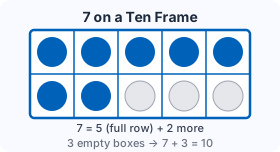 Ten frame showing 7: top row fully filled with 5 dots, bottom row has 2 dots and 3 empty boxes
The power of this layout is what the child sees without counting: a full row of 5, a partial row of 2, and 3 empty spaces. They've just learned three facts at once — 7 = 5 + 2, 7 is 3 away from 10, and 7 + 3 = 10.
Adding with Ten Frames: 8 + 5
This is where ten frames really shine. A student starts with 8 in one frame and 5 in another.
Step 1: Look at the first frame (8 dots). It has 2 empty boxes.
Step 2: Move 2 counters from the second frame (5) to fill the first frame to 10.
Step 3: The second frame now has 3 counters left.
Step 4: 10 + 3 = 13.
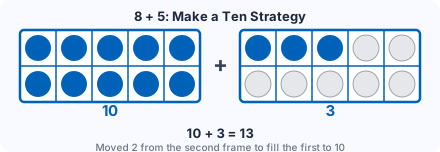 Double ten frame showing 8 + 5: first frame filled to 10, second frame shows 3 remaining, total is 13
This "make a 10" strategy is one of the most important mental math tools your child will learn. Instead of counting on from 8 five more times, they regroup the problem into something easier: 10 + 3.
For more on this strategy, see What Is a Number Line? A Parent's Guide to How Teachers Use It.
Ten Frames and Subtraction: 13 − 5
Subtraction works in reverse. Start with a double ten frame showing 13 (one full frame of 10 and 3 in the second). Remove 5 counters — take 3 from the second frame, then 2 from the first. Count what remains: 8.
The visual makes the regrouping natural. Children see that they "used up" the 3 first, then dipped into the full ten — which mirrors the borrowing concept they'll use later with larger numbers.
Ten Frames for Decimals: Showing 0.4
In upper elementary, the same grid gets a new label. The whole frame equals 1, and each box equals 0.1. To show 0.4, a student fills 4 boxes. They can see that 0.4 + 0.6 = 1.0 — the same "friends of 10" logic, now applied to decimals.
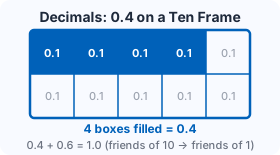 Ten frame showing 0.4 as a decimal: 4 of 10 boxes filled, each box labeled 0.1
For more on place value connections, see What Is Expanded Form? A Parent's Guide to Place Value.
How Ten Frames Connect to What You Already Know
You already think in groups of 10 without realizing it — ten frames just make that thinking visible.
When you count change, you naturally group coins toward a dollar (10 dimes). When you're packing a carton of eggs, you see the empty spaces and know how many more you need to fill 12 — same visual logic, different grid. When you estimate a tip at a restaurant, you probably round to the nearest 10 first, then adjust. That's the "make a friendly number" strategy that ten frames teach children to name and use deliberately.
Even your fingers are ten frames. Hold up 7 fingers and you instantly see 5 on one hand and 2 on the other — exactly what the grid shows. Your child's teacher is just giving that intuition a structure so kids can apply it on purpose, not just when things are easy.
The difference is that today's students are taught to recognize and name this way of seeing numbers, so they can apply it deliberately rather than only relying on memorized facts.
Watch: Ten Frames Explained
How to Help at Home
Use objects you already have
Grab buttons, coins, cereal pieces, or LEGO studs — anything small and countable. Draw a simple ten frame on paper (two rows, five columns) and let your child place objects in it. The physical act of filling boxes builds understanding faster than worksheets alone.
Ask "how many more to make 10?"
Every time your child places counters in a ten frame, ask this one question. It reinforces the "friends of 10" automatically. If they show 6, they'll see 4 empty boxes — and that 6 + 4 = 10 becomes obvious without memorization.
Fill from the top-left, row by row
Teachers typically teach children to fill the ten frame starting at the top-left and moving across the top row first, then the bottom row. If your child fills randomly, gently redirect: "Let's try filling across the top row first." Consistent placement is what makes the visual patterns work.
Don't rush to counting — let them see it
If your child pauses to look at the frame before answering, that's a good sign. They're subitizing — recognizing the quantity visually rather than counting each dot. Resist the urge to say "count them." Instead, try "what do you see?" or "how many do you think there are?"
Practice "make a 10" with two frames
Draw two ten frames side by side. Put 9 in the first and 4 in the second. Ask: "How could we move some dots to make the first frame full?" This is the exact strategy they'll use for addition in class.
Let Methodwise walk through it
When a ten frame problem comes home and you're not sure how to explain it the way the teacher would, try Methodwise. Type in the problem, pick your child's grade, and get a step-by-step explanation using the same method their teacher is using — including ten frames.
Common Mistakes to Watch For
Counting every dot instead of seeing the pattern
The whole purpose of a ten frame is to help children subitize — to see "5 and 2 more" at a glance instead of counting 1, 2, 3, 4, 5, 6, 7. If your child counts every dot, they're not wrong, but they're missing the tool's benefit. Slow down and ask "what do you notice?" rather than "how many?" The question shifts their focus from counting to pattern recognition.
Filling the frame in random order
If a child places counters scattered across the frame instead of filling row by row from the top-left, the visual patterns fall apart. They won't see "full row plus 2" if the dots are sprinkled everywhere. Gently establish the habit of filling across the top row first, then the bottom.
Forgetting what the empty boxes mean
Children sometimes focus only on the filled boxes and ignore the empties. But the empty boxes carry just as much information — they show how far the number is from 10. If a child shows 6 and can't quickly tell you how many more to make 10, practice drawing attention to the empty spaces: "How many boxes are waiting for a counter?"
Confusing "5 and some more" with the total
When a child sees a full top row and 3 in the bottom row, they might say "5" (reading the full row) instead of "8" (the total). This usually means they haven't quite internalized the two-part structure. Practice with small numbers first — show 3, then 5, then 7 — so they get used to reading the whole frame, not just one row.
Struggling to transfer to double ten frames
Moving from one ten frame to two (for numbers 11–20) is a genuine leap. Some children get confused about which frame to fill first or how to "move" counters from one to the other. Use physical counters — the act of physically picking up a counter and moving it to the other frame makes the strategy concrete.
Practice Questions
Try these with your child. Answers are below.
Ten frame basics (Kindergarten):
- Draw a ten frame and show the number 5. How many empty boxes are left?
- Show 9 on a ten frame. How many more counters do you need to make 10?
- If a ten frame has 4 empty boxes, how many dots are in the frame?
Addition with ten frames (1st–2nd Grade):
- Use the "make a 10" strategy: 7 + 5. How many do you move to fill the first frame? What's left over?
- 9 + 6: Fill the first frame to 10. How many remain in the second frame? What's the total?
- Draw two ten frames to show 8 + 4. What's the answer?
Challenge (2nd–3rd Grade):
- 14 − 6: Start with a double ten frame showing 14. Remove 6. What's left?
- If one full ten frame represents 1, and 3 boxes are filled, what decimal does that show?
Answers
- 5 empty boxes remain (top row full, bottom row empty)
- 1 more counter (9 + 1 = 10)
- 6 dots (10 − 4 = 6)
- Move 3 from the 5 to fill 7 to 10. Left over: 2. Total: 10 + 2 = 12
- Move 1 to fill 9 to 10. Remaining: 5. Total: 10 + 5 = 15
- Move 2 from the 4 to fill 8 to 10. Remaining: 2. Total: 10 + 2 = 12
- Remove 4 from the second frame (leaving 0), then 2 from the first frame. Left: 8
- 0.3 (3 out of 10 boxes = 3 tenths)
Ready to try it with your child?
Open the chat, pick the subject and your child's grade, and get a step-by-step explanation you can use to help tonight.
Try 3 Questions Free — No Signup RequiredFrequently Asked Questions
Are ten frames only used in kindergarten and 1st grade?
No — ten frames come back in 3rd through 5th grade when teachers introduce decimals. A ten frame showing 7 filled boxes becomes a model for 0.7 (seven-tenths). Students also use double ten frames (two grids, up to 20) in 1st and 2nd grade for addition and subtraction. The tool stays the same; what it represents changes as the math gets more complex.
What grade do kids start using ten frames?
Most students are introduced to ten frames in kindergarten. They continue using them through 1st and 2nd grade for addition and subtraction, and some teachers bring them back in 3rd–5th grade to teach decimals, tenths, and place value patterns.
Why do teachers use ten frames instead of just counting?
Ten frames help children recognize quantities at a glance (called subitizing) instead of counting one by one. They also build an automatic sense of how numbers relate to 5 and 10 — which becomes the foundation for mental math, regrouping, and place value.
How can I help my child practice ten frames at home?
Use small objects like buttons, coins, or cereal pieces as counters, and draw a simple two-row, five-column grid on paper. Ask your child to show different numbers, then ask 'how many more to make 10?' You can also try Methodwise for step-by-step homework help that matches your child's classroom methods.
Do ten frames only go up to 10?
No. While a single ten frame holds 10, teachers use double ten frames (two grids side by side) to work with numbers up to 20. In upper grades, the same ten-box structure can represent tenths when the whole frame equals 1.
Try Methodwise Free
When your child brings home ten frame homework and you're not sure how to explain it the way their teacher would, Methodwise walks you through it — step by step, using the same method their teacher is using.
- Start with 3 free questions — no account needed
- Free plan: 15 questions/month after signup
- Plus plan: unlimited questions + saved chat history + 7-day free trial
- Step-by-step explanations the way teachers teach
Related Articles
-
What Is Decomposing Numbers? A Parent's Guide to Breaking Apart Numbers
-
What Is the Area Model? A Parent's Guide to Box Multiplication
-
What Is a Number Line? A Parent's Guide to How Teachers Use It
-
What Are Number Bonds? A Parent's Guide to Making and Breaking Numbers
-
What Is Partial Sums Addition? A Parent's Guide to Why Your Child Doesn't 'Carry the One' Anymore
-
What Is a Tape Diagram? A Parent's Guide to Visualizing Word Problems
-
What Is Partial Quotients Division? A Parent's Guide to the New Way Kids Learn Long Division
-
What Are Common Core Math Methods? A Parent's Guide to How Math Is Taught Today
-
What Are Arrays in Math? A Parent's Guide to Visualizing Multiplication
-
Homework Help Tools: Built for Kids vs. Built for Parents — What's the Difference?
-
What Are Fact Families? A Parent's Guide to How Addition and Subtraction Connect
-
What Is the Standard Algorithm? A Parent's Guide to Why Your Child Learns the 'Long Way' First
-
Fractions on a Number Line: A Parent's Guide to Why Pie Charts Aren't Enough
-
What Are Ratios and Proportional Reasoning? A Parent's Guide to Middle School Math
-
What Is Skip Counting? A Parent's Guide to How Counting by 2s, 5s, and 10s Becomes Times Tables
-
What Math Will My Child Learn This Year? A Parent's Guide to K-8 Math Methods by Grade
-
What Are Mental Math Strategies? A Parent's Guide to How Kids Add and Subtract in Their Heads
Have questions about ten frames? Email me at hello@methodwise.co
About the Author
Samantha Black is the founder of Methodwise and an educator with over 15 years in higher education and instructional design. She built Methodwise after experiencing the homework gap firsthand as a parent of two K–8 daughters. Learn more about why we built Methodwise →