
Summarizing vs. Retelling: A Parent's Guide to Why the Teacher Keeps Saying 'Too Many Details'
June 15, 2026
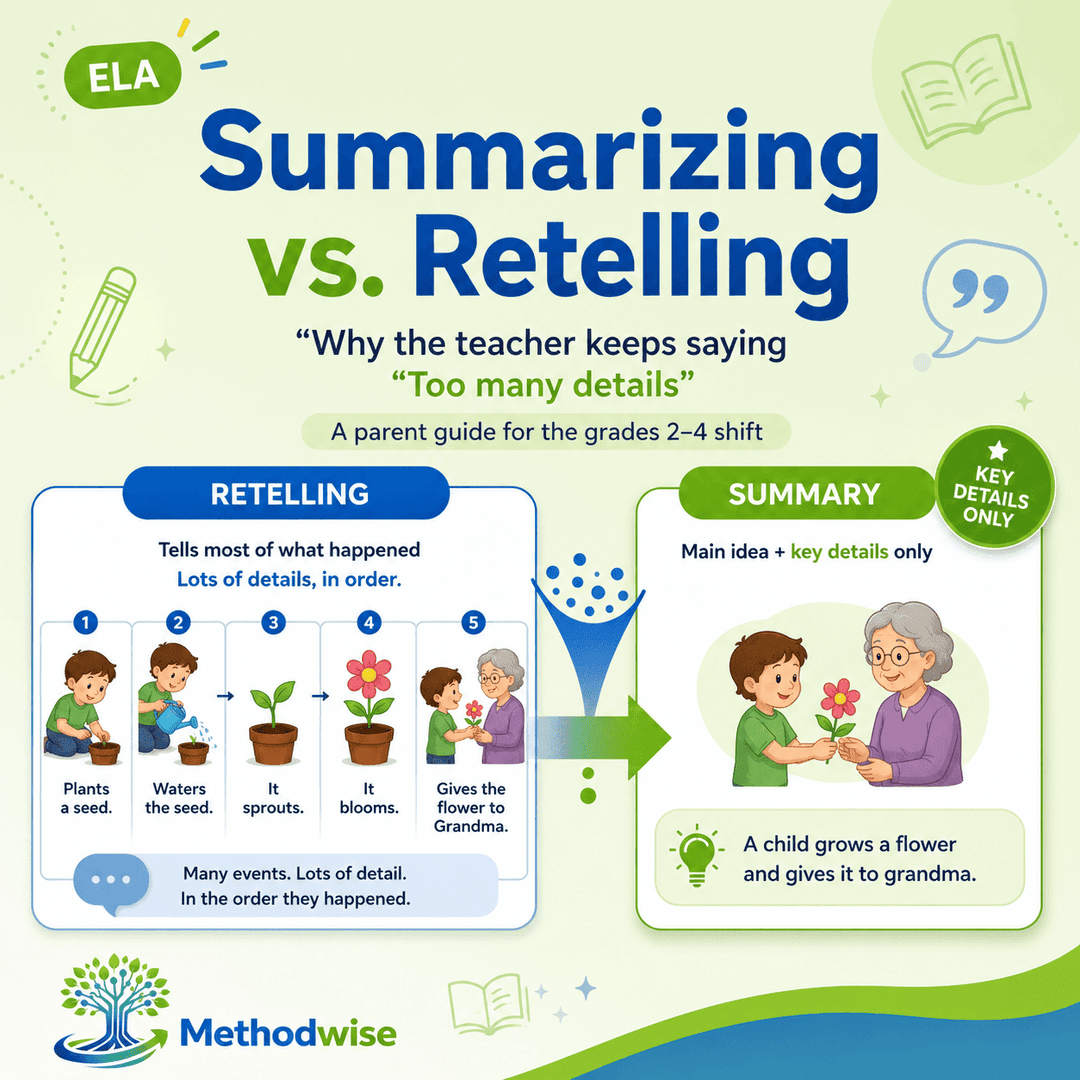
Your child brings home a reading assignment that asks them to "summarize the story in 2–3 sentences." You sit down together, they tell you everything they remember, and you help them shape it into nine clear sentences that hit every event in order. The next day it comes back with "Too many details, try again" written across the top. If you've stared at that note wondering what the teacher actually wants, you've run into the gap between retelling and summarizing. They sound interchangeable. In a 2nd, 3rd, or 4th grade classroom, they're two different tasks.
What Is Summarizing? How Is It Different from Retelling?
A summary is a short version of a text that includes only the most important information: who the story is about, what they wanted, what happened, and how it ended. A summary for a grades 2–3 student is usually two or three sentences. For grades 4–5, it's three to five.
A retelling is different. Retelling means recounting the events of the story in order, with enough specific detail that someone who hadn't read it would know what happened. Retellings can be short or long, but they include sequence and they usually include details that aren't strictly essential.
The contrast a teacher is looking for: a retelling answers "what happened in the story?" A summary answers "what is the story about?"
Stuck on tonight's homework?
Paste in the problem and get a step-by-step explanation in your child's grade level — using the same method their teacher uses.
Try 3 Questions Free — No Signup RequiredWhy Do Teachers Ask for Summaries Instead of Retellings?
In kindergarten and 1st grade, retelling is the goal. Teachers want students to recount stories with beginning, middle, and end, including key details. The work of those grades is learning to hold a story in your head and put the events in order.
Around 2nd grade, the work shifts. Once students can retell, teachers start asking them to figure out which parts of the story matter most. That skill, deciding which details support the central message and which don't, is summarizing. It's the foundation for everything that comes after it: identifying themes, comparing texts, taking notes in a content area, writing analytical essays.
A teacher who writes "too many details" is telling you that your child's retelling skill is intact. They can recount the story. What the assignment is testing now is the next skill up: filtering.
What Grade Is Summarizing Taught?
The shift from retelling to summarizing is gradual and happens across roughly three grade bands.
Kindergarten–1st Grade: Retelling with Key Details
Students focus on retelling familiar stories with beginning, middle, and end. The classroom language is "retell" or "tell me what happened." A first-grader might say: "First the wolf went to the first pig's house. Then he blew it down. Then he went to the next house..." Including the events in order is the goal, and longer is generally fine.
2nd–3rd Grade: The Transition
This is where parent confusion typically starts. The standards ask students to recount stories and determine the central message (RL.2.2), then gradually shift toward summarizing. Teachers ask for shorter, more focused responses. Some worksheets say "summarize" but accept a controlled retelling. Others ask explicitly for two to three sentences. By the end of 3rd grade, most students are expected to produce a true short summary.
4th–5th Grade: Formal Summarizing
The standards explicitly require students to "summarize the text" without including personal opinions or unimportant details. Summaries get longer (three to five sentences), and students start summarizing nonfiction as well as fiction. They're also expected to identify the theme and explain how key details support it.
Middle School and Beyond
Summarizing becomes a sub-skill of analysis. Students summarize a paragraph as part of a longer essay, summarize a chapter for a study guide, or summarize a source they're citing in research. By this point, "too many details" is no longer about word count. It's about choosing the details that serve the argument.
If your child is being asked to summarize at any of these stages, the assignment is part of a deliberate progression in reading comprehension.
How Summarizing Works
Compare a retelling and a summary of the same story, and the difference is easy to see.
Example 1: A Familiar Picture Book ("The Three Little Pigs")
A retelling looks like this:
Three pigs left home to build houses. The first pig built a house out of straw. The second pig built a house out of sticks. The third pig built a house out of bricks. A wolf came and blew down the straw house. The first pig ran to the stick house. The wolf blew down the stick house. Both pigs ran to the brick house. The wolf couldn't blow down the brick house. He tried to come down the chimney and landed in a pot of boiling water. The pigs were safe.
A summary of the same story looks like this:
Three pigs build houses out of straw, sticks, and bricks. A wolf blows down the first two, but the brick house holds. The pigs are safe because the third pig built something strong.
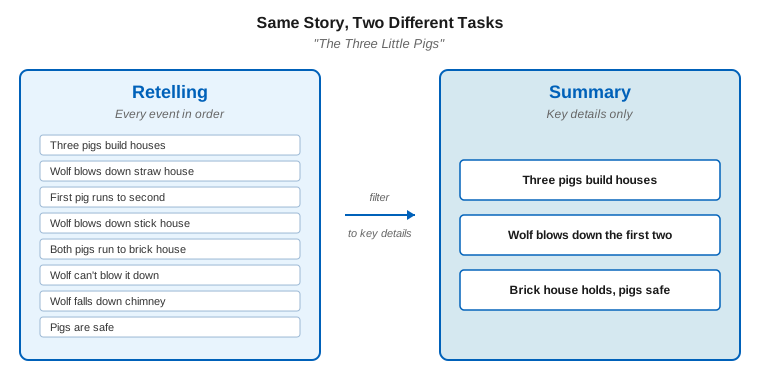 Side-by-side comparison: a retelling of The Three Little Pigs lists eight events in order, while a summary captures the same story in three sentences focused on who, what, and how it ended.
Notice what's missing from the summary: how each house got built, which pig ran where, what happened in the chimney. Notice what's there: who the story is about (three pigs), what the central conflict is (the wolf), and how it ends (the brick house holds). The summary tells you what the story is about. The retelling walks you through the events.
The rule of thumb that drives every grade-level version of this assignment looks like this:
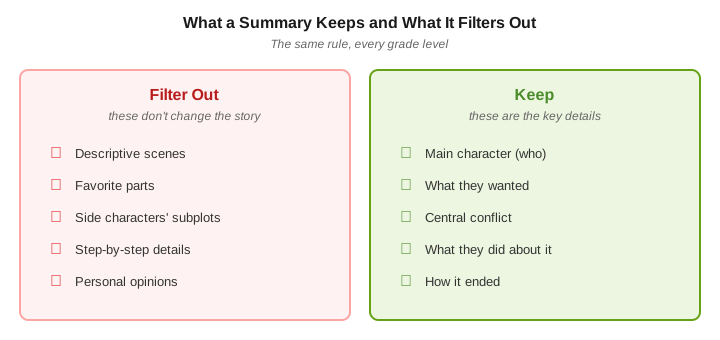 A two-column comparison: the Filter Out side lists descriptive scenes, favorite parts, side characters' subplots, step-by-step details, and personal opinions. The Keep side lists main character, what they wanted, central conflict, what they did about it, and how it ended.
Example 2: A Chapter from a Novel ("Charlotte's Web," the chapter at the fair)
A retelling-style answer:
Wilbur went to the fair with Charlotte and the other animals. They got to their pen and there was another pig there named Uncle. Fern went off with Henry Fussy. Charlotte was tired but she made a new web. The web said "Humble." Wilbur was nervous about the judging. He won a special prize even though Uncle won a blue ribbon. They got a medal.
A summary:
Wilbur is taken to the county fair to compete. Charlotte, weak but determined, spins one last web that helps Wilbur win a special prize. The chapter shows that Charlotte's friendship is what saves him.
The retelling lists the events. The summary names what the chapter is doing in the story: Charlotte's friendship saving Wilbur is the central idea, and the prize is the evidence.
Identifying the central idea of a chapter usually involves an inference. For more on how teachers help kids read between the lines, see What Is Making Inferences? A Parent's Guide to Reading Between the Lines.
Example 3: The "Somebody-Wanted-But-So-Then" Frame
Teachers in grades 2–5 often use a five-part scaffold to help students build a summary:
- Somebody: who the main character is
- Wanted: what they wanted or needed
- But: what got in the way
- So: what they did about it
- Then: how it ended
Applied to "Cinderella":
Somebody Cinderella wanted to go to the ball, but her stepmother wouldn't let her. So her fairy godmother helped her go in disguise, then the prince found her and she became a princess.
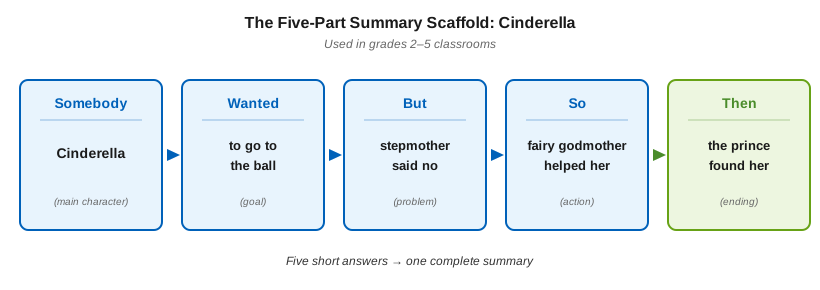 Five connected boxes showing the somebody-wanted-but-so-then scaffold applied to Cinderella: Cinderella, to go to the ball, stepmother said no, fairy godmother helped her, the prince found her.
That's a complete five-part summary in one sentence. It works because every word is doing the job of identifying who, want, conflict, response, and ending. Nothing else is in there.
A good summary depends on reading carefully enough to spot which details are doing the work. For more on the slow, deliberate reading practice that builds this skill, see What Is Close Reading? A Parent's Guide to Deeper Comprehension.
How Summarizing Connects to What You Already Know
You summarize all the time. You just don't call it that.
When a friend asks what a movie was about, you don't recite the plot scene by scene. You say something like "It's about a girl who finds out her family used to run a magic shop, and she has to decide whether to keep the business going." That's a summary. Three sentences max. Who, want, central conflict.
When you tell your partner what happened on a work call, you give them the headline first, then maybe one or two details that matter. "The contract got pushed to next quarter because legal wants another review." You're filtering automatically. You leave out who said what, who joined late, what the small talk was. You include only what they need to know to understand the outcome.
When you read a recipe and tell your kid "we're making pasta with garlic and tomatoes," you've summarized a 25-line recipe in eight words. You kept the topic and the most important features.
The difference between this and what your child is being asked to do is that today's students are taught to recognize and name this skill, so they can apply it deliberately when a teacher asks for it, rather than only doing it when the conversation calls for it.
Watch: Summarizing vs. Retelling Explained
How to Help at Home
Use the teacher's exact words
If the assignment says "summarize," resist the urge to translate it into "tell me about." The vocabulary is doing real work. When your child knows the word "summary" means short and focused, they'll start to recognize the assignment even when the wording changes.
Set the length before they start writing
A summary in grades 2–3 is two to three sentences. In grades 4–5, three to five. Tell your child the target up front, and write the sentence numbers on a scrap of paper (1. 2. 3.) before they begin. The constraint forces them to choose what matters. Without a length cap, kids default to retelling because retelling has no natural stopping point.
Use the somebody-wanted-but-so-then scaffold
This is the frame most teachers use in class. Have your child fill in each part out loud before writing: "Who is the story about? What did they want? What got in the way? What did they do? How did it end?" Five short answers turn into a five-sentence summary, or compress into a single sentence. Either format is valid.
Validate the detail before redirecting it
When your child wants to include a favorite scene that isn't essential, don't say "we don't need that." Say "that's a great detail. Save it for when we talk about the book later. For the summary, we're only including the parts that change what happens." The detail isn't wrong; it just belongs somewhere else.
Read the first and last paragraphs again
Most stories signal their central conflict in the opening paragraph and resolve it in the closing one. If your child can paraphrase those two paragraphs, they have the bones of the summary. The middle gets filtered through the somebody-wanted-but-so-then scaffold.
Let Methodwise walk through it
When the assignment is unfamiliar or your child is stuck, Methodwise can model a grade-appropriate summary for the story they read, using the same scaffold their teacher is likely using. Open the chat, paste in the story title or the worksheet question, and you'll see what a 2nd, 3rd, or 4th grade summary should look like.
Common Mistakes to Watch For
Treating the summary as a shorter retelling
A common pattern: students cut their retelling in half and turn it in as a summary. The fix is to start over from the scaffold (who, wanted, but, so, then), not from the retelling. A summary is built from the central idea outward, not from the event list inward.
Including the favorite scene
When a student loved a specific moment, they will fight to include it. If the scene doesn't change what happens or who the story is about, it's a detail, not a key detail. Help them name that distinction without judging the scene itself.
Copying sentences directly from the text
A copied sentence is rarely the right summary sentence, because authors don't write summaries of their own work into their own prose. If your child is highlighting a sentence to use word-for-word, ask them to put it in their own words first, then check whether it's still essential.
Adding their opinion
"This story was about a girl who loved her dog and it was so sad when he died" is not a summary. The "so sad" part is the reader's response, not the story's content. Summaries describe what happened in the text, not how the reader felt about it.
Forgetting who the main character is
Students sometimes summarize the plot without naming the main character, especially with short fables or fairy tales. A summary that starts "A wolf tried to blow down houses" is missing the fact that the story is about the pigs. The main character's goal is what gives a summary its shape.
Practice Questions
Try these with your child. Read the story together first, then attempt the summary.
Grades 2–3: Use a familiar picture book (Goldilocks and the Three Bears, The Tortoise and the Hare, etc.)
- Write a two-sentence summary of the story. Include who the story is about and how it ended.
- Fill in the somebody-wanted-but-so-then scaffold for the same story.
Grades 4–5: Use a recent chapter book or a short story from class
- Write a four-sentence summary of the chapter. Include the main character, what they wanted, the main problem, and the outcome.
- Read your summary back and circle any words that describe how you felt about the story. Cross them out and rewrite without them.
Mixed practice (any grade):
- Pick a movie everyone in the house has watched. Each family member writes a two-sentence summary independently. Compare the summaries. Which details did everyone include? Which did some leave out?
Answers
- Sample for "Goldilocks and the Three Bears": "A girl named Goldilocks went into the bears' house and tried their food, chairs, and beds. When the bears came home and found her, she ran away."
- Somebody: Goldilocks. Wanted: a place to rest and eat. But: the house belonged to a family of bears. So: she tried each of their things until she fell asleep. Then: the bears came home and she ran away.
- Answers will vary by chapter. Look for: a named main character, a clear want or problem, the central conflict, and the resolution. If any one of those is missing, the summary needs another sentence.
- Common opinion words to cross out: "so sad," "really funny," "boring," "best part," "I liked," "scary," "exciting."
- Most family members will include who the movie is about and how it ended. Differences usually show up in which middle event each person included. That's the point: the middle events are where retelling expands and summarizing contracts.
Ready to try it with your child?
Open the chat, pick the subject and your child's grade, and get a step-by-step explanation you can use to help tonight.
Try 3 Questions Free — No Signup RequiredFrequently Asked Questions
Is summarizing the same as finding the main idea?
They're close cousins, not the same thing. The main idea is a single sentence about what the text is mostly about. A summary uses the main idea as its backbone and adds two or three of the most important supporting details. You can think of the main idea as the spine of a summary and the supporting details as the ribs.
How long should a summary be?
For grades 2–3, two to three sentences is the standard target. For grades 4–5, three to five sentences. For middle school, a short paragraph. A useful rule of thumb: if your child's summary is the same length as the original passage, it's a retelling.
Does summarizing work the same way for nonfiction?
The skill is the same, but the structure is different. For fiction, a summary often follows somebody-wanted-but-so-then. For nonfiction, a summary names the topic and the two or three most important facts the author wants the reader to know. Nonfiction summaries also leave out examples and stay focused on the central claim.
How can I tell if my child's summary is the right length and content?
Read it out loud as if you'd never seen the story. Ask yourself: would another adult understand what the story was about? If they'd have follow-up questions like 'who was the main character?' or 'how did it end?' the summary is missing key details. If they could repeat it back without effort, the length and content are right.
Why is my child being asked to summarize when they've barely finished reading?
Summarizing is the comprehension check. Teachers use it to see whether the student actually understood what they read, not just whether they finished the pages. That's why a long retelling doesn't satisfy the assignment, even when every detail is accurate. The shorter and more focused the response, the more clearly it shows that the student understood what mattered.
Try Methodwise Free
When your child brings home a "summarize this story" assignment and you're not sure how short the teacher actually wants, Methodwise walks you through it, step by step, using the same scaffold their teacher is using in class.
- Start with 3 free questions, no account needed
- Free plan: 15 questions/month after signup
- Plus plan: unlimited questions + saved chat history + 7-day free trial
- Step-by-step explanations the way teachers teach
Related Articles
-
What Is Making Inferences? A Parent's Guide to Reading Between the Lines
-
What Is Close Reading? A Parent's Guide to Deeper Comprehension
-
Main Idea vs. Theme: What Your Child's Teacher Actually Means
-
What Is Text Structure? A Parent's Guide to How Nonfiction Is Organized
-
Reading Comprehension Strategies: A Parent's Guide to How Teachers Teach Reading
-
What Is Citing Evidence? A Parent's Guide to Text Evidence in Reading and Writing
-
Opinion Writing vs. Argument Writing: A Parent's Guide to the K–8 Writing Progression
-
Author's Purpose vs. Point of View: A Parent's Guide to PIE, Narrators, and Perspective
-
What Are Text Features? A Parent's Guide to Nonfiction Reading
-
Reading Levels Explained: Lexile, F&P, and DRA in Plain English
-
What Are Context Clues? A Parent's Guide to How Kids Figure Out New Words Without a Dictionary
-
Homework Help Tools: Built for Kids vs. Built for Parents — What's the Difference?
-
What Are Story Elements? A Parent's Guide to Characters, Setting, Problem, and Solution
-
What Is Phonemic Awareness? A Parent's Guide to Playing With Sounds Before Reading
Have questions about summarizing and retelling? Email me at hello@methodwise.co
About the Author
Samantha Black is the founder of Methodwise and an educator with over 15 years in higher education and instructional design. She built Methodwise after experiencing the homework gap firsthand as a parent of two K–8 daughters. Learn more about why we built Methodwise →