
What Is Phonemic Awareness? A Parent's Guide to Playing With Sounds Before Reading
July 19, 2026
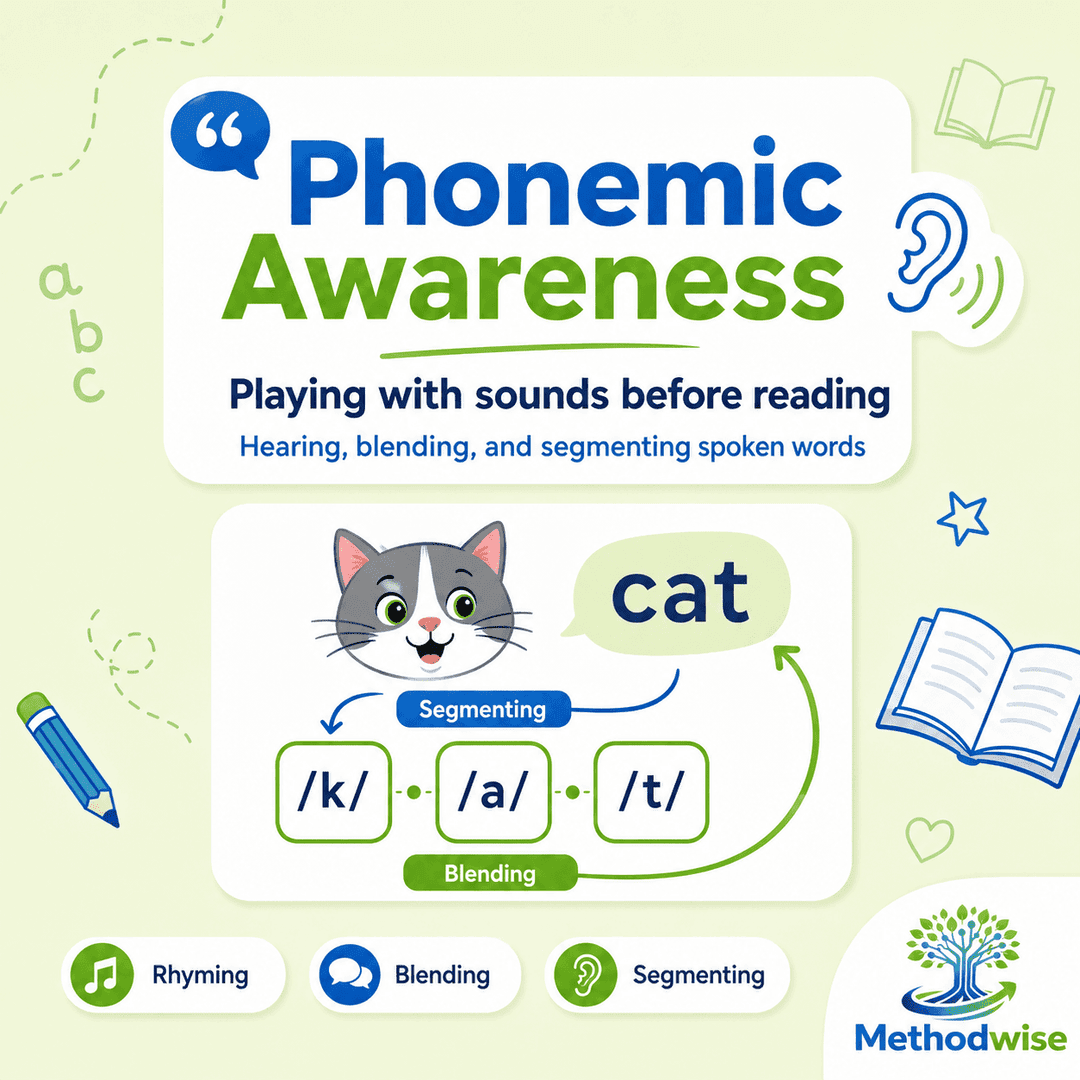
The note home from your kindergartner's teacher says the class is working on "phonemic awareness." Maybe your child has started tapping out words at dinner, holding up three fingers for c-a-t, or announcing that "sun" and "fun" rhyme. There are no letters on the page yet, which can make it feel like the reading part hasn't started. It has. This is the piece that makes the letters work later.
What Is Phonemic Awareness?
Phonemic awareness is the ability to hear and play with the individual sounds in spoken words. Those individual sounds are called phonemes, and they are the smallest units of sound in a language. The word "cat" has three of them: /k/ /a/ /t/. "Sit" has three too: /s/ /i/ /t/. A child with strong phonemic awareness can pull a spoken word apart into its sounds, push the sounds back together into a word, and swap one sound for another, all by ear.
You may also hear the broader term phonological awareness. That is the umbrella: hearing rhymes, clapping syllables, and noticing that two words start the same. Phonemic awareness is the most advanced piece under that umbrella, the part focused on single sounds. Both live entirely in the ears. No print required.
Stuck on tonight's homework?
Paste in the problem and get a step-by-step explanation in your child's grade level — using the same method their teacher uses.
Try 3 Questions Free — No Signup RequiredWhy Do Teachers Teach Phonemic Awareness?
Reading in English works by mapping sounds to letters. To read "map," a child has to hear that the spoken word is made of /m/ /a/ /p/, then connect each sound to a letter. If the sounds inside a word are a blur, the letters have nothing to attach to. That is why teachers build the ear first, often before and alongside the letters themselves.
Reading research keeps pointing the same direction: how well a young child can hear and move sounds around strongly predicts how reading will go. Practicing it early gives every child a smoother start.
Many of us learned to read by sight, memorizing words as whole shapes and sounding things out only when we got stuck. Today's classrooms make the sound work explicit and deliberate from the very beginning. The reading you are aiming for is the same reading you did as a kid. The path just starts in the ear.
What Grade Is Phonemic Awareness Taught?
Preschool and Pre-K: Big chunks of sound
The earliest sound work uses large, easy-to-hear pieces. Children clap the syllables in "ba-na-na," fill in the rhyme at the end of a familiar book, and notice when words start the same way ("silly snake"). Nursery rhymes and singalongs are doing real work here, not just passing time.
Kindergarten: Individual sounds
This is the year the sounds get small. Kindergartners blend sounds into words (/s/ /u/ /n/ becomes "sun"), break words back into sounds ("map" becomes /m/ /a/ /p/), and pick out the first, middle, and last sound in short words. This is what Common Core lists under RF.K.2, and it is the heart of phonemic awareness. Letters begin joining the sounds toward the end of the year.
1st Grade: Every sound, and moving them around
First graders segment all the sounds in a word in order and start rearranging them. Take the /s/ off "smile" to get "mile." Change the /h/ in "hat" to /m/ to make "mat." By now most of this happens with letters attached, as phonics, so the ear work and the print work reinforce each other.
If your child is working with sounds at any of these stages, it is developmentally appropriate and part of a deliberate progression. Phonemic awareness gets the sounds ready, phonics attaches the letters, and from there the work shifts toward understanding what the words mean.
For how schools measure reading once it clicks, see What Are Reading Levels? A Parent's Guide to Lexile, F&P, and DRA Scores.
How Phonemic Awareness Works
The sound work moves from big pieces to single sounds. Here are the four moves you will see most, roughly in the order kids build them.
Rhyming and word families
Split a word into its first sound (the onset) and the rest of the word (the rime). "Cat" is /k/ plus "at." Keep the "at" and swap the first sound, and you get a whole family: cat, hat, bat, sat. Hearing that the "at" stays put while the front changes trains the ear to notice chunks, and those chunks become spelling patterns down the road.
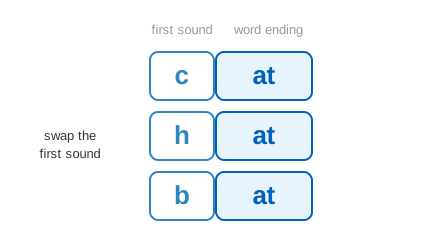 Onset and rime: the words cat, hat, and bat split into a changing first sound and the shared ending "at"
Blending sounds into a word
The teacher says the sounds slowly, and the child pushes them together into a word. /s/ /u/ /n/ becomes "sun." This is exactly what "sounding out" will feel like once letters are attached, so blending by ear now makes decoding easier later.
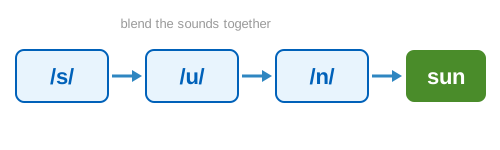 Blending: the separate sounds /s/, /u/, and /n/ combine into the word sun
Breaking a word into sounds
This is blending in reverse. The child hears "map" and taps out /m/ /a/ /p/, one tap per sound. Teachers often use a row of small boxes, one box per sound, so children can push a chip into each box as they say it. Segmenting like this is the sound skill most connected to spelling.
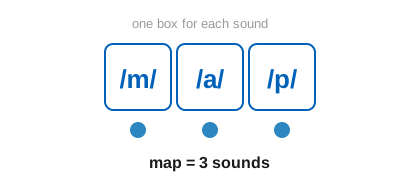 Segmenting: the word map broken into three sound boxes, one for /m/, one for /a/, and one for /p/
Changing the sounds
The most advanced move is adding, removing, or swapping a sound. Take the /p/ off "pot" to get "ot." Change the /k/ in "cot" to /d/ to make "dot." This is the bridge into spelling and word study, and it is usually happening with letters by first grade.
How Phonemic Awareness Connects to What You Already Know
You have been building this with your child for years without naming it.
- Nursery rhymes and Dr. Seuss. Every "cat in the hat" and "green eggs and ham" is rhyme practice. You have been feeding the sound-pattern part since board books.
- "I spy something that starts with /b/." When you play this in the car, you are asking your child to isolate the first sound in a word, which is a core kindergarten skill.
- Sounding out a name you have never seen. At a school event, you hit an unfamiliar last name and blend it slowly, sound by sound. That is blending, the same move your kindergartner is practicing.
- Clapping out a name, or making up Pig Latin. Pulling "Isabella" into I-sa-bel-la, or turning "pig" into "ig-pay," is taking words apart by sound for fun.
The difference is that today's students are taught to recognize and name this sound work, so they can apply it deliberately rather than only reaching for it when a word gets hard.
Watch: Phonemic Awareness Explained
How to Help at Home
Play with sounds where you already are
Car rides, bath time, and waiting rooms are perfect. Ask "what rhymes with cake?", play "I spy something that starts with /f/," or clap the syllables in everyone's name at dinner. Two or three minutes counts, and short and frequent beats long and occasional.
Tap out the sounds in short words
Pick a small word, say it slowly, and hold up one finger for each sound. "Sock: /s/ /o/ /k/, three sounds." Let your child tap along with you. Blocks, coins, or pieces of cereal make good one-per-sound markers if you want something to move.
Keep it in the ears, not on the page
None of this needs letters or worksheets. If your child wants to connect a sound to a letter, follow their lead, but the listening games stand on their own and are the whole point at this stage.
Use the words the teacher uses
If the class says "sounds," "blend," and "segment," use those same words at home. When home and school share the language, your child isn't translating between two different systems during homework.
Model instead of correcting on the spot
If your child says "cat" has two sounds, hold off on the quick "no." Say the word slowly together and tap it out: "/k/ /a/ /t/, let's count them." Reps and confidence build this skill, and a fast correction tends to shut the game down.
Let Methodwise walk through it
When a note home mentions a sound skill you are not sure how to practice, ask Methodwise. It explains the skill in plain language and hands you the exact game or prompt to try, matched to your child's grade.
Common Mistakes to Watch For
Adding a vowel to consonant sounds
The most common slip at home is saying "buh," "cuh," and "duh" instead of the clean /b/, /k/, and /d/. That extra "uh" makes blending harder, because "buh-a-tuh" doesn't sound much like "bat." Clip consonant sounds short.
Treating it as the same thing as phonics
Phonemic awareness is the ear work, and phonics attaches letters to those sounds. They partner up quickly, but a child can hear sounds well before knowing many letters, and can name letters without yet hearing the sounds inside words.
Assuming the alphabet means it is covered
Knowing letter names (ay, bee, see) is a different skill from hearing that "bat" starts with /b/. A child can sing the ABCs perfectly and still be in the early stages of the sound work.
Expecting reading to follow right away
Phonemic awareness is the runway, not the takeoff. It prepares the ear so that when letters arrive, decoding clicks into place. The payoff shows up over the year, so give it time.
Panicking over rhyming
Some children take longer to hear rhymes, and that by itself is not a diagnosis. Keep playing the games. If by the middle of kindergarten your child still cannot hear or produce simple rhymes or first sounds, mention it to the teacher. It is worth a closer look, not a reason to worry.
Practice Questions
Try these out loud with your child. There are no letters needed, just ears. Answers are below.
Rhyme and syllables (Preschool–Kindergarten):
- Which word rhymes with "cat": dog, hat, or sun?
- Clap the syllables in "banana." How many are there?
Blending and segmenting (Kindergarten):
- Blend these sounds together: /m/ /a/ /p/. What word is it?
- Say the three sounds in "sun," one at a time.
Changing sounds (1st grade):
- Say "cat" without the /k/. What is left?
- Change the /h/ in "hat" to /m/. What new word do you get?
Answers
- hat
- ba-na-na, 3 syllables
- map
- /s/ /u/ /n/
- "at"
- mat
Ready to try it with your child?
Open the chat, pick the subject and your child's grade, and get a step-by-step explanation you can use to help tonight.
Try 3 Questions Free — No Signup RequiredFrequently Asked Questions
Is phonemic awareness the same as phonics?
No. Phonemic awareness is oral: hearing and working with the sounds in spoken words, with no letters involved. Phonics connects those sounds to the letters that spell them. In kindergarten, kids often build both at the same time, but they are different skills, and the sound work usually comes first.
What is the difference between phonological awareness and phonemic awareness?
Phonological awareness is the umbrella term for hearing sound patterns in speech: rhymes, syllables, and individual sounds. Phonemic awareness is the narrowest and most advanced part of that umbrella, focused on the individual sounds (phonemes) inside words, like hearing that 'cat' is /k/ /a/ /t/.
My child knows all the letters but can't hear the sounds in words. Is that normal?
Yes. Knowing letter names is a separate skill from hearing the sounds inside spoken words. A child can sing the alphabet and still be building the ability to break 'sun' into /s/ /u/ /n/. Keep playing oral sound games; the two skills grow together over the kindergarten year.
Do I need flashcards or an app to practice this?
No. The strongest practice is oral and playful. Rhyming games, 'I spy something that starts with /f/,' and tapping out the sounds in short words do more than any worksheet. A few minutes in the car or the bath adds up quickly.
When should I be concerned about my child's sound skills?
If by the middle or end of kindergarten your child still cannot hear or produce simple rhymes, isolate the first sound in a word, or blend two or three sounds into a word, mention it to the teacher. It is worth a closer look, not a cause for alarm, and early support works well.
Try Methodwise Free
When your child brings home a sound skill like blending or segmenting and you are not sure how to practice it the way their teacher would, Methodwise walks you through it, step by step, using the same method their teacher is using.
- Start with 3 free questions, no account needed
- Free plan: 15 questions/month after signup
- Plus plan: unlimited questions + saved chat history + 7-day free trial
- Step-by-step explanations the way teachers teach
Related Articles
-
What Are Story Elements? A Parent's Guide to Characters, Setting, Problem, and Solution
-
Summarizing vs. Retelling: A Parent's Guide to Why the Teacher Keeps Saying 'Too Many Details'
-
Reading Comprehension Strategies: A Parent's Guide to How Teachers Teach Reading
-
Reading Levels Explained: Lexile, F&P, and DRA in Plain English
-
What Is Making Inferences? A Parent's Guide to Reading Between the Lines
-
Main Idea vs. Theme: What Your Child's Teacher Actually Means
-
What Is Close Reading? A Parent's Guide to Deeper Comprehension
-
What Is Citing Evidence? A Parent's Guide to Text Evidence in Reading and Writing
-
Opinion Writing vs. Argument Writing: A Parent's Guide to the K–8 Writing Progression
-
Author's Purpose vs. Point of View: A Parent's Guide to PIE, Narrators, and Perspective
-
What Is Text Structure? A Parent's Guide to How Nonfiction Is Organized
-
What Are Text Features? A Parent's Guide to Nonfiction Reading
-
What Are Context Clues? A Parent's Guide to How Kids Figure Out New Words Without a Dictionary
-
Homework Help Tools: Built for Kids vs. Built for Parents — What's the Difference?
Have questions about phonemic awareness? Email me at hello@methodwise.co
About the Author
Samantha Black is the founder of Methodwise and an educator with over 15 years in higher education and instructional design. She built Methodwise after experiencing the homework gap firsthand as a parent of two K–8 daughters. Learn more about why we built Methodwise →