
What Is Text Structure? A Parent's Guide to How Nonfiction Is Organized
May 25, 2026
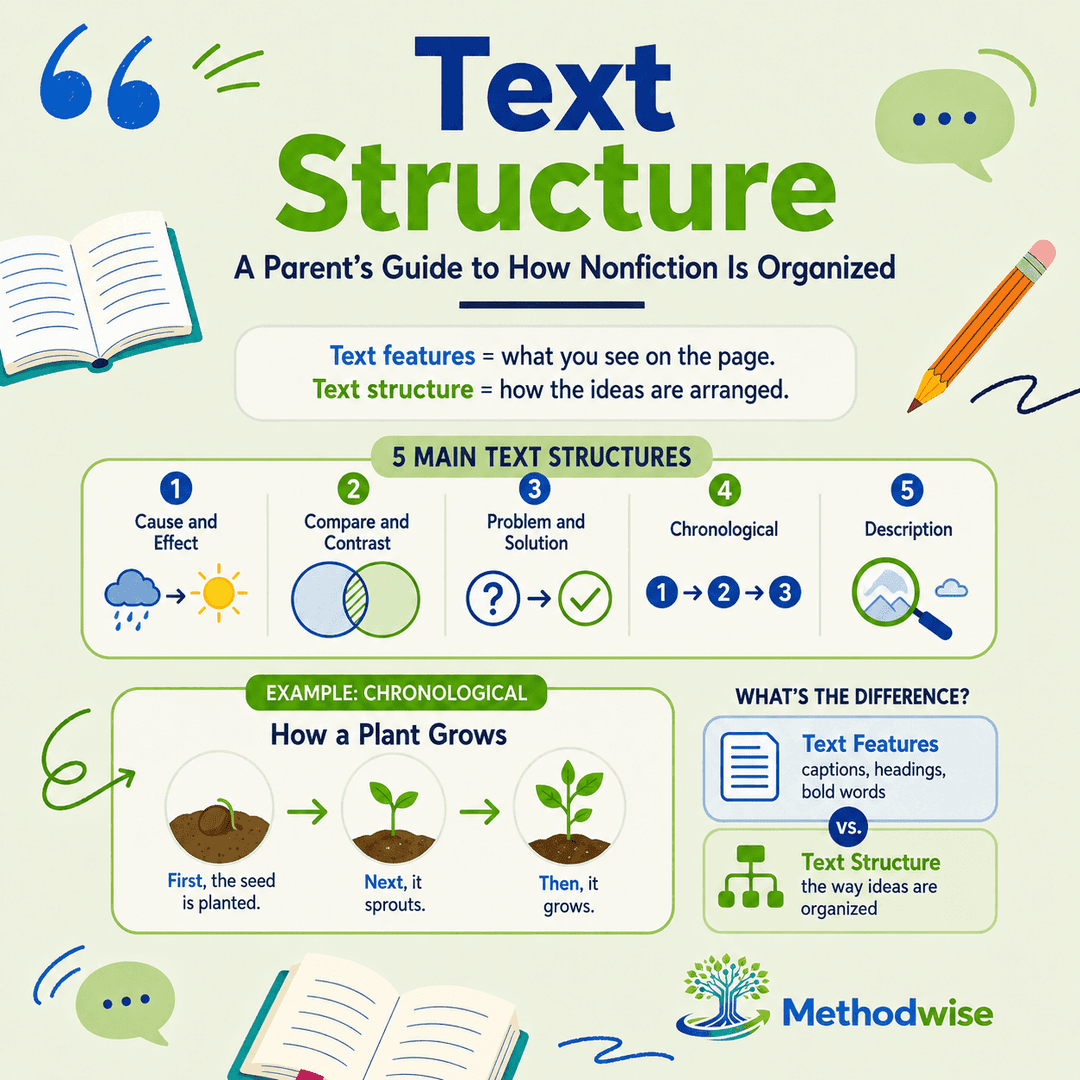
If your child has come home with a reading worksheet that asks them to "identify the text structure" or has been told to look for "signal words like because or however," and your reaction was "the text what now?" — welcome. You're not behind. Text structure is one of those things most of us absorbed without ever being formally taught, and now teachers are teaching it on purpose because it's on every state reading test from third grade up.
Text structure is the pattern an author uses to organize information in a nonfiction piece. There are five main patterns your child will learn: cause and effect, compare and contrast, problem and solution, chronological (or sequence), and description. Knowing which pattern an author chose helps a reader follow the ideas, predict what's coming next, and remember what they read. If you've already read our What Are Text Features? blog, think of it this way: text features are what you see on the page; text structure is how the ideas behind the page are arranged.
What Is Text Structure?
Text structure is the underlying organizational pattern an author uses to arrange the ideas in a nonfiction text. It's not about what the text says — it's about how the information is organized.
The five patterns your child will be taught are:
- Cause and effect — why something happened, and what resulted
- Compare and contrast — how two or more things are alike and different
- Problem and solution — what went wrong, and how it was (or could be) fixed
- Chronological / sequence — events or steps in the order they happened
- Description — main idea supported by details, characteristics, and examples
Each pattern has its own "signal words" — little phrases like because, however, first, or for example — that tip the reader off about which structure the author is using. Teaching kids to spot those signal words is one of the fastest ways they learn to identify structure.
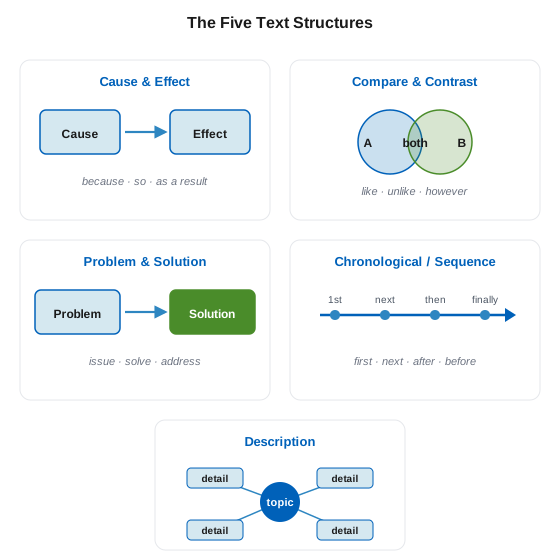 Five text structures overview: cause and effect with arrow, compare and contrast with Venn diagram, problem and solution with arrow, chronological with timeline, description with central topic and details
Why Do Teachers Use Text Structure?
If you learned to read in the 80s or 90s, you probably weren't taught text structure as an explicit concept. You read stories, answered comprehension questions, and trusted that meaning would become clear if you kept reading. That worked fine for fiction, where the structure (beginning → middle → end) is mostly the same every time.
Nonfiction is different. A magazine article, a science textbook chapter, a historical document, and a how-to guide are all organized very differently — and a reader who doesn't recognize the organization will struggle to follow the ideas. Today's teachers spend explicit instructional time on text structure because research shows that students who can identify the structure of a nonfiction text understand it better, remember it longer, and write better summaries.
The shift mirrors what happened with reading nonfiction in general: standards now expect students to spend roughly half their reading time on informational text by third grade, and the proportion keeps growing. If students are going to read that much nonfiction, they need explicit tools to handle it — and text structure is one of the most powerful tools in the kit.
There's also a real-world payoff. The ability to recognize how a text is organized transfers to writing, to research, to following instructions, to reading the news, to interpreting policy memos at work. It's a lifetime skill — not just a worksheet skill. More importantly, it helps students move from just reading words to actually organizing and reasoning about ideas.
Stuck on tonight's homework?
Paste in the problem and get a step-by-step explanation in your child's grade level — using the same method their teacher uses.
Try 3 Questions Free — No Signup RequiredWhat Grade Is Text Structure Taught?
Text structure is introduced gently in the early grades and gets significantly more rigorous from fourth grade onward. Here's the typical progression.
Kindergarten–2nd Grade — Implicit exposure
In K–2, students aren't usually asked to name the structure of a text yet, but they're being exposed to all five patterns through read-alouds and beginning nonfiction. A teacher might say "this book tells us what happened first, then next, then last" (chronological), or "this article tells us why we should brush our teeth — what's the problem and what's the solution?" The vocabulary is informal, but the thinking is being seeded.
By second grade (RI.2.5), students are expected to identify the main purpose of a text and to know various text features. Structure isn't named explicitly yet, but they're learning that some texts tell stories of events, some compare two animals, and some explain how to do something.
3rd Grade — Naming the patterns
Third grade is when text structure typically gets named. Students learn the terms chronological order, cause and effect, and compare and contrast, and they start identifying which pattern a short article uses. A common assignment looks like: "Read this paragraph about why leaves change color. Is the author telling you the order something happens, the causes and effects, or comparing two things?"
Teachers focus heavily on signal words at this stage, because signal words are the most concrete clue a young reader has.
4th–5th Grade — All five structures, applied
Fourth grade is the year text structure becomes a full topic. The Common Core standard (RI.4.5) calls for students to "describe the overall structure (e.g., chronology, comparison, cause/effect, problem/solution) of events, ideas, concepts, or information in a text or part of a text." Fifth graders go further (RI.5.5): they compare and contrast the structure of two or more texts on the same topic and explain how the structure affects meaning.
At this stage, your child's homework might ask: "Why did the author choose a problem/solution structure for this article? How would the article be different if it were written as a cause/effect piece?" The student is no longer just identifying the structure — they're evaluating the author's choice.
Grades 6–8 — Analysis and evaluation
Middle schoolers analyze how a particular sentence, paragraph, or section fits into the overall structure of a text and how that contributes to the development of ideas (RI.6.5 → RI.8.5). They evaluate whether the structure works well, compare how two authors writing about the same topic chose different structures, and explain how a structural choice shapes the reader's understanding.
Assignments at this level might compare a news article (problem/solution) and an opinion piece (cause/effect) about the same event and ask: "How does each author's structure shape what you, as a reader, end up believing about the issue?"
If your child is working with text structure at any of these stages, it's developmentally appropriate and part of a deliberate progression from "I can spot the word because" to "I can evaluate why an author organized the piece this way."
The 5 Types of Text Structures (With Examples)
Let's walk through each of the five patterns, with a short example of what your child will see in class and the signal words to listen for.
Cause and Effect
A cause/effect text explains why something happened and what resulted. There's usually at least one "cause" (what makes something happen) and one "effect" (what happens as a result), often with a chain of consequences.
Example passage (Grades 3–5):
Honeybee populations have declined sharply in recent years. Pesticides used on farms kill bees directly, and the loss of wildflower habitats means bees have fewer places to find food. As a result, fewer flowers and crops are being pollinated, which means lower harvests for farmers and higher food prices for everyone.
Signal words: because, since, so, therefore, as a result, due to, caused by, leads to, consequently.
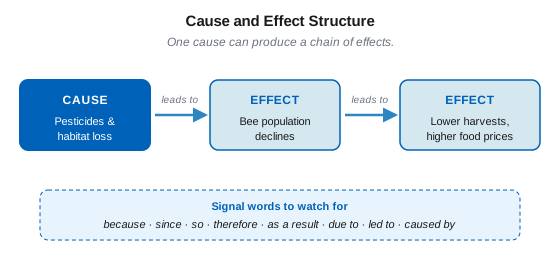 Cause and effect diagram showing one cause leading to multiple effects with arrows
The author's job in a cause/effect piece is to make the chain of "this happened, which caused this" easy to follow. The reader's job is to track that chain — and to notice that effects often become new causes further down the chain.
Text features and text structure work together. The text features (headings, bold words, diagrams) help you navigate the page; the structure tells you how the ideas connect. For more, see What Are Text Features? A Parent's Guide to Nonfiction Reading.
Compare and Contrast
A compare/contrast text shows how two or more things are alike and different. The author might group similarities and differences into separate sections or alternate point by point.
Example passage (Grades 4–5):
Frogs and toads look similar at first glance, but they have some clear differences. Both are amphibians, both lay eggs in water, and both eat insects. However, frogs have smooth, moist skin, while toads have dry, bumpy skin. Frogs are usually found near ponds and streams, but toads can live farther from water. In contrast, frogs leap long distances, while toads hop in short, low movements.
Signal words: like, unlike, both, similarly, however, on the other hand, in contrast, whereas, while, but, different from.
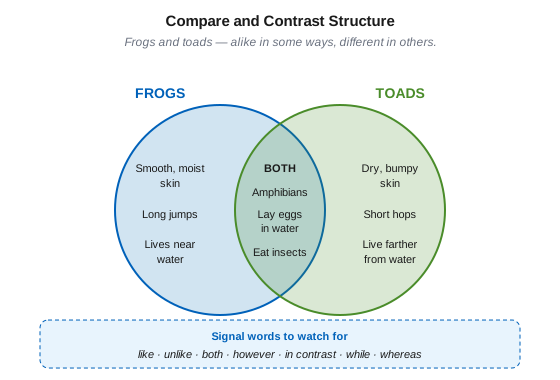 Compare and contrast Venn diagram showing two overlapping circles with shared traits in the middle and unique traits on each side
Compare/contrast texts often use a chart or Venn diagram as a built-in text feature — a strong clue that this is the structure being used.
Problem and Solution
A problem/solution text presents an issue and then explains how it can be (or has been) addressed. There's usually a clear "what's wrong" section followed by one or more proposed solutions.
Example passage (Grades 4–5):
Many students in our school don't get enough physical activity during the day. Recess has been shortened to fifteen minutes, and most students sit for the rest of the school day. One solution is to add short "movement breaks" between lessons — just five minutes of stretching or jumping every hour. Another solution is to lengthen recess back to twenty-five minutes. Schools that have tried these changes report that students focus better in class and behave more positively at lunch.
Signal words: problem, issue, challenge, solution, solve, resolve, answer, fix, address, propose.
A problem/solution structure has a built-in argument — the author is usually trying to convince the reader that the problem matters and that the solution is worth considering. Recognizing this structure helps a student notice when an article is leaning toward persuasion.
Once your child has identified the structure, the next thing teachers ask for is the textual evidence that proves it — pointing to the signal words and organizational moves that make their case. For more, see What Is Citing Evidence? A Parent's Guide to Text Evidence in Reading and Writing.
Chronological / Sequence
A chronological text presents events or steps in the order they happen. This includes histories, biographies, timelines, how-to articles, and any text where order matters.
Example passage (Grades 3–4):
The Wright brothers spent years preparing for their famous flight. First, they studied how birds glide through the air. Next, they built and tested kites and gliders on the windy beaches of Kitty Hawk, North Carolina. After many failed attempts, they designed a powered airplane in 1903. Finally, on December 17, 1903, Orville Wright became the first person to fly a powered airplane. The flight lasted only twelve seconds.
Signal words: first, next, then, after, before, finally, last, during, while, soon, later, meanwhile, and specific dates or times.
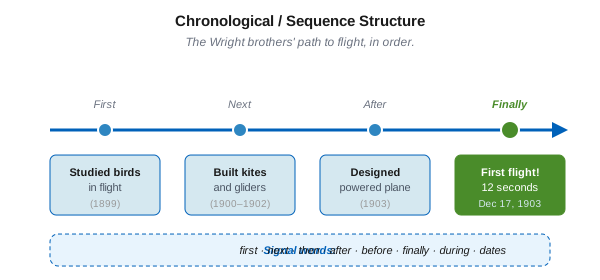 Chronological timeline showing four events left to right with year labels and arrows connecting them
Chronological is the easiest structure for most kids to spot — the dates and "first/next" words give it away. The harder version is when the structure is sequence (steps in a process) rather than chronology (events in history). Both follow time order, but sequence is usually instructional (how to bake a cake), and chronology is usually historical (how the Civil War unfolded).
Description
A description text presents a main idea and supports it with characteristics, features, and examples. There's no time order, no comparison, no cause/effect chain — just a topic and the details that explain it.
Example passage (Grades 3–5):
The Amazon rainforest is one of the most diverse ecosystems on Earth. It covers more than two million square miles across nine South American countries. The forest is home to over forty thousand plant species, three thousand types of fish, and countless insects, mammals, and birds. The trees in the Amazon are so tall and dense that very little sunlight reaches the forest floor. The air stays warm and humid year-round.
Signal words: for example, for instance, such as, characteristics, features, includes, looks like, an example of, specifically.
Description is the "default" structure — when none of the other four patterns fit, it's usually description. That makes it both the most common and the trickiest to identify, because there are no flashy signal words like because or however to tip the reader off.
How Text Structure Connects to What You Already Know
You use all five of these structures every day, without naming them.
Cause and effect: When you tell your kid why they can't go to a friend's house — "It's raining hard and the roads are slick, so we're staying home tonight" — that's cause/effect. You name a cause and the effect it produces. You do this every time you explain why something is the way it is.
Compare and contrast: When you decide which grocery store to go to — "Target's closer, but Trader Joe's has better produce" — you're running a compare/contrast analysis. Real estate listings, restaurant menus, car reviews, and even Facebook arguments are full of compare/contrast.
Problem and solution: When you read a news article about traffic in your neighborhood and the proposed roundabout, that's problem/solution. When your kid's teacher emails about a behavior issue and suggests a plan, that's problem/solution. Sales pitches, op-eds, and self-help books all use this structure constantly.
Chronological: When you tell someone how your day went — "First I dropped off the kids, then I went to the dentist, after that I picked up groceries" — that's chronological. Recipes, instruction manuals, vacation stories, true-crime podcasts, and biographies all rely on chronological structure.
Description: When you describe your dog to a new neighbor — "He's a big golden retriever, super friendly, loves the water, terrible with squirrels" — that's description. You're giving a topic (your dog) and a set of details that characterize it. Wikipedia articles, product descriptions, and most opening paragraphs of nonfiction books use description.
The difference is that today's students are taught to recognize and name these patterns, so they can apply them deliberately rather than just stumbling into the right structure when they're writing or just hoping to follow along when they're reading.
Watch: Text Structure Explained
How to Help at Home
Name the structures when you read together
When you're reading anything nonfiction with your child — an article, a magazine, even an email — try naming the structure out loud. "This is a problem/solution article. The author is telling us what's wrong, and then how to fix it." Hearing the vocabulary in casual context helps your child connect it to what they're learning at school.
Hunt for signal words
This is the single most useful exercise for grades 3–5. Pick any nonfiction paragraph and circle every signal word (because, however, first, for example, as a result). Then ask: "Based on these words, what kind of structure is this?" Signal words are the most reliable clue a young reader has, and learning to scan for them is a skill that pays off on every reading test.
Use the right vocabulary
When your child says "the author talks about why and what happened," gently rename it: "Right — that's cause and effect." Or when they say "there are two animals being talked about," nudge them: "So this is compare and contrast?" Matching their language to the teacher's vocabulary helps when they encounter the same terms on tests and worksheets.
Don't correct without validating
If your child says a paragraph is "description" when you're sure it's "cause and effect," resist the urge to just say no. First ask: "What made you think it was description? Where do you see that?" Often the child has noticed something real — they just haven't seen the deeper pattern. Validate the observation, then guide them toward the signal words that point to a different structure.
Connect structure to author's purpose
Once your child is comfortable identifying structures, level up the conversation: "Why do you think the author chose this structure? What would be different if they had used compare/contrast instead?" This is exactly the kind of thinking that fifth- and sixth-grade tests ask for, and it makes your child a more critical reader of everything — including ads, social media, and news.
Let Methodwise walk through it
If your child is stuck on a specific text structure assignment — identifying the pattern in a passage, finding signal words, or explaining why the author chose that structure — Methodwise can walk you through it using the same approach their teacher uses, with a quick check to make sure they understand the pattern before moving on.
Common Mistakes to Watch For
Picking the structure based on the topic, not the organization
This is the most common mistake students make. A student sees an article about animals and assumes it must be compare/contrast (because, you know, animals get compared). But the article might actually be chronological (the life cycle of a butterfly) or cause/effect (why a species is endangered). The structure is about how the ideas are arranged, not what the article is about.
Ignoring signal words
Signal words are the fastest, most reliable clue to text structure, but kids often skip over them or treat them as filler. If your child can't identify the structure, ask them to highlight every because, however, first, as a result, and for example in the passage. The pattern usually pops out immediately.
Calling everything "description"
Description is the catch-all structure students reach for when they're not sure. If your child's default answer is "description," dig deeper: are there any signal words? Is there a time sequence? Are two things being compared? Is there a cause and an effect? Description should be the last guess, not the first.
Missing the structure within a structure
Longer articles often use one dominant structure with smaller patterns nested inside. A historical article might be chronological overall but include a compare/contrast paragraph in the middle. Teachers ask students to identify the overall structure first, then notice the smaller patterns. If your child is confused, ask: "What's the structure of the whole piece? Now look at just this paragraph — does it use the same structure or a different one?"
Confusing structure with purpose
These are related but not the same. Purpose is why the author wrote the piece (to inform, to persuade, to entertain). Structure is how the author organized it (cause/effect, problem/solution, etc.). An author with a persuasive purpose might choose a problem/solution structure to deliver that purpose — but the two are different questions.
Practice Questions
Try these with your child. Answers are below.
Grades 3–4 — Identify the structure:
-
"First, the seeds are planted in spring. Next, they sprout in early summer. After that, the plants grow taller and produce flowers. Finally, by late fall, the seeds are harvested." What text structure is this passage?
-
"Cats and dogs are both popular pets, but they have very different personalities. Cats are independent and quiet, while dogs are social and energetic." What text structure is this passage?
-
"Many neighborhoods don't have safe places for kids to play outside. One solution is to build small parks on empty lots. Another idea is to close streets to traffic on weekends so kids can play safely." What text structure is this passage?
Grades 5–6 — Identify the structure and the signal words:
-
"Heavy rains last spring caused the river to overflow its banks. As a result, dozens of homes were flooded and several roads had to be closed for weeks. The flooding also led to crop losses on nearby farms." What is the structure, and what signal words tell you?
-
"The blue whale is the largest animal on Earth. Adult blue whales can grow up to one hundred feet long and weigh as much as two hundred tons. They feed mostly on tiny shrimp-like creatures called krill, eating up to eight thousand pounds of food per day." What is the structure, and what signal words tell you?
Challenge — Grades 6–8:
-
A magazine article about climate change opens with a description of a melting glacier, then explains the causes of the melting, and finally proposes three solutions. Which structure best describes the overall article, and why?
-
Two articles cover the same school policy change — one uses cause/effect, the other uses problem/solution. How might the structure each author chose shape what the reader walks away believing?
Answers
-
Chronological / sequence. The signal words first, next, after that, and finally mark a clear time order.
-
Compare and contrast. The passage names two things (cats and dogs) and points out both similarities (both are popular pets) and differences (while cats are independent, dogs are social). Signal words: both, but, while.
-
Problem and solution. The first sentence states the problem (no safe places to play). The next two sentences propose solutions. Signal words: solution, idea.
-
Cause and effect. Heavy rains (cause) led to flooding (effect), which led to other effects (closed roads, crop losses). Signal words: caused, as a result, led to.
-
Description. The passage names a topic (the blue whale) and gives characteristics (size, weight, food). There's no time order, no comparison, no cause/effect chain, and no problem to solve. The signal word for example doesn't appear here, but the absence of because, however, or first is itself a clue — the structure is descriptive.
-
Problem and solution is the best overall answer, because the author's main move is to identify a problem (climate change, illustrated by the glacier) and propose solutions. The description of the glacier and the cause/effect explanation are nested inside the larger problem/solution structure. This is a great example of how a long article uses smaller patterns within a dominant one.
-
The cause/effect article focuses the reader's attention on why the policy was changed and what's resulting from it — it tends to feel explanatory and neutral. The problem/solution article frames the policy change as either the problem itself or the solution to a problem, which gives the article a built-in argument. Same topic, very different reading experience. This is why teachers want students to notice structure: it shapes what you, as a reader, end up paying attention to.
Ready to try it with your child?
Open the chat, pick the subject and your child's grade, and get a step-by-step explanation you can use to help tonight.
Try 3 Questions Free — No Signup RequiredFrequently Asked Questions
Are graphic organizers like Venn diagrams, timelines, and cause/effect maps part of text structure?
Yes — each graphic organizer is the visual that matches one of the structures. A Venn diagram goes with compare/contrast. A timeline goes with chronological. A cause-and-effect map (boxes connected with arrows) goes with cause/effect. A T-chart with 'problem' and 'solution' columns goes with problem/solution. A web with a topic in the middle and details branching out goes with description. When your child's teacher asks them to 'fill in a graphic organizer' while reading, they're really asking the student to identify the structure first and then sort the information into the matching shape.
My child has to write a 'compare and contrast essay' for class. Is that the same as the text structure they're learning to read?
Exactly the same — just applied to writing instead of reading. Once students can recognize the five structures in someone else's writing, the next step is using those structures in their own. By 4th and 5th grade, students are typically asked to write a paragraph or short essay in one of the structures (most often compare/contrast or cause/effect). If your child can identify the structure when reading, they have a ready-made template for organizing their own writing — same signal words, same shape.
How is text structure actually tested on state reading exams?
Most state reading tests include at least one multiple-choice question that names the five structures directly — usually phrased as 'Which text structure does the author use in paragraph 3?' with the five patterns as the answer choices. Tests also include short-answer questions like 'Why did the author choose this structure?' The strongest preparation is making sure your child can both name the structure and point to the signal words or organizational moves that prove it.
My child does fine on text structure quizzes but still struggles with overall reading comprehension. Is identifying the structure really helping?
Naming the structure is just the first step — the payoff comes when students use the structure to make sense of what they're reading. If your child can label a passage as cause/effect but can't tell you the main idea, try asking: 'What's the cause? What's the effect? Why does the author want you to know this?' The structure is a tool for understanding, not a label to memorize. Make sure the conversation always returns to meaning.
Does my child need to memorize the signal words?
Not a perfect list, but recognizing the most common ones makes a big difference. The fastest-payoff signal words to know cold are: because, so, and as a result (cause/effect); however, unlike, and both (compare/contrast); first, next, and finally (chronological); problem and solution (problem/solution); and for example and such as (description). If your child can spot those fifteen words quickly, they can identify the structure of almost any passage they'll see on a test.
What if I'm not sure how to explain a text structure assignment?
Methodwise can walk you through any text structure question your child brings home — identifying the pattern, pointing out the signal words, and explaining how to write the answer the way the rubric is looking for it.
Try Methodwise Free
When your child brings home a text structure assignment and you're not sure how to explain it the way their teacher would, Methodwise walks you through it — step by step, using the same method their teacher is using.
- Start with 3 free questions — no account needed
- Free plan: 15 questions/month after signup
- Plus plan: unlimited questions + saved chat history + 7-day free trial
- Step-by-step explanations the way teachers teach
Related Articles
-
What Are Text Features? A Parent's Guide to Nonfiction Reading
-
Reading Comprehension Strategies: A Parent's Guide to How Teachers Teach Reading
-
Main Idea vs. Theme: What Your Child's Teacher Actually Means
-
What Is Close Reading? A Parent's Guide to Deeper Comprehension
-
Reading Levels Explained: Lexile, F&P, and DRA in Plain English
-
What Is Citing Evidence? A Parent's Guide to Text Evidence in Reading and Writing
-
What Is Making Inferences? A Parent's Guide to Reading Between the Lines
-
Author's Purpose vs. Point of View: A Parent's Guide to PIE, Narrators, and Perspective
-
What Are Context Clues? A Parent's Guide to How Kids Figure Out New Words Without a Dictionary
-
Homework Help Tools: Built for Kids vs. Built for Parents — What's the Difference?
-
Opinion Writing vs. Argument Writing: A Parent's Guide to the K–8 Writing Progression
-
Summarizing vs. Retelling: A Parent's Guide to Why the Teacher Keeps Saying 'Too Many Details'
-
What Are Story Elements? A Parent's Guide to Characters, Setting, Problem, and Solution
-
What Is Phonemic Awareness? A Parent's Guide to Playing With Sounds Before Reading
Have questions about text structure? Email me at hello@methodwise.co
About the Author
Samantha Black is the founder of Methodwise and an educator with over 15 years in higher education and instructional design. She built Methodwise after experiencing the homework gap firsthand as a parent of two K–8 daughters. Learn more about why we built Methodwise →